Fox Searchlight has announced the start of principal photography in Los Angeles on The Night Watchman, starring Keanu Reeves, Forest Whitaker and a sprawling ensemble cast. Reeves stars as Tom Ludlow, a veteran LAPD cop who finds
life difficult to navigate after the death of his wife. When evidence
implicates him in the execution of a fellow officer, he’s forced to go against the cop culture he’s been a part of his entire life, ultimately
leading him to question the loyalties of everyone around him. One surmises more rules of conduct, written or unspoken, are then broken.
The movie represents the continued mining of a seam for Training Day and Harsh Times scribe David Ayer, who jumps back behind the camera after helping polish an original script by James Ellroy. Hugh Laurie, Chris Evans, Jay Mohr, Terry Crews, Cedric the Entertainer, Common, The Game, John Corbett, Kirstin Pierce and Amaury Nolasco round out the cast, among others.
The innovative “Masters of Horror” anthology series gets unleashed in collected form on August 28, from Anchor Bay Entertainment. Housed in a specially designed “mausoleum” (above), the box
set contains all 13 DVDs from the series’ first season — each disc boasting two
to three hours of bonus features — as well as a special 14th disc of all-new, never-before-seen
footage. Winner of numerous accolades, including an Emmy and two Saturn awards,
the “Masters of Horror” season one box set will be limited to 20,000 units, so
once the mausoleums are gone, there will be no resurrection.
“We really wanted to give the fans something special for the
season one box set, as a thank you for their unwavering support,” explains Mick
Garris, the series’ creator and executive producer. “We’ve always strived to
make ‘Masters of Horror’ something truly unique within the genre, far from the
remakes and sequels synonymous with modern horror, and now fans can enjoy season
one in its entirety, and as a single experience.”
The “Masters of Horror” set presents each episode complete
and in its entirety, in 1.78:1 anamorphic widescreen and riveting Dolby digital
5.1 surround sound. Housed on separate discs, the 13 episodes include John Landis’ fantastic Deer Woman, William Malone’s Fair Haired Child, Stuart Gordon’s Dreams in the Witch House, Lucky McKee’s Sick Girl, Joe Dante’s superb Homecoming and eight more hour-long films. Each disc features up
to three hours’ worth of value-added supplements, including audio commentaries from
the filmmakers, behind-the-scenes featurettes, career retrospectives, festival
interviews, picture and storyboard galleries,
trailers, DVD-ROM versions of the scripts and more. The set’s bonus disc
contains a “Masters of Horror” dinner, with Garris and the season one directors
gathered at Hollywood’s legendary Magic Castle; a “Masters of Horror” DGA panel
discussion; and special interviews, conducted by Garris, with filmmakers Steven
Spielberg and John Boorman.
It’s a happy birthday to Tom Cruise, I reckon, who, despite what Oliver Stone might have you believe, was born on the 3rd of July. My gift to Cruise, who turns 45 today, is that I’ll not mention more than once his DVD review of Dawson’s Creek, and also change the site’s banner for a few days, to commemorate his upholstery dancing on The Oprah Winfrey Show.
Glancing forward at Cruise’s filmography, the teaser trailer for Lions for Lambs is up, a bunch of war-on-terror speechifying driven by bizarre music (one feels like a rave might break out at any moment). And Bryan Singer’s Valkyrie — a rooted-in-truth drama about an assassination plot against Adolf Hitler during World War II — is in the news, all because German officials won’t let production use a key historical site, owing to Cruise’s beliefs as a Scientologist.
Of more dire consequence, though, is the threatened 2009 pairing of Cruise and Ben Stiller in 20th Century Fox’s comedy The Hardy Men, about grown-up versions of the Stratemeyer Syndicate’s intrepid Bayport boy investigators. Long a pet project of sorts for Stiller, this used to be a vehicle for he and Jim Carrey, and I read an awful, awful draft of it more than a half dozen years ago. That Simon Kinberg (Mr. & Mrs. Smith, the last X-Men installment, the forthcoming Jumper) is apparently the latest to tackle a full-commission rewrite gives the project a flickering chance, but the choice of Shawn Levy (Cheaper by the Dozen, Night at the Museum) to direct tells me that even if Cruise eventually does commit to it (giving birth to all the stories about how he “really wanted to do a comedy for [his] kids,” blah, blah, blah), this will be a clamorous, one-note pairing, full of cheap physical mimicry and a creaky mystery plot likely driven by smuggling, land-use, corporate takeover or the like. Instead of just being intense, Cruise will try to be mock mock-intense, and Stiller will ape Cruise’s trademark laugh ad nauseam.
It’s July 3, and you know what that means. No, not the release of Transformers, silly!
That means it’s only one month and one week away from the release of Bratz, the live-action movie based on the big-eyed, slutty little play-dolls of the same name! For the past several months I’d been trying to convince myself that this movie didn’t actually exist, that my previous posting on it was merely the result of a publicist somehow lacing my email with peyote. (Don’t laugh, I think the CIA’s been working on that…) The above production picture seems to confirm its existence, though, and now I can’t wait to see and review it.* Hey, at the very least we’ll be able to see if your roommate’s band made the soundtrack…
For those in the Los Angeles area, writer Cameron Crowe and director Amy Heckerling’s teen comedy classic Fast Times at Ridgemont High will enjoy a special 25th anniversary (!) screening on Thursday,
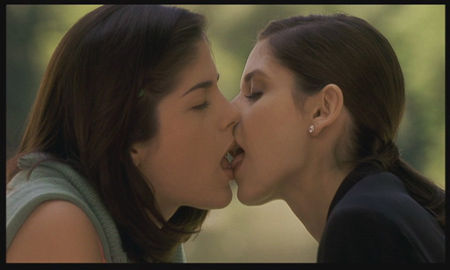
July 26, at 7:30 p.m., at the Aero Theatre, with in-person guests of the to-be-announced variety. And really… what better way to celebrate this news than by reliving Phoebe Cates’ memorable fantasy sequence moment (above)? The Aero Theatre
is located at 1328 Montana Avenue in Santa Monica; for 24-hour recorded
information on tickets, directions and the venue’s upcoming schedule,
phone (323) 466-FILM.
I’ve enjoyed his work in an awful lot of movies — everything from The Green Mile, Galaxy Quest and The Hitchhiker’s Guide to the Galaxy to the underrated Confessions of a Dangerous Mind — but I think that Sam Rockwell has to have the most consistently awful hair in Hollywood today.
I get that his wild-guy roles sometimes dictate a shaggy or disheveled look, and from time to time Rockwell also rocks the seedy facial hair and/or porn ‘stache, which does him no additional favors as far as attractiveness. But in both films and real life, almost every time I see this guy I wanna toss him a comb. The impetus for this post was this particular picture(Rockwell’s impression of Nick Nolte’s mug shot?) from the Los Angeles Film Festival premiere of his latest movie, Joshua, but browsing through his IMDB image gallery is its own effective stomach muscle exercise in restrained laughter.
This reputation for bouffant ridiculousness is one of a couple reasons it’s so weird to see Rockwell as a wealthy, hedge-fund managing, racquetball playing family guy in Joshua. Hell, Rockwell probably took the part for this fact alone — simply wanting to see what a normal, upper-middle-class style and trim might look like. Though he sports a few moments of brushed-back, tangled mess, Rockwell for the most part leaves the crazily-askance-‘do heavy lifting to costar Vera Farmiga, who gets to play bat-shit crazy, and sport her hair accordingly. Still, Rockwell: stop taping squirrels to your head, a la Donald Trump. You’re better than that.
I guess Kenneth Keith Kallenbach is a sort of forerunner to
William Hung, the American Idol contestant,
from a few years back, who was so awful that he achieved a strange sort of meta-fame,
bypassing any and all requirements of manifested talent or hard work. Like
Hung, Kallenbach’s fame — to the degree that it really exists— seems to hinge
on a combination of fortuitous discovery and the snickering derision of those
who from thence forth afford him a platform. All I know is that, Kentucky
waterfall ’do or not, Kallenbach is an awful, awful… comedian or actor, musician
or entertainer, however you want to slice it. (Based on the lanky physicality
and hair, though, I suppose it’s worth noting that Sam Rockwell
could play likely him in a biopic if some suitably grandiose tragic fate should
befall him.)
Billed as a one-of-a-kind jack-of-all-trades, Kallenbach’s bizarre
ascension charts itself back to Howard Stern, on whose very first Channel 9
show he appeared. His outgoing personality and strange delivery — think a
pretty spot-on Bill Paxton, by slight way of Beavis — grabbed one’s attention, I
guess, though since I’m not a habitual listener of Stern’s (favoring XM over
Sirius, sorry…), I’m not sure how Kallenbach is deployed/tolerated, and whether
his apparently recurring guest spots as part of the shock jock’s “Wack Pack” allow for his own brand of air-quote
comedy, or whether he’s really just doing Stern’s bidding.
This single-disc DVD, dubbed American Icon, compiles eye-gougingly atrocious clips of Kallenbach’s
almost two decades in entertainment, from ramshackle, man-in-the-street bits
where he rephrases passersby’s replies to his queries and adds a random lame
observation (on someone’s favorite talk show host: “Yeah, I like Ellen
[DeGeneres] too… I think she’s a lesbo”) to longer-form sketch material. The
entire affair employs production values just below your average cable access
show (sleeping bags duct-taped to a wall serve as the backdrop for an
interstitial talk show wraparound bit, wherein Kallenbach interviews himself)
and, simply put, none of it is funny. Kallenbach talks about bits like cutting off
and eating his own hair, or putting firecrackers in his pants and the like, but
we see precious little of this type of thing, and his humor certainly doesn’t
even fall into the Jackass category
of classification, which might have some goosing, occasional entertainment
value, no matter how insipid the host. Instead, here we get Kallenbach
prattling on and on about himself, and starring in stupid Superman sketches that
will have even the biggest Bryan Singer
detractors yearning for the relative comfort of Superman Returns.
Clocking in at over 90 minutes, this title doesn’t even have the decency
of brevity; bits with an eponymous musical side project, old stand-up footage and
phony phone calls (in which Kallenbach’s “victims” get off much better
one-liners than he) round out the slate.
Housed in a regular Amray case, American Icon is presented on a region-free disc in a cruddy full
screen transfer, with source audio that also sometimes (against considerable
odds) manages to grate almost on par with the material itself. There are no special
features, per se, just the cold comfort of knowing that this DVD is billed as
being comprised of never-before-seen sketches and shorts, etcetera. It should
stay that way, really. F (Movie) D+ (Disc)
Hey, remember dashing billionaire Robin Colcord (Roger Rees)
from the sitcom Cheers? Wanna see him
totally nude in a somewhat kinky, heavily arthouse-inflected sexual drama of
submission and domination? Great news — now’s your chance, in the form of writer-director
Eric Werthman’s Going Under!
Rees stars as Peter, a married psychotherapist who lives a
life of parallel intellectual pattycake alongside his novelist wife. The movie
centers on his relationship with Suzanne (Geno Lechner, above), a professional
dominatrix with whom he’s been involved in a strictly defined, sensual affair
of non-penetrative role-playing in a walk-up dungeon where their anonymity is
protected. Suzanne, however, is preparing to quit her job and pursue her love
of art full time. She has a soft spot for Peter, though, and agrees — and first
broaches the subject, in fact — to see him on the “outside world,” where they
share their real names and try to do normal things like have coffee and chat.
Naturally, all kinds of awkwardness ensues, especially when Peter tries to come
clean to his wife, and confess a deeper obsession to Suzanne, who’s also been dabbling in lesbianism.
Peter’s relatively unexamined sexual fetishes are one thing
(the movie winks and dashes past this point with a blasé disclosure and a simple
line of dialogue from Suzanne: “Most therapists take a while to admit it”), but his increasingly erratic acting out stretches credulity for an alleged
professional of his ilk. So too, it’s sad to say, does the notion of Suzanne as
a serious artist; we see her projects, which point to a certain talent, but
learn nothing of consequence of what drives and interests her, what informs
this work that therefore feels quite separate and apart from what we see in the
rest of the movie. Going Under is
painstakingly constructed and fairly nicely shot (David Lynch would probably
like some of S&M scenes, one of which recalls the druggy “Pink Room” from Twin Peaks: Fire Walk with Me), but its
narrative rings rather hollow, and there’s not enough fuel in the tank to
really drive the plot’s engine. What one is left with is a quite tonier but rather limp iteration of the old Cinemax model of deviant sexual exploration. Where’s Zalman King, one wonders?
Housed in a regular Amray case in turn stored in a cardboard
slipcover, Going Under is presented
in 1.78:1 anamorphic widescreen, with Dolby digital 5.1 surround sound and
Dolby surround 2.0 audio mixes. An audio commentary track with Werthman and
Rees kicks off the bonus material, and their rapport is solid and banter quite scholarly and informed, if sometimes off the mark with respect to what’s actually unfolding on screen. A 17-minute segment entitled “Pushing the
Boundaries” is comprised of interviews with Rees and Lechner, the latter of
whom talks some about her career trajectory (in particular landing Schindler’s List), and describes having
a strong reaction to this material. Rees, meanwhile, characterizes his typical
offer sheet as consisting of “bad choices or badly lit lawyers in a lot of
movies.” He claims his agents initially kept the project from him, and then
tried to convince him it was “too naughty,” but that good friend Bebe Neuwirth
(I guess some Cheers friendships do
stand the test of time) gave him the cheeky go-ahead. Six random minutes of
footage from the S&M fetish “Black & Blue Ball,” narrated by Lee Kross,
leave one sure of their own sexual proclivities, which don’t involve ball
torture. Also, available as a DVD-ROM audio file, there are reflections on the
movie from Marta Helliesen, a licensed Ph.D. C- (Movie) B+ (Disc)
Michael Bay is an unparalleled conductor of destruction, that much we know. He likes his set pieces big, his explosions bigger, his bass deep, his music cues thundering and his subtext bold, highlighted and rendered in all caps. At the screening of his forthcoming Transformers that I attended, he welcomed the audience and said he was on hand, just recently back from Australia, “to make sure it’s fucking loud,” with all appropriate exclamation.
The film certainly delivers in terms of its effects work, from Industrial Light & Magic, and Bay trades in the typical sort of emphatic, canted close-ups and adrenalized style
that have been his hallmark throughout his career. The
problem is that Bay, for
all his arguable skill as a conjurer of sugar-rush catharsis,
has little sense of spatial coherence. He’s a top-notch imagist, as all those Clio Awards somewhat attest (that also explains the segments of Transformers that come off as car commercials), but his basic aesthetic sensibility doesn’t seem to have advanced that much beyond his swirling, shadow-inflected work on Aerosmith’s “Janie’s Got a Gun” music video.
It sounds hackneyed to say, but Bay truly does play by his own cinematic rules, collapsing established spaces to suit momentary need, and frequently creating escape through reverse shots rather than any sort of
sensible internal story logic. The resultant action can be eye-popping, but also wholly devoid of any true or artful tension. He’s kind of like a home run hitter in baseball, in my opinion — always swinging for the fence with iconic images and “cool-factor” explosions. Frequently he strikes out, but sometimes he smacks one the bejesus out of the park… often within the same movie.
That said, as fun as it sometimes is letting the action of Bay’s movies wash over you, it’s generally the
cinematic equivalent of a false show-and-tell exercise — bravura
demonstration lacking any rooted emotional weight or
involvement. I know it has the air-quote disadvantage of being less grounded in reality than Live Free or Die Hard, but for all its state-of-the-art, tech-assisted carnage, the action in Transformers matters less, and is less involving, than that of the Bourne films. As with the worst moments of Bad Boys II, the ending of Transformers just feels like you’re being ejaculated upon.
Henry James’ classic novella Turn of the Screw gets a mood-driven re-imagining in In a Dark Place, starring Leelee
Sobieski. A sort of cut-rate ghost story with heavy ’70s-style arthouse
inflections, and plenty of lurking window and point-of-view shots, the movie
might most surprise James, though, for the over-under of its tub and bathrobe
scenes, which total a hearty dozen (below).
Sobieski stars as Anna Veigh, an art teacher who is sort of
shipped off from her current position, to a post as a nanny for two young
orphans, 10-year-old Miles (Christian Olson) and Flora (Gabrielle Adam). Her
new workplace is a remote country estate with beautiful if deserted grounds,
and despite having already seen their fair share of hell in the deaths of their
parents and Anna’s predecessor, Miss Jessel, the children seem courteous and charming,
if initially a bit strange. This quietly mannered world quickly fades as Anna makes
a series of disturbing discoveries, catching glimpses of figures lurking on the
grounds which she later learns are those of two ex-employees who are now dead. Though
she at first questions her own sanity, it comes to seem that the figures have
sinister intentions, and so Anna is forced to confront dark secrets buried deep
in her own psyche as she fights, in somewhat vaguely defined fashion, to
cleanse the children’s souls of darkness.
It’s worth mentioning at this point, lest someone think this
is a good companion piece to Alejandro Amenábar’s The Others, that Anna is accompanied throughout all this by the
children’s uncle’s chilly secretary, Ms. Grose (Tara Fitzgerald, a sort of younger, poor woman’s
Lena Olin), who clearly holds some sort of secrets. It’s never really explained
why Anna is hired for a job that Ms. Grose is materially assisting in — and
could seemingly do herself, actually — but this question fades into
insignificance when the latter’s cold behavior morphs into strangely blackmailed
affection.
Helmed by debut director Donato Rotunno, In a Dark Place has the certain advantage of all sorts of strange little
alleyways not typical of such genre pieces, as well as some weird directorial flourishes,
like an oddball violin electronica-infused sequence which juxtaposes Anna’s
wilderness wanderings with Ms. Grose playing dress-up and writhing about in her
clothes. So it’s original, really, in
a way, but not necessarily all good. The movie delves into the subject of abuse,
and how those abused can become abusers, but only in a very elliptical manner —
one that’s interesting without being wholly satisfying. Sobieski is good at
conveying Anna’s vulnerabilities, but not her slide into… well, quasi-madness,
let’s say, which the script rather short-changes. She does display a bit of cleavage and side-boob, and just a flash of bare behind, though — enough, along with Fitzgerald’s aforementioned
writhing, to help earn an R rating for a film that is otherwise a very tame,
proper and almost PG-rated story of mistreatment and alienation.
Presented in 1.78:1 widescreen, In a Dark Place comes with solid English language Dolby digital 5.1
surround sound and 2.0 stereo audio mixes, as well as optional English and
Spanish subtitles. The sole DVD bonus feature is a 12-minute making-of featurette
which includes interviews with Sobieski, Fitzgerald and director Rotunno, who confesses
to ignoring James’ source text and all previous adaptations, and starting from
scratch with Peter Waddington’s screenplay. Sobieski, meanwhile, says (though
none too convincingly) that her initial attraction to the movie was its “sensitive
and chiseled script,” and talks about how the film was a departure for her in a
sense, because she was heretofore always used to being the youngest on the set. C (Movie) C+ (Disc)
Acclaimed South Korean director Kim Ki-Duk (Spring, Summer, Fall, Winter… and Spring)
delves back into morally cloudy water with this strange, ethereal, minimalist sea-set
piece, an exploration of rescue, responsibility, duty and proper adult boundaries that
relies heavily on expression, gestures and body language to tell its powerful
story.
The Bow centers on a crusty old man (Jeon Sung-Hwan) and a beautiful young girl
(Samaritan Girl’s Han Yeo-Reum) who live
on a fishing boat which has been floating at sea for over 10 years, the man
having plucked the little lost girl from the ocean at that time. Since then, the man has shown the girl how to fish, and cared for her in every way. But
the man plans to marry the girl on her 17th birthday, and counts the days down
on his calendar, buying scraps of fabric for her wedding dress in piecemeal
fashion and locking them away.
In addition to the girl and life on the ocean, the bearded old man
also cherishes only his bow, which he uses predominantly as a weapon to fight
off would-be admirers of his lovely shipmate. However, the bow is also a useful
device for shamanistic fortune telling, and as well creates wonderfully
enchanting music. The quiet couple’s peaceful and secluded life changes when a
teenage boy comes aboard, and the girl’s horizon and orientation are irrevocably
altered.
The set-up of The Bow is rather arbitrary, and Ki-Duk further ups the arthouse ante by trading in silences. He’s not interested in revealing back stories of his characters (hence their lack of names), or having them come to epiphanies about their situations. The story and setting are almost nipped from a fable of yore; it seems an excuse to play around in grey areas of devotion and subjugation. To that end, the acting and uniformity of tone and vision is what carries The Bow, but it’s certainly not for everyone, and certainly not for the end of a long day, which is the circumstance under which I first tried to watch the movie. If the alignment of interest and attention is right, though…
Housed in a regular Amray case, The Bow is presented in anamorphic widescreen in a very nice transfer, with Dolby digital
5.1 surround sound and DTS surround sound 5.1 audio tracks, both in the movie’s
native Korean. Naturally, English and Spanish subtitles are also available. The
big supplemental extra is a 35-minute making-of featurette, which interweaves subtitled
interviews with the director and his female star with on-set footage of them at
work. Other DVD special features consist of the movie’s original theatrical
trailer, a photo gallery and previews of other Tartan releases. To purchase the film via Amazon, click here. B- (Movie) B- (Disc)