A polished technical package lends considerable emotional weight to Supremacy, a siege/hostage drama shot through with racial animus that recently made its world premiere at the Los Angeles Film Festival. Based on real events, director Deon Taylor’s movie connects largely on the strength of its solid acting and charged stakes, but suffers a bit from muddled plotting and a dramatically diffuse end game. Continue reading LAFF: Supremacy
Monthly Archives: June 2014
DVD Column, June 23
That Awkward Moment, another bro-tastic laffer which attempts to thread the needle between twentysomething sexual exploration and acting out and relationship comedy (read: accepted “male” and “female” genres) is an awkward mash-up, and in the end represents nothing more than a momentary, wholly understandable blip on the respective filmographies of its talented young cast. A naked stab at blended American Pie and Swingers-type antics, writer-director Tom Gormican’s film banks heavily on the ample chemistry of its players, to intermittent but largely unmemorable effect. Continue reading DVD Column, June 23
The Signal
Several years ago, in 2011, multi-hyphenate director Evan Glodell and a group of collaborators with whom he shared a long list of short-form collaborations made a weird little film, saturated in feverish tones, called Bellflower. Whatever one thought of that movie itself as a finished narrative product, its construction was so audacious and of a piece as to almost take one’s breath away. The Signal, directed by Will Eubank, is an extraordinarily different work, but one every bit as charged and shot through with cool assurance and technical savvy. It’s the type of indie offering that cuts right through all the noise and clutter, signaling the arrival of undeniable new talents.
Co-written by director Eubank, his brother Carlyle Eubank and David Frigerio, The Signal, which premiered at this year’s Sundance Film Festival, unfolds in confident shorthand strokes, its characterizations winnowed down to spare essences. It starts off as a road trip movie. Nic Eastman (Brenton Thwaites), his girlfriend Haley Peterson (Olivia Cooke) and his friend and fellow MIT student Jonah Breck (Beau Knapp) are heading west when they decide upon a detour. A mysterious hacker known only as “NOMAD” has been messing with Nic and Jonah, and when they’re able to pinpoint his location, they decide to pay an unscheduled visit. Their directions lead them to an isolated area, however. Suddenly, there’s a flash.
When Nic regains consciousness, he finds himself trapped in a waking nightmare. He’s groggy and injured, and sealed off to boot from Haley and Jonah. A doctor in a hazmat suit, Wallace Damon (Laurence Fishburne), keeps Nic in isolation, informing him that he believes he may have come into contact with aliens. Eventually Nic escapes his enclosed compound, but encounters a number of strangers (including Lin Shaye) who force him to further re-evaluate his impressions of his situation.
The Signal is nominally a science-fiction-rooted thriller, but it’s powered by mystery more than incident, and dread more than horror. In this this regard, the first act especially is rapturous. The film as a whole is beautiful, though — an experiential treat. Eubank has a previous directorial credit under his belt (the little-seen Love), but has also served as a second unit director and cinematographer on a variety of features. Collaborating here with cinematographer David Lanzenberg, Eubank delivers a movie with a visual template that is alluring and hypnotic — the cinematic equivalent of a lonely drive down a dark desert highway. Composer Nima Fakhrara assists this evocation of mood with a score — a slow piano leitmotif which incorporates droning elements — that connotes a kind of high-brow menace.
That the film’s narrative eventually paints itself into a bit of a corner is perhaps somewhat expected. It’s here, too, where the representational tack of the movie’s first act comes back to bite it in the rear end just a little. While the performances herein are uniformly great, the plot separates Nic, Haley and Jonah, and when the story brings them back together it feels like too much time has passed. A stronger channeling of subjective point-of-view or, conversely, a slightly more conventionally structured narrative of investigation that keeps our frazzled trio together would have rooted The Signal, and afforded it more emotional punching power.
Still, the dark, involving swirl of this thought-provoking low-budget effort — a blend of Moon, The Blair Witch Project, THX-1138 and Chronicle, among other titles — doesn’t let go of a viewer easily. Even if there are some hiccups in its wind-down, there’s nowhere else one would rather be while watching it. (Focus, PG-13, 97 minutes)
The Only Real Game
A stirring nonfiction sociocultural curiosity that taps into the power of sports to bridge divides and develop kinships across incredible distances, director Mirra Bank’s The Only Real Game tells the story of a small pocket of India obsessed with baseball. Narrated by Academy Award winner Melissa Leo, the film is an involving reminder of the fact that ambassadorships need not be political, and that human understanding and connection turns on a much more intimate axis. Continue reading The Only Real Game
Think Like a Man Too
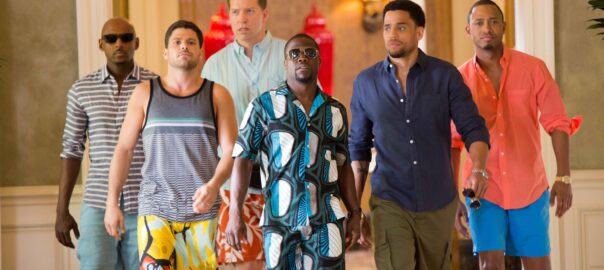
A busy, energetically pitched ensemble comedy that ultimately elicits more weariness than laughs, director Tim Story’s follow-up to surprise spring 2012 hit Think Like a Man, adapted from Steve Harvey’s 2009 book Act Like a Lady, Think Like a Man, can’t decide whether it wants to assay modern relationships or just thrash around in the wading pool of Las Vegas-set clichés. It settles for waving its arms, making noise and pointing out that change unsettles all of us, men and women.
Returning scribes Keith Merryman and David. A. Newman ably deliver delineated characters. But they’re so busy servicing the various relationship crises of their couples that there’s a paucity of jokes that push past anything other than the most obvious, surface-level set-ups. If the first film traded on friction between established types (e.g., “The Mama’s Boy,” “The Non-Committer,” “The Player,” “The Girl Who Wants the Ring”), the extent to which the advice of Harvey’s book still serves as an inspiration seems here to be limited to a couple rejoinders and a scratchy, ill-fitting voiceover narration from Kevin Hart, in which he randomly invokes basketball analogies.
Story (Barbershop, the Fantastic Four films) is capable of locating humor amidst resonance, but here he seems beholden to some invisible, overcharged pace car, chasing loud, cheap laughs in a manner that reliably undercuts any moments of more emotionally grounded reality. For the full, complete review, from Screen Daily, click here. (Sony/Screen Gems, PG-13, 106 minutes)

Supermensch: The Legend of Shep Gordon
A documentary about its titular talent manager, Supermensch: The Legend of Shep Gordon, directed by writer-actor Mike Myers, has the potential to be a slice of yawning, self-congratulatory star-fuckery of the highest order. After all, in addition to its famous director, it has plenty of recognizable celebrities who all line up to sing the praises of its subject. And yet, thanks to whip-smart pacing, this warm-hearted and unfussy nonfiction valentine emerges as an engaging portrait of a life less ordinary — a man who embraced and promulgated selflessness, even while, in his early days, indulging in druggy partying and frequently sporting a T-shirt that read, “No head, no backstage pass.” For the full, original review, from Paste, click here. (Radius/TWC, R, 84 minutes)
Code Black Redux
Ryan McGarry’s Code Black, which debuted at the Los Angeles Film Festival last year, opens June 20 in New York City at the IFC Center and June 27 in Los Angeles at the Landmark Theater, before expanding throughout the summer in more than a dozen more cities. Turning up the knob on cinematic advocacy to 11, the film unfolds from 2008 through 2012, painting a fairly dire portrait of an American health care system on the verge of outright collapse. For my original review of the movie, click here.
LAFF: Evolution of a Criminal
When one talks about personal filmmaking as a pathway to something special, they’d be hard-pressed to come up with a better example than Evolution of a Criminal, director Darius Clark Monroe’s documentary examination of a bank robbery he committed as a teenager. The winner of the Grand Jury Prize at this year’s Full Frame Film Festival and part of the Summer Showcase section at the Los Angeles Film Festival, the movie — lent his name by executive producer Spike Lee — is an engrossing evocation of poverty in America, as well as, more pointedly, a moving look at redemption and second chances. Continue reading LAFF: Evolution of a Criminal
Halloween: The Complete Collection Blu-ray Set Gets Date
What producers Moustapha Akkad, Debra Hill and Irwin Yablans, writer-director John Carpenter and stars Jamie Lee Curtis and Donald Pleasence started in 1978 has transformed into one of the most durable, iconic — and copiously studied — horror film franchises ever created. Over the years, audiences have lived and relived the terrors of Michael Myers through 10 feature films, as well as various re-edits and alternate versions. Yet to date, with rights spread across multiple home entertainment studios, the complete saga of Michael Myers could be told only in pieces, in individual DVD and Blu-ray releases.
Through the unprecedented collaboration of Anchor Bay Entertainment and Scream Factory, however, that changes on September 23, with the arrival of the Halloween: The Complete Collection Blu-ray box set. Alongside a 10-disc version that includes the original theatrical versions of the Halloween films and select bonus features, a deluxe edition release comes spread across a whopping 15 discs, with all of the Halloween feature films to date — Halloween, Halloween II, Halloween III: Season of the Witch, Halloween 4: The Return of Michael Myers, Halloween 5: The Revenge of Michael Myers, Halloween: The Curse of Michael Myers, Halloween H20, Halloween: Resurrection, and Rob Zombie‘s Halloween and Halloween II. In addition, the latter set includes the never-before-released producers’ cut of Halloween: The Curse of Michael Myers, as well as the ultra-rare network TV version of the original Halloween, the network TV version of Halloween II, and unrated versions of Zombie’s Halloween and Halloween II.
Again, bonus content from previous releases is ported over, but among the hours of brand new bonus features are updated interviews with cast and crew from the entire franchise. In response to years of fan feedback, the first Halloween will now also include an option for the original mono audio track. The 15-disc release comes with a limited edition 40-page book written by Michael Gingold of Fangoria Magazine; collectible packaging will include a newly commissioned illustration on the outer case, with each film separately stored in its own black Blu-ray case with complementary original theatrical one-sheets as their key art.

22 Jump Street
There wasn’t necessarily reason to attach a lot of expectations to 2012’s 21 Jump Street, starring Jonah Hill and Channing Tatum, but the irreverent and self-referential reboot of the same-named, late-1980s TV series that helped launch the career of Johnny Depp delved into young male anxieties and issues of adolescent-adjacent friendship with considerable aplomb. Its sequel, 22 Jump Street, even more fully embraces and explores masculine relationship dynamics, while also wittily working over like a heavyweight’s speed bag Hollywood’s empty-headed love of franchising. Abundant in charm and loose-limbed energy, it’s a guaranteed crowd-pleaser, possessing everything one wants from a big Hollywood studio action-comedy. For the full, original review, from Paste, click here. (Sony, R, 112 minutes)
Dances With Films: 120 Days
A West Coast premiere at the recent Dances With Films Fest, the documentary 120 Days throws an affecting spotlight on the personal side of immigration, telling the story of a man who counts down the final four months with his family while weighing his options facing a federal “voluntary” self-deportation order.
Continue reading Dances With Films: 120 DaysDances With Films: Being Awesome
A recent presentation at the Julien International Film Festival and a competition title at the Dances With Films Fest in Los Angeles, well-meaning indie effort Being Awesome cycles through well-worn clichés of stuck-in-a-rut, cusp-of-thirtysomething frustration, but adds nothing much new or of interest to the emotionally-adrift-guys subgenre.
Continue reading Dances With Films: Being AwesomeDances With Films: The Jazz Funeral
A world premiere and Grand Jury honorable mention selection at the recently concluded 17th annual Dances With Films Fest, writer-director Jesse Rosen’s The Jazz Funeral is a relaxed, shrewdly observed portrait of the sort of crucible that a lot of young men must pass through in entering into a functional, adult, peer relationship with their father.
Continue reading Dances With Films: The Jazz FuneralBirdman Teaser Trailer Promises Wild Ride
The teaser trailer for one of fall’s more interesting films — Alejandro Iñárritu’s Birdman, starring Michael Keaton as an actor famous for once portraying an iconic superhero but now going through an existential crisis — reveals it to be a jazzy, audacious, gleefully deranged slice of high-art cinema, and seemingly certainly a lot more loose-limbed than Biutiful, Babel, 21 Grams or Amores Perros. Opening to a downbeat version of Gnarls Barkley’s “Crazy,” this looks like a case study in slipping-knot sanity entertainingly rendered. Great subtitle on its poster, too: “The Unexpected Virtue of Ignorance.” Amy Ryan, Edward Norton, Naomi Watts, Emma Stone, Andrea Riseborough and Zach Galifianakis co-star. The film releases October 17 via Fox Searchlight.
Ivory Tower
While renewed calls for a national focus on income inequality, predominantly grounded in a discussion of a minimum wage hike, are met with predictable squeals of “Class warfare!” from barons of industry, perched-on-high professional capitalists and other assorted defenders of the status quo, there’s an important second front in this developing battle — one that can be seen in the emerging populism of Senator Elizabeth Warren, who has made student loan debt (and the attendant profits reaped by federal government programs) one of her pillar issues. The new documentary Ivory Tower dives headlong into this thorny issue, not bemoaning achievement gaps or assaying the relative deterioration of American high schools and the public educational system, but instead asking pointed questions about what it is reasonable to expect from institutions of higher education, and how they may need to be retooled in the digital age.
Continue reading Ivory TowerLin Shaye Talks The Signal
I had a chance to speak to noted character actress Lin Shaye last week one-on-one, about her work in The Signal. The chat is excerpted after the jump.
Ai Weiwei: The Fake Case
Chronicling some of the very tangible costs of dissident behavior in societies much less freer than ours, Danish filmmaker Andreas Johnsen’s Ai Weiwei: The Fake Case is an absorbing nonfiction look at renowned Chinese multimedia artist Ai Weiwei, who, after just under three months of isolated imprisonment with no formal charges, is transferred to house arrest and put on a year’s probation, barred from giving interviews or having a domestic online presence.
Alison Klayman‘s superb 2012 documentary Ai Weiwei: Never Sorry offered up a much more rounded portrait of the man as an artist, though that film also dealt heavily with the political activism (including spearheading a citizens’ investigation into the more than 5,400 children who were killed in the 2008 Sichuan earthquake, in large part owing to shoddy government construction) which landed Ai in trouble with Chinese authorities. Following a contentious arrest, Klayman’s film actually ends with Ai emerging from his aforementioned confinement. Ai Weiwei: The Fake Case, then, tracks his cautious reemergence and attempts to come to grips with the emotional and physical fallout (sleep difficulties, a fog of depression) stemming from his detention. It’s less a study of China as a society in flux and more an unobtrusive document of roiled personality. For the full, original review, from Paste, click here. (International Film Circuit, unrated, 89 minutes)
Director Will Eubank Talks The Signal
I had the chance to speak to director Will Eubanks one-on-one last week, about buzzy Sundance Film Festival-minted sci-fi title The Signal. The conversation is excerpted after the jump.
Gone Doggy Gone
An amusing, madcap blend of social satire, character comedy and well-worn road trip tropes, Gone Doggy Gone, co-written and directed by Kasi Brown and Brandon Walter, unfolds against the backdrop of a kidnapped canine. The low-budget indie film effectively winds up a bunch of characters who are by degrees self-centered, delusional and inept, and then spends the remainder of its 89-minute running time bouncing them off one another at odd angles, like rubber balls in a stairwell.
The Best of Fest winner at the First Glance Film Fest and the Audience Award winner at the Julien Dubuque International Film Festival in April, Gone Doggy Gone centers on Los Angelenos Abby and Elliott Harmon (Brown and Walter), a married professional couple on emotional autopilot who dote on their teacup terrier, Laila, treating her like a baby. After a series of personal and occupational humiliations send their (overly) devoted dog-sitter Jill (Shaina Vorspan) into a tailspin, she snaps and kidnaps Laila, emailing the Harmons a ransom video. Abby and Elliott quickly uncover the truth, but Jill hits the open road. A pursuit follows, with the Harmons’ wisecracking, weed-smoking friend Kat (Kate Connor) tagging along for the ride. After disastrous attempts at interception on their own, along with other assorted mishaps, Abby and Elliott hire Dan (Jeff Sloniker, seemingly channeling John Belushi), a slovenly, bumbling, would-be private investigator who works with his father Stan (Office Space’s Richard Riehle). As they then nominally tail him and await results, though, Dan becomes smitten with Jill, further feeding a roundelay of misunderstanding and haplessness.
At its core, Gone Doggy Gone has a great concept — something that’s both easily relatable from a comedic perspective and, in the manner in which it essays the way pets are kind of a starter baby for DINK-ers who in earlier generations would’ve already started a family, plugged into the current zeitgeist. Brown and Walter’s instincts encompass plenty of comedy of debasement, but the ranginess and rapid-fire pacing of their work as much as anything else assure that Gone Doggy Gone never loses hold of a viewer’s interest. There are also some great purposefully terrible local commercials and a dream-sequence riff on The Silence of the Lambs, showcasing a canny sense of spoofery.
In its third act — with a pit stop at a hippie friend of Kat’s, and a reversed blackmail plot — the film succumbs a bit to the kitchen-sink instincts of so many independent films, in which bigger and more clamorous is confused with necessarily better. Low-budget films that lack the resources of some of their bigger-budget genre counterparts often seem to reach for hijinks, writ large, in an effort to clinch market salability. The character of Dan, already a bit broadly sketched, figures into the proceedings more and more, but what’s meant to track as a strand of misguided obsession paralleling Jill’s just seems like misspent time. It feels like there’s a slightly more reigned in treatment of the same premise and end game that could have yielded even richer results.
What Gone Doggy Gone has going for it, though, is solid banter writing and some crisp, engaging characterizations and acting. The diminutive and demure Vorspan, playing a character who seems like she’s from a Todd Solondz film by way of the Farrelly brothers (or perhaps the other way around), is a real treat — cracked and vulnerable in a uniquely compelling way. Brown, meanwhile, has the wicked gleam in her eye of a raging, on-the-warpath, manic-sad compulsive, which works well in contrast with Walter’s more baseline, normalized exasperation at the unfolding situation. Ultimately, whether you’re the one who’s pooch-fixated or it’s someone else in your life, the freewheeling absurdism of Gone Doggy Gone will strike a chord of amusement. For more information on the movie, click here to visit its website. (Buzzworm Films, R, 89 minutes)
Korengal
From mid-May 2007 through the summer of the following year, Sebastian Junger and his colleague Tim Hetherington chronicled the deployment of a platoon of American troops in a remote and notoriously deadly Afghanistan valley. The resulting experiential travelogue of war reportage, 2010’s Restrepo, picked up a Grand Jury Prize at the Sundance Film Festival and was nominated for an Academy Award for Best Documentary. The follow-up, Korengal, comes three years after Hetherington was tragically killed covering the civil war in Libya, and builds on the psychological perspicacity of its predecessor, delving in a very simple and direct way into what war and some of its aftereffects feel like. For the full, original review, from Paste, click here. (Saboteur Media/Goldcrest Films/Outpost Films, R, 84 minutes)
Burt’s Buzz
It’s immediately clear by the film’s odd, buzzy opening — the raucous reception of its septuagenarian subject in a Taiwan airport — that Burt’s Buzz isn’t going to be a normal documentary. Unfortunately, though, it turns out to be atypical in a variety of exasperating and ultimately fatal ways. In fact, if there were an upper-level college or film school class specifically about burying the lede, it would be difficult to immediately think of a more fitting example than Jody Shapiro’s nonfiction portrait of an amiably deposed hippie businessman, which putters about aimlessly, getting to its most essential questions only an hour into its running time or leaving them entirely unasked.

Burt’s Buzz ostensibly tells the story of the founder of Burt’s Bees, Burt Shavitz, who lives a penny-pinching existence in rural Maine in a cramped cabin surrounded by antique peculiarities, and opines that “a good day is one when no one shows up and you don’t have to go anywhere.” Fifteen minutes in, though, Burt’s Buzz hasn’t really established his connection to the company (apart from his bearded, crazy-prospector-type likeness), and given that Shavitz evidences a complete and utter lack of entrepreneurial instinct, the audience is left bobbing around like a cork in the ocean, wondering how the hell he got this enterprise off the ground.
Eventually, more than 35 minutes into the movie, the name Roxanne Quimby pops up — a recently divorced mother of two and lapsed graphic artist at the time she met Shavitz and moved in with him in 1984. Using the extra, saved beeswax from hives that Shavitz tended to harvest honey that he would sell out of the back of his truck, Quimby started making candles. They then expanded into other crafts and personal care products, peddling their wares around town and at festivals and the like. Sprinkled throughout the rest of the film, like a dusting of confectionary sugar, are references to a business empire that would top $3 million in sales by 1994, and set up shop in North Carolina. When Shavitz and Quimby split up, she would take the company with her.
Mostly, Burt’s Buzz is just a vehicle for its subject’s laconic charm and heavy-lidded musings; it follows him as he makes a series of personal appearance, handing out free lip balm samples at a Target in Minneapolis, and then traveling abroad, doing interviews with local press and appearing at awkward public Q&As meant to increase brand awareness. Shavitz seems mostly bewildered by all the attention and pretty much disengaged from anyone and everyone with whom he crosses paths, though there’s also an awkward scene where he attempts to thank his Taiwanese guide and translator, and basically ends up petting her.
Shavitz’s assistant theorizes at one point late in the movie that he’s completely emotionally shut down and incapable of basically love of any sort with another human being — something a lot of the footage would seem to support. But director Shapiro — who does talk to Shavitz’s ex-pat brother Carl, five years his junior, who moved to Great Britain in 1966 and never came back — doesn’t delve substantively enough into the root causes of this behavior to drum up anything more than perpetual cusp-of-intrigue diddling. There’s a bit of material on Shavitz’s New York upbringing, but the movie quickly moves on from that. And while it lays out a narrative for how Shavitz came to sign away his company (he got caught cheating with a twentysomething-year-old that worked at one of the company’s stores), there are only half-truths, equivocations and vague references (“Roxanne really wanted to own me, and no one’s ever going to own me — you can rent somebody, but you can’t buy them”) that in the end don’t really tell a viewer a damn thing.
Incurious and eager to please, Burt’s Buzz never digs into why Shavitz is still doing promotional appearances (given his spartan existence, how much money does he really require, or even want?). The waves of plaintive hurt that emanate from its subject hold one’s interest in passages, but basically go nowhere. Then there’s the sort of slimy fact that, since Burt’s Bees — which Quimby sold 80 percent of her stake in for $177 million in 2003 — was actually bought by the Clorox Company in 2007 for over $900 million, Burt’s Buzz is a silent, amiably dumb witness if not outright accomplice to peddling a fundamentally false narrative of the company as still some paragon of Earth-friendly, less-is-more simplicity. More than any deeper understanding of Shavitz that emerges, the feelings that Burt’s Buzz most elicit are those of uncomfortable condescension — at watching thousands upon thousands of Taiwanese being fed a fat shit sandwich of phony American capitalism. For the full, original review, from ShockYa, click here. For more information, click here to visit the movie’s website; Burt’s Buzz opens in Los Angeles at the Laemmle Music Hall. (FilmBuff, unrated, 88 minutes)
Griffin Dunne Talks The Discoverers, More
Maybe it’s the slightly patrician demeanor, maybe it’s the hair. Whatever the case, Griffin Dunne has a visage and persona that seem built to entertainingly sustain indignity and exasperation. This trait was in rich evidence all the way back in 1985, in Martin Scorsese’s offbeat, underrated After Hours. And it’s on display again in writer-director Justin Schwarz’s debut feature, The Discoverers.
Dunne stars in the film as Lewis Birch, a washed-up history professor whose plans for a two-birds-with-one-stone vacation/academic conference getaway with his teenage children (Madeleine Martin and Devon Graye) are undone when his mother passes away suddenly and his estranged father (Stuart Margolin) stops speaking and goes AWOL on a Lewis and Clark historical re-enactment trek. Grasping for reconnection, Lewis leads his kids into a world of playacted discovery that ends up triggering some of the real thing. On the film’s opening weekend, I had a chance to chat one-on-one with Dunne in Los Angeles, about sibling rivalries, family frailties, history, starting fires and more. The conversation is excerpted over at Paste, so click here for the read.
Director Lukas Moodysson Talks We Are the Best!
Swedish-born poet and novelist Lukas Moodysson made a splash with his film debut, Show Me Love, in 1998, and has since then delivered a number of controversial and experimental films. His latest movie, the adventurous romp We Are the Best!, centering on a group of tomboyish tweens in 1982 Stockholm, is a return to the more optimistic and loose-limbed vibe of his early work. I recently had a chance to speak to Moodysson one-on-one, about his movie, punk music, religion and being a “self-critical amateur.” The conversation is excerpted over at ShockYa, so click here for the read.
Beau Knapp Talks The Signal
I had the chance to speak one-on-one with Beau Knapp on Tuesday, about the moody, low-budget sci-fi flick The Signal, which worked up a buzz at the Sundance Film Festival earlier this year and hits theaters on June 13 from Focus Features. The conversation is excerpted over at ShockYa, so click here for the read.
The Fault in Our Stars

Director Josh Boone’s adaptation of John Green’s bestselling novel about two teenagers who meet at a cancer support group and fall in love, The Fault in Our Stars is engagingly plotted and anchored by rich characterizations — a swollen tearjerker that confirms the star presence of Shailene Woodley. For the full, original review, from Screen Daily, click here. (20th Century Fox, PG-13, 126 minutes)