Daily Archives: July 1, 2007

Going Under

Hey, remember dashing billionaire Robin Colcord (Roger Rees)
from the sitcom Cheers?
Wanna see him
totally nude in a somewhat kinky, heavily arthouse-inflected sexual drama of
submission and domination? Great news — now’s your chance, in the form of writer-director
Eric Werthman’s Going Under!

Rees stars as Peter, a married psychotherapist who lives a
life of parallel intellectual pattycake alongside his novelist wife. The movie
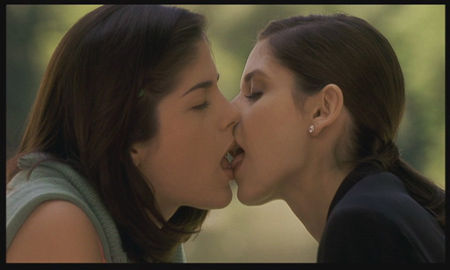
centers on his relationship with Suzanne (Geno Lechner, above), a professional
dominatrix with whom he’s been involved in a strictly defined, sensual affair
of non-penetrative role-playing in a walk-up dungeon where their anonymity is
protected. Suzanne, however, is preparing to quit her job and pursue her love
of art full time. She has a soft spot for Peter, though, and agrees — and first
broaches the subject, in fact — to see him on the “outside world,” where they
share their real names and try to do normal things like have coffee and chat.
Naturally, all kinds of awkwardness ensues, especially when Peter tries to come
clean to his wife, and confess a deeper obsession to Suzanne, who’s also been
dabbling in lesbianism.

Peter’s relatively unexamined sexual fetishes are one thing
(the movie winks and dashes past this point with a blasé disclosure and a simple
line of dialogue from Suzanne: “Most therapists take a while to admit it”), but
his increasingly erratic acting out stretches credulity for an alleged
professional of his ilk
. So too, it’s sad to say, does the notion of Suzanne as
a serious artist; we see her projects, which point to a certain talent, but
learn nothing of consequence of what drives and interests her, what informs
this work that therefore feels quite separate and apart from what we see in the
rest of the movie. Going Under is
painstakingly constructed and fairly nicely shot (David Lynch would probably
like some of S&M scenes, one of which recalls the druggy “Pink Room” from Twin Peaks: Fire Walk with Me), but its
narrative rings rather hollow, and there’s not enough fuel in the tank to
really drive the plot’s engine
. What one is left with is a quite tonier but rather limp iteration of the old Cinemax model of deviant sexual exploration. Where’s Zalman King, one wonders?

Housed in a regular Amray case in turn stored in a cardboard
slipcover, Going Under is presented
in 1.78:1 anamorphic widescreen, with Dolby digital 5.1 surround sound and
Dolby surround 2.0 audio mixes. An audio commentary track with Werthman and
Rees kicks off the bonus material
, and their rapport is solid and banter quite scholarly and informed, if sometimes off the mark with respect to what’s actually unfolding on screen. A 17-minute segment entitled “Pushing the
Boundaries” is comprised of interviews with Rees and Lechner
, the latter of
whom talks some about her career trajectory (in particular landing Schindler’s List), and describes having
a strong reaction to this material. Rees, meanwhile, characterizes his typical
offer sheet as consisting of “bad choices or badly lit lawyers in a lot of
movies.” He claims his agents initially kept the project from him, and then
tried to convince him it was “too naughty,” but that good friend Bebe Neuwirth
(I guess some Cheers friendships do
stand the test of time) gave him the cheeky go-ahead. Six random minutes of
footage from the S&M fetish “Black & Blue Ball,” narrated by Lee Kross,
leave one sure of their own sexual proclivities, which don’t involve ball
torture
. Also, available as a DVD-ROM audio file, there are reflections on the
movie from Marta Helliesen, a licensed Ph.D. C- (Movie) B+ (Disc)

Michael Bay Blows Shit Up!

Michael Bay is an unparalleled conductor of destruction, that much we know. He likes his set pieces big, his explosions bigger, his bass deep, his music cues thundering and his subtext bold, highlighted and rendered in all caps. At the screening of his forthcoming Transformers that I attended, he welcomed the audience and said he was on hand, just recently back from Australia, “to make sure it’s fucking loud,” with all appropriate exclamation.

The film certainly delivers in terms of its effects work, from Industrial Light & Magic, and Bay trades in the typical sort of emphatic, canted close-ups and adrenalized style
that have been his hallmark throughout his career. The
problem is that Bay, for
all his arguable skill as a conjurer of sugar-rush catharsis,
has little sense of spatial coherence
. He’s a top-notch imagist, as all those Clio Awards somewhat attest (that also explains the segments of Transformers that come off as car commercials), but his basic aesthetic sensibility doesn’t seem to have advanced that much beyond his swirling, shadow-inflected work on Aerosmith’s “Janie’s Got a Gun” music video.

It sounds hackneyed to say, but Bay truly does play by his own cinematic rules, collapsing established spaces to suit momentary need, and frequently creating escape through reverse shots rather than any sort of
sensible internal story logic. The resultant action can be eye-popping, but also wholly devoid of any true or artful tension. He’s kind of like a home run hitter in baseball, in my opinion — always swinging for the fence with iconic images and “cool-factor” explosions. Frequently he strikes out, but sometimes he smacks one the bejesus out of the park… often within the same movie.

That said, as fun as it sometimes is letting the action of Bay’s movies wash over you, it’s generally the
cinematic equivalent of a false show-and-tell exercise
— bravura
demonstration lacking any rooted emotional weight or
involvement. I know it has the air-quote disadvantage of being less grounded in reality than Live Free or Die Hard, but for all its state-of-the-art, tech-assisted carnage, the action in Transformers matters less, and is less involving, than that of the Bourne films. As with the worst moments of Bad Boys II, the ending of Transformers just feels like you’re being ejaculated upon.

In a Dark Place

Henry James’ classic novella Turn of the Screw gets a mood-driven re-imagining in In a Dark Place, starring Leelee
Sobieski. A sort of cut-rate ghost story with heavy ’70s-style arthouse
inflections
, and plenty of lurking window and point-of-view shots, the movie
might most surprise James, though, for the over-under of its tub and bathrobe
scenes, which total a hearty dozen
(below).

Sobieski stars as Anna Veigh, an art teacher who is sort of
shipped off from her current position, to a post as a nanny for two young
orphans, 10-year-old Miles (Christian Olson) and Flora (Gabrielle Adam). Her
new workplace is a remote country estate with beautiful if deserted grounds,
and despite having already seen their fair share of hell in the deaths of their
parents and Anna’s predecessor, Miss Jessel, the children seem courteous and charming,
if initially a bit strange. This quietly mannered world quickly fades as Anna makes
a series of disturbing discoveries, catching glimpses of figures lurking on the
grounds which she later learns are those of two ex-employees who are now dead. Though
she at first questions her own sanity, it comes to seem that the figures have
sinister intentions, and so Anna is forced to confront dark secrets buried deep
in her own psyche as she fights, in somewhat vaguely defined fashion, to
cleanse the children’s souls of darkness.

It’s worth mentioning at this point, lest someone think this
is a good companion piece to Alejandro Amenábar’s The Others, that Anna is accompanied throughout all this by the
children’s uncle’s chilly secretary, Ms. Grose (Tara Fitzgerald, a sort of younger, poor woman’s
Lena Olin
), who clearly holds some sort of secrets. It’s never really explained
why Anna is hired for a job that Ms. Grose is materially assisting in — and
could seemingly do herself, actually — but this question fades into
insignificance when the latter’s cold behavior morphs into strangely blackmailed
affection.

Helmed by debut director Donato Rotunno, In a Dark Place has the certain advantage of all sorts of strange little
alleyways not typical of such genre pieces
, as well as some weird directorial flourishes,
like an oddball violin electronica-infused sequence which juxtaposes Anna’s
wilderness wanderings with Ms. Grose playing dress-up and writhing about in her
clothes. So it’s original, really, in
a way, but not necessarily all good
. The movie delves into the subject of abuse,
and how those abused can become abusers, but only in a very elliptical manner —
one that’s interesting without being wholly satisfying. Sobieski is good at
conveying Anna’s vulnerabilities, but not her slide into… well, quasi-madness,
let’s say, which the script rather short-changes. She does display a bit of cleavage and side-boob, and just a flash of bare behind, though — enough, along with Fitzgerald’s aforementioned
writhing, to help earn an R rating for a film that is otherwise a very tame,
proper and almost PG-rated story of mistreatment and alienation.

Presented in 1.78:1 widescreen, In a Dark Place comes with solid English language Dolby digital 5.1
surround sound and 2.0 stereo audio mixes, as well as optional English and
Spanish subtitles. The sole DVD bonus feature is a 12-minute making-of featurette
which includes interviews with Sobieski, Fitzgerald and director Rotunno
, who confesses
to ignoring James’ source text and all previous adaptations, and starting from
scratch with Peter Waddington’s screenplay. Sobieski, meanwhile, says (though
none too convincingly) that her initial attraction to the movie was its “sensitive
and chiseled script,” and talks about how the film was a departure for her in a
sense, because she was heretofore always used to being the youngest on the set.
C (Movie) C+ (Disc)

The Bow

Acclaimed South Korean director Kim Ki-Duk (Spring, Summer, Fall, Winter… and Spring)
delves back into morally cloudy water with this strange, ethereal, minimalist sea-set
piece, an exploration of rescue, responsibility, duty and proper adult boundaries
that
relies heavily on expression, gestures and body language to tell its powerful
story.

The Bow centers on a crusty old man (Jeon Sung-Hwan) and a beautiful young girl
(Samaritan Girl’s Han Yeo-Reum) who live
on a fishing boat which has been floating at sea for over 10 years, the man
having plucked the little lost girl from the ocean at that time. Since then, the man has shown the girl how to fish, and cared for her in every way. But
the man plans to marry the girl on her 17th birthday, and counts the days down
on his calendar, buying scraps of fabric for her wedding dress in piecemeal
fashion and locking them away.

In addition to the girl and life on the ocean, the bearded old man
also cherishes only his bow, which he uses predominantly as a weapon to fight
off would-be admirers of his lovely shipmate. However, the bow is also a useful
device for shamanistic fortune telling, and as well creates wonderfully
enchanting music. The quiet couple’s peaceful and secluded life changes when a
teenage boy comes aboard, and the girl’s horizon and orientation are irrevocably
altered.

The set-up of The Bow is rather arbitrary, and Ki-Duk further ups the arthouse ante by trading in silences. He’s not interested in revealing back stories of his characters (hence their lack of names), or having them come to epiphanies about their situations. The story and setting are almost nipped from a fable of yore; it seems an excuse to play around in grey areas of devotion and subjugation. To that end, the acting and uniformity of tone and vision is what carries The Bow, but it’s certainly not for everyone, and certainly not for the end of a long day, which is the circumstance under which I first tried to watch the movie. If the alignment of interest and attention is right, though…

Housed in a regular Amray case, The Bow is presented in anamorphic widescreen in a very nice transfer, with Dolby digital
5.1 surround sound and DTS surround sound 5.1 audio tracks, both in the movie’s
native Korean. Naturally, English and Spanish subtitles are also available. The
big supplemental extra is a 35-minute making-of featurette
, which interweaves subtitled
interviews with the director and his female star with on-set footage of them at
work. Other DVD special features consist of the movie’s original theatrical
trailer, a photo gallery and previews of other Tartan releases. To purchase the film via Amazon, click here. B- (Movie) B- (Disc)