Monthly Archives: August 2006

Pirates Spawns Market Flood, X-Rated and Otherwise

Hey, did you hear the one about the adult movie Pirates? Yes, they also released a cut rated… aRRRRRgh!

In an anticipatory mooring to the wild success of this summer’s Pirates of the Caribbean: Dead Man’s Chest,
this movie and, indeed, all sorts of nautical swashbuckler DVDs and
strange tie-in products have made their way to the market in the past
six weeks — everything except that entirely un-clamored for special
edition of Cutthroat Island
(sorry, Renny Harlin). There have
been legitimately licensed, pirate-themed fruit snacks and white
chocolate M&Ms, the utterly bizarre and justifiably long-forgotten
Cheech Marin/Tommy Chong/John Cleese 1983 pirate spoof Yellowbeard (with David Bowie thrown in for good measure!), Echo Bridge’s release of Blackbeard
and even an electronic talking piggie bank, among many other items. But
the loosely associated tie-in that certainly drew the most attention is
Pirates, an erotic action-adventure romp
from singularly monikered writer-director Joone and his company, Digital Playground.

While racking up all manner of intra-industry awards, the epic-scale
film also made history for its seven-figure budget and as the first
modern adult feature to be re-edited to receive an R rating from the
Motion Picture Association of America
, the body which rates all the
mainstream big screen fare of its seven signatory studios. “From the
time we were writing the script, we wanted to make a movie that could
play without any sex in it,” says Joone. “We went in with that
mentality — saying that we needed a great story, and as strong
characters as possible.”

Wait… characters, acting? Didn’t those go the way of the dinosaur in
adult films of the post-video age?
“Most of the girls that are in it
are contract stars,” says Joone, of a cast that includes headliner
Jesse Jane
, Carmen Luvana, Janine, Devon (above), Teagan Presley and Austyn Moore. “And I wanted to use Evan (Stone), who’s to me like
the Bob Hope of the industry. But you go in writing characters that
they can play, not characters that they have to be actors to play.
You’re not making them do things that are way out of their range.” Duly
noted.

Still, when it came time to solicit the MPAA for an R rating, they
didn’t seem as enamored with his efforts at legitimate storytelling
structure. “I remember the first cut we gave them had a lot more sex in
it and they came back with a flat no,” says Joone. “It was, ‘This movie
is not going to pass.’ We asked if they thought it was possible to get
an R-rated cut out of it, and they said, ‘We think you can.’ So that
was a little light at the end of the tunnel, and then it became a
journey of how to get there, because they don’t really tell you what
isn’t passing, they just say very general things, like, ‘It feels
like it has too much sex.’
Or they even said that they were OK (with
certain content) because the characters were on their honeymoon, but in
this scene it’s people that are not married. So you’re just faced with
some things where you’re like, ‘Oh, OK then. I guess if you’re not
married, you’re not supposed to have sex.’”

It
was a six-month process of give-and-take, spanning from December of
2005 through May of this year, and one that resulted in a movie far
less explicit or titillating than any number of R-rated mainstream
thrillers
. Joone left the experience a bit baffled but unbowed. “Out of
context it doesn’t work as well,” he notes. “There were scenes where,
from day one, there was no problem with it, but suddenly, in the last
two iterations, there was a problem with it. You felt like you were
chasing your tail. Studios get way more leniency with their films… both
because of stars and the fact that they know it’s going to be a
theatrical release or whatever. I mean, we could not, in our movie,
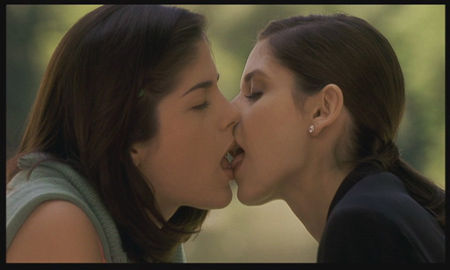
have two girls kissing.
And in how many movies have you seen that?”

The admittedly hamstrung but still diverting, R-rated cut of Pirates,
which imports the loopy adventure and soused leading man of its
Hollywood namesake, is available from MTI Home Video with a clutch of
extras, while if it’s academic comparison you crave, the triple-disc
version of the original movie offers both standard and WMV-HD
presentations of the film in 16×9 widescreen, plus bloopers, photo
galleries, audio commentary tracks with the stars, behind-the-scenes
specials on the visual effects and other production elements of the
movie, casting videos (umm… what?), cast biographies, trailers and more.

And as for a sequel? “Everybody wants me to do it,” admits Joone
with a sigh, “but for me, if I’m going to do it, it’s got to be 10
times better than the first one.” He sees the future of big budget
adult productions as a rather tenuous one. “My philosophy is that
[Digital Playground] is not a porn company, we’re an entertainment
company,” he says. “You don’t have a studio system. You can do whatever
kind of movie you want as long as it has sex in it. And so, as a
filmmaker, you sort of look at the sex as the commercial that pays for
the movie
. But the problem with adult right now is that there are not a
lot of filmmakers and storytellers in this arena. A lot of the films
that are being made are gonzo or pizza-man-knocking-on-the-door-type
scenarios.
I think for the future to be successful, you need creative
filmmakers behind the projects. If you have that, you will be
successful — talented people putting together a great product. Our
focus has been about making great movies that are geared toward
couples.
They’re not about degradation — it’s great people, good
times.”

After a little more talking, too, Joone seems to be coming around to the notion of another Pirates
adventure, something the enormous grosses of the Disney sequel as well
as the to-scale market success and critical embrace of his film
certainly seem to indicate an audience for. “I’m really thinking about
doing it,” he says, “so long as I get the right pieces together.”

Alice in Wonderland

Alice in Wonderland
has a glowing reputation as one of the greatest adolescent fantasies
ever, but most of that emanates from Lewis Carroll’s beloved children’s
books, and not necessarily the 1985 live-action small-screen production
of the same name
. Though Emmy-nominated and star-stocked,
master-of-disaster producer Irwin Allen’s version musters only
fleetingly hallucinatory and largely inadvertent amusements
, leaving
one to turn back to Carroll’s classics for consolation.

Directed by Harry Harris (television’s Fame), Alice in Wonderland mashes both the titular tale and Through the Looking Glass
together into one 190-minute movie. Young Alice’s (Natalie Gregory)
adventures begin when she gives chase after a very unusual White Rabbit
(Red Buttons) and stumbles into a world that grows ever curiouser and
curiouser. As she tries to find her way back home, Alice attends a tea
party with the Mad Hatter (Anthony Newley), plays a strange form of
croquet with some unusual royalty and meets a Cheshire Cat (Telly
Savalas), a Mock Turtle (Ringo Starr!) and, of course, Tweedledee and
Tweedledum (Eydie Gormé and Steve Lawrence, respectively). Grammy
winner Steve Allen, the original host of The Tonight Show,
provides the movie with an array of songs, and the rest of the
bizarrely cobbed-together cast includes Shelley Winters, Ernest
Borgnine, Sammy Davis Jr., Beau Bridges, Sid Caesar, John Stamos, Pat
Morita, Karl Malden, Sherman Hemsley, Sally Struthers, Jack Warden and
Carol Channing, who I have to admit really freaked me out as the White
Queen.

Carroll’s novels work so well precisely because of the fashion in which they stimulate flight-of-fancy imagination, and Alice in Wonderland
almost immediately paints itself into a corner with the forced
whimsicality of its interpretation; it becomes a forced march of
reliably unreliable star cameos
. The art and production design are
certainly nice achievements for its era (it was notably here, after
all, that the Emmys rewarded it, with nods for Art Direction, Costume
Design, Makeup, Hairstyling and Sound Editing) and a few of the musical
numbers stand out above the fray, but just as many are creepy (Savalas’
“Meow Baby”) and misguided. By and large the movie is an excruciating
tour of duty that feels like a series of sketches strung together at
some awful awards show rehearsal holding pen
.

Housed in a regular, white Amray case, Alice in Wonderland is
presented in 1.85:1 anamorphic widescreen, with a Dolby digital 5.1
English language track. There are no supplemental extras here, though
the quality of the picture transfer is fairly solid. In addition to its
solo offering, Alice in Wonderland will be available in a two-pack DVD set with the 1965 version of Rodgers & Hammerstein’s Cinderella, starring Lesley Ann Warren, Ginger Rogers and Jo Van Fleet. D+ (Movie) D+ (Disc)

A Canterbury Tale

Michael
Powell and Emeric Pressburger’s 1944 film is a profoundly personal
retelling of Chaucer’s famous literary tale of pilgrimage
, made
relevant and current because of its contextual resituating in a
Nazi-threatened England.

The film gracefully segues from its
brief period prologue to the tumult of Great Britain in August, 1943,
where it focuses in on three modern-day incarnations of said wanderers.
First is plainspoken American army sergeant Bob Johnson (played with
folksy charm by John Sweet), a genial Oregon native who gets off at the
wrong train stop. We also meet Alison Smith (a pleasantly pie-faced
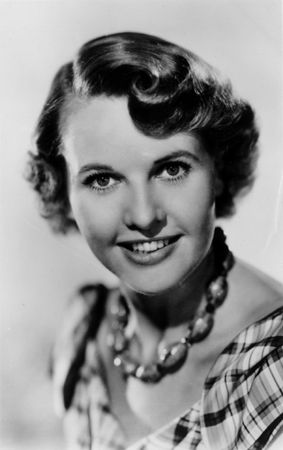
Sheila Sim
), a melancholic London shop clerk who’s signed on to work at
a local rural farm after her fiancé has been killed in the war, and
abrasive, upper crust Englishman Peter Gibbs (Dennis Price), also a
sergeant in the military as well as a cinema organist. Teaming with
local squire Thomas Colpeper (Eric Portman) to solve a series of
bizarre assaults that play as only slightly subdued sexual metaphor —
someone’s dousing women’s hair with glue, and fleeing — Bob, Alison and
Peter make their way to the mythical town of the title, each finding a
bit of redemption along the way.

Though later released in a truncated American cut, this original version of A Canterbury Tale
showcases the full latitude of Powell and Pressburger’s ambling
rhythms
. Mixing perversity and pastoralism in unusual fashion, it’s a
movie that’s both beautiful to look at and also elliptically evocative.
While it at least partially and irrevocably remains a document of its
time and place, A Canterbury Tale also showcases the luminescence of dinged humanity amidst discord and turmoil
.

Spread out over two discs and available in a thicker-than-usual Amray case, A Canterbury Tale
is presented in 1.33:1 full frame with an English language mono track,
and while the transfer is a fairly solid one with respect to color
levels, there is still some grain and surface scratching throughout.
Optional English subtitles are also available. Film historian Ian
Christie sits for a feature-length audio-commentary track crammed with
production minutiae, and there are also two six-minute excerpts from
the aforementioned American version of the movie
, with Kim Hunter
playing Bob Johnson’s Stateside bride to be.

The film’s second disc includes a new, 20-minute video interview
with Sim
, who warmly recalls the production. There’s also a 2001
documentary by Nick Burton and Eddie McMillan, John Sweet: A Pilgrim’s Return
,
which documents its subject’s first return to England in more than 55
years. David Thompson’s superb, 24-minute production doc A Canterbury Trail,
meanwhile, delves into plenty of biographical detail about Powell’s
adolescence. Alongside a booklet featuring essays from Graham Fuller,
Peter von Bagh and the recollections of neophyte actor Sweet, is the
1942 doc Listen to Britain, full of wartime sights and sounds, and a 2001 video-installation piece of the same name from artist Victor Burgin. B (Movie) B+ (Disc)

Free Screening of The Fountainhead

For those interested and in Los Angeles, a free screening of the 1949 version of The Fountainhead,
based on Ayn Rand’s classic text
, will be held Sunday, August 13, at
the Directors Guild of America at 7920 W. Sunset Blvd. in Los Angeles.
Doors open at 2:00 p.m. and the screening starts at 2:30. Following the
screening, a panel discussion and Q&A on the movie and its
production designer, Edward Carrere, will be held, moderated by
screenwriter and Art Directors Film Society founder John Muto.
Panelists include Jeff Britting, manager of the Ayn Rand Archives, and
filmmaker and author James Sanders. RSVPs are required, and may be made either by clicking through here to this web site or by phoning (818) 762-9995.

The Shaggy Dog

The leap from small-screen stardom to silver-screen viability is a tough one, as former Home Improvement star Tim Allen’s movie career amply demonstrates. Built chiefly on the foundation of two franchises — Toy Story and The Santa Clause
— in which he is either not seen at all or seen in heavily
prostheticized form, Allen is one of those guys who paying audiences
seem to be able to take or leave. Many films in which he’s taken a more
decidedly straightforward human form (2001’s Joe Somebody, the following year’s Big Trouble) have flat-out tanked, with Galaxy Quest — in which he anchored an estimable ensemble — being the notable exception. The Shaggy Dog,
then, further extends Allen’s status as distributor Disney’s adult-male
counterpart to Lindsay Lohan — which is not to say a serial partier and
late arriver on set, but the star of remade in-house properties
.

Upping the antics and, of course, the CGI, The Shaggy Dog
did decently for Disney at the box office this spring, but, call me
old-fashioned, there’s something more inherently charming about the
low-fi 1959 original
, based on Felix Salten’s novel and starring Fred
MacMurray. It helps that in that movie it’s not MacMurray who
actually suffers the self-pawing indignity of the magical
transformation into the titular canine, but instead his son Wilby
(Tommy Kirk). Here, though, Allen is workaholic lawyer (and animal
loather) Dave Douglas, who never quite has enough time for his wife
Rebecca (Kristin Davis), his son Josh (Spencer Breslin) and his
activist teenage daughter Carly (Zena Grey). Things change, though,
when the bite of an immortal Tibetan dog (yes, you read right)
transforms Dave constantly back and forth, and pits him — via a series
of constant misunderstandings and botched explanations of his
predicament — against an evil pharmaceutical company out to extract an
anti-aging serum.

Director Brian Robbins brings a deft, light touch to the staging of
the material and Robert Downey, Jr. has a blast as the unprincipled Dr.
Kozak — watching him here makes you realize what a great strictly kids’
performer he could be — but Cormac and Marianne Wibberley’s (I Spy, National Treasure) script never really gels and comes up with many scenarios beyond the expected. All in all, The Shaggy Dog
is exactly the movie you anticipate it to be, almost to the scene. If
dutifully fulfilled requirements in the name of a moralizing family
narrative still floats your boat, then so be it
.

Housed in a regular, white Amray snap case, The Shaggy Dog
comes with a paper insert listing chapter stops, and is presented in
the viewer’s choice of 1.33:1 full screen or 2.40:1 widescreen, the
latter enhanced for 16×9 televisions. A Dolby digital 5.1 surround
sound English language track anchors both releases, along with French
and Spanish subtitles, while the full-screen version also includes
French and Spanish 2.0 audio tracks.

As far as supplemental features, a four-minute collection of deleted
scenes is put forth, along with a brief segment which purports to offer
up translations for dog’s bark
. (Without benefit of a canine, I was
unable to put this featurette to the test.) Director Robbins and
producer David Hoberman’s glad-handing audio-commentary track is
available on the widescreen version of the movie
, and centers mainly
around general, and genial, production anecdotes. A
two-and-a-half-minute blooper reel
— showcasing Allen’s nervousness
with some of the animals and Downey, Jr. cracking up over several lines
— and sneak peeks at other Disney titles round things out. C (Movie) B- (Disc)

White Coats

Former SCTV
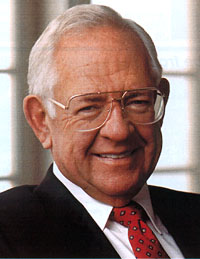
founding member Dave Thomas (no, not the dead Wendy’s founder) drops
multi-hyphenate skills in this hospital-based laffer, previously known
as Intern Academy. While not without its broad moments — the very obvious rip-off, err… template here is Scrubs — the movie works well enough as a comedy of colorful relationships, and should thus provide amusing counterpoint to fans of Grey’s Anatomy, which has, of course, supplanted ER as the dominant surgical soap of the American small screen.

Written and directed by Thomas, White Coats
is set at St. Albert’s Hospital, where a budget crunch has driven away
most of the top talent and forced philandering administrator Dr. Cyrill
Kipp (Dan Aykroyd) to sell off equipment to keep things going. This
leaves Dr. Omar Olson (Thomas) on the front lines with a group of five
interns to grapple with lost patients, bizarre emergency-room cases and
the like. It’s here that the movie spends most of its time and focus,
charting the personal foibles and back stories of its young charges

(the neurotic, the hottie working her way through med school by
stripping, et al) by bouncing them off one another in randy and/or
otherwise charged fashion
, all while also still allowing for some
showcase fun from Thomas’ considerable roster of friends, including
Dave Foley, Matt Frewer, Saul Rubinek and Maury Chaykin.

Housed in a regular Amray case, White Coats is presented in
1.85:1 anamorphic widescreen, with a Dolby digital 5.1 English-language
track. Additionally, the case lists optional English subtitles, but
both English and Spanish subtitles are available, though, in a glitch, the former switches to
Spanish roughly three-fifths of the way through the feature
.
Thankfully, no such malfunctions mar Thomas’ delightful
audio-commentary track, in which he discusses the inspiration for the
movie, the difficulties inherent in mounting a homegrown Canadian
production and the film’s Edmonton, Alberta shoot, chiefly on location
in an abandoned hospital. He also winkingly acknowledges the beseeching
insistence of financiers and other producers to include some nudity in White Coats, and how this eventually led to the subversive inspiration for the flesh that the film does ultimately bare.

Other supplemental extras include a nice chunk of behind-the-scenes
footage and a 10-minute gag and gaffe reel
, which replicates some
material that runs under the closing credits. There’s also a collection
of trailers for other First Look releases, and 13 minutes of cast
auditions for three of the interns — Viv Leacock, Ingrid Kavelaars and
Christine Chatelain. B- (Movie) B- (Disc)

World Trade Center

In the storied Hollywood history of career colonics, there’s never quite been as distinctively psychologically premonitory a movie as World Trade Center, or at least not recently. As directed by Oliver Stone, it’s a repudiation of all that the filmmaker has most come to embody over the last two decades — his swaggering anti-authoritarianism, his distended style, his cynical (I won’t bow to the reductive, desultory tag of “conspiracy”) perspectives and overtly masculinized frames; honestly, it feels like a mea culpa filed from the set of Alexander. Lacking angles, lacking controversy, lacking context — surprising for a man who so loves tangled background — World Trade Center is an unerringly conscientious, professional and emotionally engaging film, if also never a particular uniquely enlightening one.

Universal’s United 93 earlier this year. Part of this is due to the latter film being the first major studio project out of the gate, certainly, but is the true measure of healing really an extra four months? (We also have the added distraction of Mel Gibson’s drunken slurs, a benefit only insomuch as the fact that only so much reprimanding entertainment news can be foregrounded in the first 12 minutes of any given regular newscast.) But World Trade Center is also by design a movie of much more comfort, a movie of easy affirmation. It doesn’t confront us with any of the hijackers themselves, or ask us to consider the distressing choices of those Americans aboard a doomed jetliner. It instead delivers a flipside portrait of the unbelievable courage and resolve found in those reacting — purely and instinctively — to correspondingly incredible tragedy.

Reduced to a pair of eyes and covered visage for much of the film, Cage delivers a performance rooted in palpable regret. As they stave off death — jointly trapped but out of sight from one another — John and Will’s mutual urgings and conversations cover a range of topics, but center plaintively around their families. “I married the right one, you know?” says John at one point to a similar affirmation by Will, even though the film doesn’t shy away from showing us the former’s uncommunicative marriage, beset by problems of withdrawal. Using a variety of time-tested, low-fi means (fade-ins and -outs wherein John imagines alternate scenarios), World Trade Center slowly makes us believe what our eyes at first can’t confirm, the weight of these words. It also makes deft use of all sorts of small details — pebbles and dust being literally vacuumed out of the mouths of those pulled from rubble, for instance — to bring home the horror of that living hell.

The character of Dave Karnes, though, is problematic as rendered here, in that he embodies most robustly an emotion — laser-focused vengeance — that predominates the days and weeks after September 11, but not its swirling eye center. Swooping down from… where, exactly?, Karnes is given to steely-eyed glares and sanctimonious statements like, “I don’t know if you all know this, but we’re at war,” and, “We’re gonna need some good men to avenge this,” delivered to himself more than anyone else. Dave is first shown glimpsing the attacks on television. Then he goes to get a haircut (a “jarhead” job, he asks for), consult tersely with his priest and slip back into his old military fatigues before reporting for self-activated duty at ground zero. All of this, including the haircut, may be true (in fact, I almost assume it is), but it rings false in its juxtaposition to the rest of this narrative.

For a movie so baldly emotive — I’m not being flip when I say that World Trade Center is Stone’s most feminine work — overt flag-waving of this nature comes across as goading, perfunctory patriotism. We don’t need someone to remind us that we hate the terrorists — we hate those who take the lives of more than 2,750 innocent civilians, citizens from over 80 different countries — because we certainly do. What makes memories of that day so quickly summon a lump in the throat is the utter disbelief we recall, and the surging sympathies it brings forward. While a quality dramatization in many respects, World Trade Center lacks a bit in that department. (Paramount, PG-13, 123 minutes)

On Creative Individuals in Name Only

Of
the many thrills that come from interviewing creative people —
variously, unknown, ascendant and at the top of their game — there’s
also the under-discussed flipside
: talking with, 1) vapid young
“actors” (line-reciters is more like it) who have neither a sense of
film history nor an appreciation for their occupational good fortune
and, 2) perfectly genial writers and directors who are nonetheless so
relentlessly on script — occasionally reciting entire career-checking
passages verbatim from press notes no doubt spit-polished into
significance by some friendly faction in the dark wings — that you
realize they actually have less summary insight or thoughts about
several months or years of their own work than you do after 90 to 120
minutes with it.

The former are I suppose to be expected in a culture that so readily embraces the subsequent casts of The Real World and other MTV reality
show jetsam as bonafide celebrities. Who needs “craft,” after all, when
you can colorfully carouse and pontificate about your misguided
hook-ups on national television?
That latter, though… whew, well those
are just the most depressing interviews. I was reflecting upon this
recently — and in particular an interview with the director of an
American independent film, with major stars, that released last year —
and it struck me doubly disheartening because it’s (generally) not like
these people are complete idiots.

No, they’re just folks who’ve lucked their way (or been born) into
the comfortable middle.
And while they may nominally be decision-makers
or creators, they’re not really. They’re just industrious cogs in a
machine, functional advancers of agenda who speak in simple enough
sentences to delight those who are predisposed to automatically agree
with them
. Ask them what any of it might mean, however, and you’ll find
an alarming vacuum of original thought or opinion.

I’ll Always Know What You Did Last Summer

Released in 1997, I Know What You Did Last Summer had the heat and cachet of an adaptation of Lois Duncan’s teen-friendly novel by Scream
screenwriter Kevin Williamson
, as well as the mushrooming star appeal
of Sarah Michelle Gellar and Jennifer Love Hewitt. (For the ladies,
there was also Ryan Phillippe and some kid named Freddie Prinze, Jr.,
who I’m now convinced was an aberrant, late ’90s collective
hallucination on the part of teenagers and Hollywood casting
directors
.) After a $72 million domestic gross, its
rushed-into-production sequel attempted to urbanize things with the
addition of Mekhi Phifer and pop-singer-turned-reciter-of-words Brandy
Norwood, the result being diminished returns across the board.

the decidedly less buxom I’ll Always Know What You Did Last Summer,
arrives with a cast of unknowns, but definitely less of a creative thud
than one might expect
. Still, the point is that the original I Know What You Did Last Summer
(which came out when one of this sequel’s costars, Torrey DeVitto was
13) wasn’t a movie predicated on twist or concept — it was a star
vehicle, albeit a collective and relatively minor one. This film
doesn’t have the dangled promise of any known cleavage — or much
cleavage at all, really — and as such will find a hard time
establishing any sort of commercial beachhead, even in the
straight-to-video market.

Distancing itself from the first two movies, I’ll Always Know What You Did Last Summer
finds its requisite group of teens pulling a July 4th prank
based on
the urban legend of those characters. When things go wrong, though, and
a friend ends up dead, Amber (Brooke Nevin), Colby (David Paetkau), Zoe
(the aforementioned DeVitto), Roger (Seth Packard) and Lance (Ben
Easter) are devastated. Flash forward a year, when someone begins
stalking them and telling them they know about their dark, shared
secret.

Director Sylvain White utilizes a variety of in-camera cuts to up
the movie’s frenetic pacing
, and though the angsty panic that this
flash technique induces eventually morphs into overpowering music-video
affectation, it’s at least a bit different than the sort of hopelessly
straightforward rendering one might expect. White is aided in this
regard by veteran cinematographer Stephen Katz (the original The Blues Brothers), who does a great job of evoking mood on a budget; it’s not at all a stretch to say that I’ll Always Know What You Did Last Summer
has the more mannered look and feel of a European film, and White and
Katz deploy an effective array of practical “trick shots” usually not
indulged in such a movie. At the same time, while I won’t spoil the
final revelatory twist, it does feel like a reach, and would drag the
franchise in the wrong direction if ever followed up upon in the same
vein.

Packaged in a regular Amray case, I’ll Always Know What You Did Last Summer
is presented in a solid, 1.85:1 anamorphic widescreen transfer, with an
English language Dolby digital 5.1 audio track and a French language
Dolby surround track. (Optional English and French subtitles are also
available.) Special features include a feature-length audio-commentary
track in which director White details the movie’s cold Park City, Utah
shoot
(which substitutes for summer in Colorado) and his attempts at
subtly tweaking genre expectation. There’s also a hearty, quite nice
27-minute making-of featurette
which provides an array of on-set
footage and interviews with cast and crew, including veteran stuntman
Don Shanks (Halloween 5: The Revenge of Michael Myers), who plays the menacing, hook-wielding fisherman. C (Movie) B- (Disc)

Barnyard

Barnyard,
a colorful animated showcase that sacrifices a bit of narrative cogency for frenzied
jamborees, pratfalls and musical montage-fed poignancy
. With neither a broad television advertising campaign nor
top-shelf star voice talent, Barnyard
will face a tough go of things in theaters. With the number of
computer-animated movies increasing seemingly fivefold, it takes more than
merely anthropomorphized critters to turn out audiences, and Barnyard — a simple, throwback story of
family, fraternity and learned responsibility — lacks the immediacy of a big,
bold narrative hook.

The movie has an enjoyably manic pace and satisfying message
for kids
, but it’s doubtful that it can make substantial commercial inroads.
Opening on a comparable number of screens, Barnyard
could conceivably match or possibly best The
Ant Bully
’s $8 million bow, benefiting from both the film’s strong
Nickelodeon brand marketing connection and potential audience runoff from Talladega Nights, but anything in the
range of co-producer Nickelodeon’s previously successful Rugrats films seems doubtful. With little chance to break out to a
wider constituency, Barnyard should
find better returns in ancillary markets, where the movie’s voluble charisma
will offer repeated charm for the under-10 set
.

Ben the Cow (voiced by Sam Elliott) is the patriarch of the
barnyard, and for him the farm’s fence defines their space. He lovingly but
sternly enforces its borders, warning all against the dangers of attack from a
pack of marauding coyotes, who are led by the beady-eyed Dag (voiced by David
Koechner). Ben’s carefree son Otis (voiced by Kevin James), on the
other hand, happily indulges his state of arrested development, even though he
feels the first tinge of a care-giving impulse upon the arrival of pregnant cow
Daisy (voiced by Courteney Cox). When Ben is no longer able to lead the
animals, Otis must learn to heed his father’s mantra: “A strong man stands up
for himself, but a stronger man stands up for others.”

Though Oedekerk is best known for live-action comedies like Bruce Almighty and the Ace Ventura films, Barnyard is hardly his first foray into animation (he co-wrote Jimmy Neutron: Boy Genius and created
and executive produced Santa Vs. The
Snowman
), so the film doesn’t lack a cohesive style. While nitpickers will
question biographically correct details like the cow’s udders (girl cows are
differentiated by longer eyelashes and bows on their heads) and the consistency
in movement of quadrupeds on two legs, these elements are obviously of far less
concern to Oedekerk, who aims for a more emotive truth than a practical one.
Either you happily buy into the conceit — the joke of animals walking, talking
and even playing music when humans aren’t looking — or you don’t, and suffer a
grumpy ride.

Barnyard’s
animation is comparatively simple and clean when compared to the deeper frames
of Pixar’s efforts
, with cows having big, boxy faces, and other animals being
marked by a similarly rounded straightforwardness. Lively, light and airy is
the focus, in both word and deed
. As Otis, meanwhile, Kevin James’ playful
voice performance perfectly captures the blithe bounciness of a good-hearted
but self-involved adolescent.

Several fleeting bits are tossed in for adults, from a “Lord
of the Hoof” bit and animals enjoying a “mechanical man” ride to jokes about
lactose intolerance, but Barnyard is
by and large pitched to a younger crowd, and thus driven by Otis’ manic energy. In an inversion of the rural American ritual of “cow
tipping,” Otis and some of his wild friends seek revenge on a snotty boy
(voiced by Oedekerk) who tips a sleeping cow; they steal a car (!), sneak into
his bedroom and “tip” him out of bed, then flee in a sequence that turns into a
protracted police chase.

John Debney’s score, several songs by the North Mississippi
Allstars and the movie’s amped-up sound design all combine
to give the movie an aural propulsion tailor-made for kids
. Similarly, while Dag is a relatively menacing figure and
several of the brief coyote attacks might be a bit intense for very small children,
the movie’s action is bloodless. (Paramount, PG, 87 mins.)

Teen Box Office Sex Appeal

Some box office hits are easy to predict, but every summer there are a couple of surprises, and this year that list includes John Tucker Must Die, whose robust debut returns were probably at least partially driven by these va-voomish bra-and-panty shots.

Produced for under $18 million, the movie opened on 2,500 screens
and pulled in over $14 million last week
, for a hearty $5,576 per
screen gross. Heading into this weekend, it had already added another
$10.5 million to its coffers, and now stands to be quite a tidy
moneymaker for distributor 20th Century Fox, who’s also had another
under-the-radar hit this summer session with The Devil Wears Prada, which has now crawled past $110 million in just over a month of release.

John Tucker Must Die centers on three ex-girlfriends
(Ashanti, Sophia Bush and Arielle Kebbel) of the titular high school
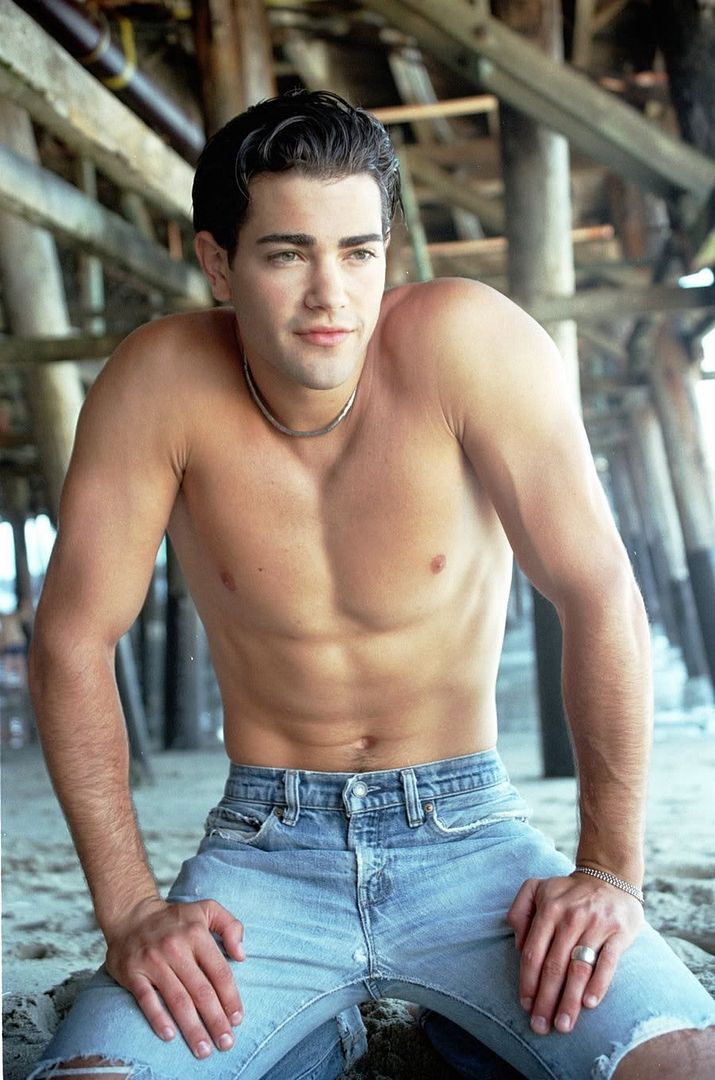
basketball stud and serial cheater (Desperate Housewives’ Jesse Metcalfe) who collaborate to turn the tables on their former beau by getting him to fall for the new girl in town (Brittany Snow) in order to watch him get his heart broken, so sure, it tapped into, in
savvy fashion, a certain vein of female adolescent vengeance
.

But
who else thinks these pictures helped drive male attendance amongst the
under-17 set? Though only rated PG-13 — for sexual content and language
— the movie was heavily touted on Comedy Central for the past two weeks, with separate “his and hers” TV ads. Guess which these were a part of?

For her part, Snow (American Dreams, The Pacifier) has already been cast in the big screen musical re-do of Hairspray, but with the box office performance of John Tucker Must Die, look for a, ahem, further bump in profile. Scarlett Johansson may not be looking over her shoulder just yet, but surely the phone calls from the folks at Maxim have already begun.

Time to Leave

including this item on Swimming Pool, but Time to Leave
represents a return to his least stylized mode of work, as well as
being perhaps his most personal movie. The film centers on gay
photographer Romain (Le Divorce’s Melvil Poupaud, a sort of
Gaelic Matthew Fox), a standoffish and secular Parisian in his early
30s, who finds out that he has inoperable cancer and only a few months
to live. From there, Romain begins to act up. He breaks up with his
boyfriend Sasha (Christian Sengewald), spitting, “Like with all
couples, routine is killing desire.” And he lashes out at his sister
Sophie (Louise-Anne Hippeau), nastily assessing her fragile marriage
and asserting he has no desire to ever photograph her children. He’s
acting out of pure instinct, but showing all these emotions to come
from a selfish, self-centered place.

Romain’s deepest connection is with his grandmother Laura (Jeanne
Moreau), and it’s only to her that he can disclose the news of his
sickness. And then, just as Romain’s world is getting smaller and
turning inexorably inward, he’s happened upon by Jany (Valeria
Bruni-Tedeschi), a waitress who has had trouble conceiving a child with
her sterile husband. She makes Romain a proposition which he initially
refuses, but then — as illness and emaciation sets in — he comes to
more deeply consider.

Short (83 minutes), tightly shot and anchored by Poupaud’s excellent performance, Time to Leave
is essentially a melodrama drained of any florid touches. When tears
finally occur we don’t see them prominently featured, but rather only
the in-profile tracts of where they’ve already rolled. Ozon (top left,
with Poupaud) builds to an elegiac finale that doesn’t beseech you with
its lamentations. We all have a Time to Leave, the film reminds us, though for some that time is cruelly too soon.
Distributed by Strand Releasing, Time to Leave is in limited release now, expanding throughout the month.

Talladega Nights: The Ballad of Ricky Bobby

Leslie Bibb), and two sociable, foul-mouthed sons, Walker
and Texas Ranger
. Yes, life is good for Ricky, and his win-at-all-costs
approach has made him a national hero in short order.

A frightening crash, however, sends him to the hospital and robs him
of his nerve, and Ricky falls on hard times. Booted from his racing
team and left by his wife, Ricky returns to his small hometown and gets
a job delivering pizzas. Cal and Lucius (Michael Clarke Duncan), his
ex-crew chief, try to coax him back into action, but it takes
reconnecting with his father and mother (Jane Lynch) and former
assistant Susan (Amy Adams) to put Ricky back on the winning track.

On a more than subliminal but hardly politicized level, Talladega Nights plays as a filmic extension of the trademark man-child obliviousness Ferrell brought to his Saturday Night Live
interpretation of President George W. Bush.
Squinty and possessing of
an unerring confidence — he describes himself as a big, hairy American
winning machine — Ricky’s mantra is, “If you ain’t first, you’re last.”
He’s funny, yes, but he works as a character at least partly because
he’s such a product of the current zeitgeist — a swaggering cowboy
brought down to Earth
. It’s no particular coincidence, either, that the
movie’s “villain” is a gay Frenchman, Formula One racecar driver Jean
Girard (an amusing Sacha Baron Cohen), who shows up to challenge Ricky
for NASCAR superiority and expedites his fall from grace.

As a film, Talladega Nights evinces much more of a sense of rootedness than Anchorman; cinematographer Oliver Wood (The Bourne Identity)
captures the pulse-pounding reality of the racing sequences in
poker-faced fashion, and director Adam McKay and Ferrell’s script has a
more finely attuned and (nominally) realistic trajectory. While still
seeded with whiplash reversals, the underlying impulses and motivations
are all real, and part of the difference between the two collaborations
is that Talladega Nights drags the audience in on the
characters’ pop-psychological evaluations
. Ergo, dim bulb Cal is
subconsciously aware that he holds jealousy over Ricky always finishing
first and refusing to share the spoils (“I’ll just bury it deeper down
inside!” he exclaims agreeably after Ricky declines to let him win),
just as Reese is aware of his primal urge to sabotage things when he
gets a belated chance at some semblance of familial normalcy. The old
adage is “if you can’t fix it, feature it,” and Talladega Nights
does this to wryly winning effect, even going so far as to tweak the
movie’s sponsor and product placement deals, of which Ricky is
obviously a proxy holder.

While not without a small handful of dry spells, the laugh factor in Talladega Nights
is certainly as high as if not higher than anything else this summer
. Possessing pitch
perfect timing and finely honed improv instincts, Reilly and Cole are
excellent additions to the cast, and really flesh out their characters.
Ferrell, meanwhile, delivers another indelible and hilarious character
— deserving, indeed, of his own ballad. (Columbia, PG-13, 108 mins.)

The Night Listener

Swimming Pool, Mulholland Drive or even Identity,
there’s neither a strongly rooted and compulsively sympathetic central
character, nor an engaging, swirling elusiveness to the movie that
keeps it dancing ahead of total cognition until after the final reel
.
Gabriel in and of himself is a well sketched and fully
three-dimensional character, and decently embodied by Williams, but his
obsession here with Pete seems arbitrary (the result of heretofore
obscured paternal instincts?), leaving the actor to fall back on that
trademark look of intestinal discomfort that substitutes, variously,
for pained worry, pained compassion and pained disappointment. As it
moves forward, the film, too, becomes rife with implausibilities.
Joe
Morton plays Gabriel’s agent in a few scenes and Sandra Oh wanders in
as a friend of his, and while they feed and agree with Gabriel’s
doubts, none of these ostensibly bright people seems to have any good
ideas about how to discern the truth in non-dangerous and non-creepy
ways. Without stronger connective tissue to the factitious disorder on display, The Night Listener is an exercise in moody obligations. (Miramax, R, 82 mins.)

The Girls Next Door: The First Season

It’s a not particularly well-kept secret that most men under 50
years of age — given the opportunity — would happily spend the entire
day looking at pictures of scantily clad and/or naked women on the
Internet. It’s also inevitable, really, that as reality television has
gotten bigger and bigger, there would be a series that would eventually
lead us to the doorstep of Playboy founder Hugh Hefner
, and inside his namesake mansion. These two things dovetail nicely in The Girls Next Door,
the jiggly, wealth-flaunting cable series centered around Hefner, his
trio of blonde live-in girlfriends and their ring-a-ding lifestyle.

The
three women in question are the now-21-year-old Kendra Wilkinson, Holly Madison, 26, and Bridget Marquardt, the grand dame of the group at 32
years of age. As one might imagine for the concubines of a millionaire
retiree, there aren’t exactly many taxing occupational demands or
worried conversations about how they’re going to pay the gas bill this
month
. Instead there’s an abundance of premium-quality leisure
activity, so the 15 episodes included here chart all manner of
lounging, partying and cheery beverage sipping, from a trip to Las
Vegas, an AFI salute to George Lucas and a wine-tasting jaunt to
Northern California to “fight night,” Hefner’s famous Midsummer Night’s
Dream party, celebrating Kendra’s 20th birthday and more. In fact,
based on all this evidence, I’d confidently estimate that the girls
spend a good 30 percent of their lives posing for pictures
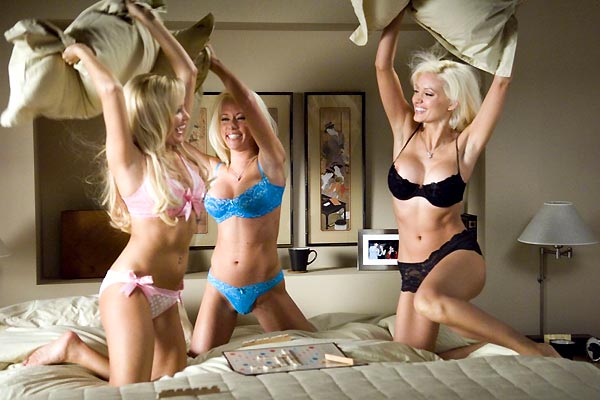
. And another 15 percent pillow-fighting.

Sold in a cardboard slipcase that houses three slimline cases and three discs (one for each lady!), The Girls Next Door: The Complete First Season
is presented in 1.33:1 full screen, with optional English and Spanish
subtitles. Bonus features include more than 50 minutes’ worth of
un-bleeped and un-blurred deleted scenes, audio commentaries with the
girls, network promos and a voluminous (though tasteful) photo gallery
.
In addition to the shock of some of these many dozens of photos
featuring the women in full clothes (including jeans!), two pictures in
particular of Hefner cracked me up. In most photos, of course, Hef has
that same dignified and extremely photogenic look — it feeds his image
as pleasant and avuncular, yet still unattainable to folks like you and
I. In one here, though, from what I presume to be a costume-themed pool
party, he has on Bettie Page print shirt and a ball cap cocked to the
side, b-boy style. In another… well, there’s no polite way to put this:
he looks like a grinning idiot. It’s the exact look you would expect on
the face of someone crashing the gates of the Playboy mansion, and it
made me laugh out loud because I think this is the first photo of its
kind that’s slipped through the steely, image-vetting clutches of the Playboy machine
.

The real… I don’t know, shock, or maybe jaw-dropping and wincingly
comedic value of the set, though, arrives in extra interview footage
with the ladies. Two-and-a-half minutes never seemed as long as it does
with San Diego native Kendra
, who talks about going to massage therapy
school a couple days a week and… I can’t remember what else. The other
ladies have a bit more life experience, so when Northern
California-bred college grad Bridget cops to it “being a great
opportunity” to be Hefner’s girlfriend in her six-minute chat
, you
clench your teeth and shake your head a bit less than you otherwise
might. Then there’s the Alaskan-born Holly, who’s apparently Hefner’s
“main” squeeze. I quote, verbatim: “This is going to be hard to
articulate because I don’t think I ever realized I was beautiful. I
think I realized I was ambitious enough to change myself into that
person, because it takes effort to be beautiful, whether it’s getting
your hair done or getting surgery or whatever.”
Guys — and I cannot
stress this enough — skip these segments. C+ (Show) A- (Discs)

The Departed’s Trailer Bows

The trailer for Martin Scorsese’s crime drama The Departed has gone live online and despite the film somewhat puzzlingly not playing at the Toronto Film Festival — the
preeminent staging ground for early fall studio Oscar hopefuls — expect
a huge promotional push from distributor Warner Bros., which I’m hearing really likes its
chances with the movie as a star-laden, overtly commercial slice of
genre pie
, despite some production overruns and editing room difficulties.

Set in South Boston, the film is of course an Americanized update of the 2002 Hong Kong import Infernal Affairs,
starring Andy Lau and Tony Leung, about at-odds twentysomethings, one
of whom is an undercover cop assigned to infiltrate a criminal
syndicate, and the other of whom is a police officer who’s really a
mole for said racket
. Leonardo DiCaprio is Billy Costigan, the undercover operative, and Matt Damon is Colin Sullivan, who feeds information to Jack Nicholson’s gangland honcho. Mark Wahlberg, Vera Farmiga, Martin Sheen,  Alec Baldwin, Ray Winstone and Anthony Anderson also star.

The accents are all ladled on pleasantly thick, the camerawork looks smooth and in constant motion, Nicholson does his trademark raised-eyebrows-and-lowered-head thing… basically,
this is a trailer that whets existent appetites and delivers upon
expectations if not completely wows, though it does achieve a certain
swooping if mannered grandeur
courtesy of its use of that Pink Floyd
tune “Comfortably Numb.” Good times. You can check it out in Quicktime by clicking here.

The Descent

I’m not sure what intelligent-design proponents would make of Neil Marshall’s horror spelunking picture The Descent,
in which slimy, bug-eyed humanoid creatures stalk a group of female
explorers whose internal strife poses almost as much of a combined
threat as these rampaging carnivores. Regardless, the movie is ample
proof that “different” and “bad” need not be mutually exclusive
descriptors
. While Stateside distributor Lions Gate is aggressively
pumping this film — which has already enjoyed a successful run abroad —
as the late summer horror entry from “the studio that brought you Saw and Hostel,” they’d be wise to hope for a quick commercial cash-in and cash-out, lest aficionados recall primarily this sloppy, unengaging film during the studio’s next cycle on the genre merry-go-round.

Filmed in Scotland but set in North Carolina, The Descent
centers on a half dozen women who reunite, a year after the tragic
death of Sarah’s (Shauna Macdonald) husband and daughter, for a sort of
athletic retreat of good, old-fashioned unmapped cave exploring. When
their entranceway collapses and traps them all underground, the
controlling instincts of hotheaded daredevil Juno (Natalie Mendoza,
above, rocking the Michelle Rodriguez part) rub some of the ladies the wrong
way. Of course, that’s not all with which they have to grapple. As they
negotiate plunging gulfs and narrow passages, it comes to their
attention that a group of carnivorous creatures is on their trail.
Split up from one another, graphic attrition ensues.

The most interesting thing about the The Descent is the
manner in which old individual grudges, rancor and guilt warp the
women’s collective survival efforts.
There is no gung-ho collective. In
fact, one heat-of-the-moment death (an accident or murder?) fuels
reprisal, and turns part of the action inwards. (Here I was reminded of
The Rock’s character of Sarge from Doom, for whom the siege
becomes a blanket excuse for unfettered vengeance.) But this is
ultimately a false emotional arc, as the women’s motivations seem
whimsical and unclear
; Juno in particular fluctuates between
earnestness and disingenuousness, and Sarah’s catharsis — however
inventive in a piece like this — is not ours.

For a movie that attaches so much significance to inter-party
bickering and subtle power plays, the dialogue is also often
stultifyingly wrongheaded
. “If there’s someone down here, maybe they
can help get us out!” exclaims a character at one point early on. Yes…
if there’s anyone else trapped hundreds of feet underground, they surely have been merely waiting for the right moment to step forward and lead others out to safety.

This is a slightly different point of comparison, but some folks blasted 1999’s The Blair Witch Project
— and decried it, a little too loudly, as not scary — because of the
jittery camerawork. I’d suggest, though, that while at times admittedly
disorienting, it certainly fit within the prescribed narrative confines
of the story. The Descent, on the other hand, is a dark and
stressed-out mess
. The movie is effectively claustrophobic at times,
but wholly incidentally so
. Marshall fails in consistently defining the
spatial relationships of his frames, none of the action cuts together
well and the final five to 10 minutes — most of what is being touted in
the trailer, not coincidentally — devolves into an orgy of eye-gouging,
skull-cracking, blood-spewing, flash-cut violence.

That finale notwithstanding, The Descent is actually fairly
restrained and mannered for much of its running time
— almost too much
so. Heartening, this deep focus on character in such a genre piece.
Still, it doesn’t change the fact that none of these characters are
particularly sympathetic, leaving the audience to root for their
demise, if only they could distinguish the action. (Lions Gate, R, 99 mins.)

Talladega Nights Set to Lap Competition

Will Ferrell’s Talladega Nights: The Ballad of Ricky Bobby is going to be absolutely huge. I caught it last night in Westwood with an all-media crowd, and it slayed. Whereas Anchorman
was hilarious but in many ways a formless blob, this movie is better plotted

and a marked step forward for scribe-turned-director Adam McKay. It
will certainly be Ferrell’s biggest opener, easily besting the $31 million bow for 2003’s Elf,
and while I don’t follow tracking gossip with any degree of regularity,
in my opinion it’s not insane to think a $50 million weekend is within
reason
. Rumor has it that Universal’s move of Accepted from August 11 to August 18 had at least something to do with wanting to give Talladega Nights another week to breathe.

The Boondocks: The Complete First Season

Aaron
McGruder’s politically charged comic strip “The Boondocks” has drawn
all sorts of acclaim as well as criticism, so intent is it on pushing
the envelope on race relations and political activism in its depictions
of a pair of boisterous African-American boys who get shipped to the
suburbs to live with their grandfather. Two-dimensionality gets a
subversive upgrade
, though, in The Boondocks: The Complete First Season, the DVD release of the Cartoon Network’s small screen adaptation of the panel.

Nominated for a 2006 NAACP Image Award for Outstanding Comedy Series, The Boondocks
centers on Robert Freeman (voiced by John Witherspoon), irascible
grandfather and legal guardian to his two grandsons — Huey, a
10-year-old leftist revolutionary determined not to enjoy the newfound
affluence surrounding him, and 8-year-old misfit Riley, a proud product
of contemporary rap culture
. Race relations, tabloid media, hip-hop
mores, graffiti art and the angst of to-scale capitalism are all
touched upon in these outrageous half-hour narratives.

“The Garden Party” centers on Granddad’s perpetual paranoia that
Huey and Riley will embarrass him in front of their new neighbors,
while “Guess Hoe’s Coming to Dinner” finds Granddad scoring a date with
a beautiful young woman, only to find out she’s a prostitute. In “Let’s
Nab Oprah,” Huey angles to stop Riley and a gang of ne’er-do-well
idiots from kidnapping the titular talk-show queen. The coup-de-grace,
though, may be “The Trial of R. Kelly,” in which Huey rants of the
R&B singer’s underage accuser of sexual molestation, “She saw piss
coming and stayed. I saw piss coming and moved. So why should I miss
out on the new R. Kelly album?”

Staying mostly true to the panel, the series’ animation style is
best described as a sort of minimalist collision of Japanimation and
spiky, urbanized attitude
— with big, expressive eyes, sparsely
rendered backgrounds, angular forms and an abundance of forced
perspective. The juxtaposition of this style with this content is
initially jarring, but, visually speaking, it’s rather hypnotic.

It’s undeniable, too, that while a bit of it is shock for shock’s
sake, McGruder’s writing touches a nerve and explores topics and arenas
left wholly un-tread by most modern comedy
. Like Chappelle’s Show, The Boondocks
turns a sharp and sometimes critical eye on minority culture, as in
“The Return of the King,” which finds Martin Luther King, Jr. returning
to the present day, shocked at what’s become of the civil rights
struggle. In what may be uncomfortable for some, the series also gets
much mileage from the word N-word, exploring the unnecessary escalation
of conflict in what it terms “nigga moments.”
(McGruder notes that “six
out of 10 ‘nigga moments’ involves a sneaker,” and he rates them as the
third-leading cause of death among black males, behind pork chops and
FEMA.) Some of this is quite funny in its skillful level of honed
satire, but also delivered tellingly at a specific audience subset,
which thus makes McGruder’s claims that the show “isn’t about trying to
change people’s minds politically or socially” a bit disingenuous
.

Packaged in three slimline cases in turn housed in a cardboard slipcase, The Boondocks: The Complete First Season
runs approximately 300 minutes in sum total, and is presented in a
crisp, 1.78:1 widescreen transfer with an English language stereo track
and optional English subtitles. Special features include a variety of
both audio and video episodic commentaries by McGruder and the show’s
creative team, and a superb 21-minute behind-the-scenes featurette that
delves into the strip’s leap to the small screen
. If we unfortunately
don’t get an extremely clear sense of the writing collaboration here,
everything else is illuminated, though I certainly would have liked
more material with Regina King, who voices both Huey and Riley. Other
supplemental extras include a collection of three deleted scenes, 10
minutes worth of cobbled together animatics, four minutes of unaired
television promos and five printable storyboards
. While I’m not buying
McGruder’s strategy of under-the-radar analysis avoidance, the show is
provocative and engaging while not sacrificing its comedic instincts. The Boondocks definitely isn’t for all tastes, but this is a finely produced set for anyone inclined to give it a look. B (Show) A- (Disc)

Prison Break: The Complete First Season

I first tuned into Prison Break
last August, I’ll be honest, not because of Fox’s ubiquitous promos or
the fact that Brett Ratner was a producer and helmed the pilot episode,
but because I was a huge fan of Don Siegel’s 1979 film Escape From Alcatraz,
starring Clint Eastwood. For some folks it’s submarine movies, for some
it’s Mob thrillers; me, I’m smitten by all the labyrinthine,
clandestine planning of a nice jailbreak
, so the idea of turning that
conceit on its head by having a guy break into a prison seemed a fairly inventive and intriguing one, right up my alley. That view wouldn’t last the full season, though.

While
most inmates would do anything to get out of Fox River Penitentiary,
structural engineer Michael Scofield (a steely-eyed Wentworth Miller)
has made it his business to try to get in. Believing his brother
Lincoln Burrows (Blade: Trinity’s Dominic Purcell) has been
sentenced to jail die for crime — the murder of the Vice President’s
brother — that he did not commit, Michael concocts a scheme to save him
from the inside out. Armed with prison blueprints — tattooed in code
all over his body — and an impossibly intricate escape plan, Michael
gets himself purposefully incarcerated via an armed robbery frame-up,
all in order to bust he and Lincoln out. Wondering just what the hell
is going on is Veronica Donovan (Robin Tunney), Michael’s counsel and
Lincoln’s ex-flame, now engaged to another, of course.

From the get-go, everything about Prison Break seemed kind of
annoying, from Ratner’s bombastic direction and penchant for commercial
bumper flash-cuts
to the exposition-laden dialogue and notion of the
body map tattoo to (especially) Miller’s penchant for going all “Blue
Steel” in every scene
. I watched a few more episodes in regular
rotation, then tuned out. Viewing the rest of the season here in
marathon fashion is a confirmation of what little I’ve missed. While
Stacy Keach’s squinty, popsicle-stick-model-making warden, Peter
Stormare’s criminally connected inmate and an effectively slimy Robert
Knepper (who bears the unfortunately menacing nickname “T-Bag” Bagwell)
lend the proceedings some surface engagement and Tunney gamely tries to
crank up the outraged befuddlement, Prison Break seems awfully
wound up on itself. Thing is, there’s not enough gravitational pull
here to make the show’s central conceit work dramatically, and neither
is there enough pop zing to make it breathlessly fun
.

The complete first season of Prison Break comes spread out
over six discs with simple, branching menu screens, and packaged in
three slimline cases housed in a master cardboard slipcase. All 22
episodes are presented in a 1.78:1 widescreen aspect ratio, with a 5.1
Dolby surround sound audio track. Regardless of arguable merit, it’s a
nice commercial jump-off for the series, as this DVD set’s supplemental
features include audio commentaries on select episodes by Ratner,
creator Paul Scheuring and a wide assortment of other cast and crew
.
There are also promotional TV spots, the Fox Movie Channel’s “Making a
Scene” special, a nice spread of alternate and deleted scenes, and a
trio of other production featurettes that give viewers a
behind-the-scenes look at Michael’s tattoo body art, the filming
location of the Joliet Correctional Center and the like. For me, Prison Break
is all in service of a rather wan and flimsy political conspiracy arc,
something we’ve seen handled before, and frequently much better. For
others, though, there might be some modicum of pleasure in the
willfully murky plottings. C- (Show) A- (Disc)

Ratings Updates Help Kids Track Nudity… or Sad Lack Thereof

In random but recent ratings news, the Motion Picture Association of
America’s Classification and Ratings Administration bestowed a PG upon Rocky Balboa,
the who’re-ya-foolin’-with-that-title sixth film in Sylvester
Stallone’s pugilistic franchise, for “boxing violence and some
language.” Rated PG-13 were this fall’s All the King’s Men (“for an intense sequence of violence, sexual content and partial nudity”) and DOA: Dead or Alive (“for pervasive martial arts and action violence, some sexuality and nudity”) and next winter’s Ghost Rider (“for horror violence and disturbing images, including flaming heads”).

OK, I made that last part up, but has anyone else noticed that the
print poster explanations for movie ratings are often hilarious in
their completely earnest, poker-faced straightforwardness?
If I were a kid today, I’d be scouring those for help finding big screen nudity. It was also
confirmed that  Martin Scorsese’s remake of Infernal Affairs for Warner Bros., The Departed,
will be rated R for “strong brutal violence, pervasive language, some
strong sexual content and drug material.” Yep, that sounds about right
for a Scorsese crime picture.

Route 66: The Ultimate DVD Collection

Certainly
driving semi-leisurely cross-country today takes a certain type of
spirit, but it’s still a markedly different one than in times past.

Back before short-distance air travel became ubiquitous and interstate
driving more drab and impersonal, there was Route 66 — a lively swath
of freeway that cut its way 2,000-plus miles across the United States,
and into the imagination of many who would travel it. Route 66: The Ultimate DVD Collection takes a look back at that time and that road.

Produced and directed by Christopher Lewis and hosted by best-selling author Michael Wallis, Route 66
consists of a trio of hour-long titles spread out over three discs, and
collectively delves into both the history of the highway itself and the
back stories of literally dozens of small towns through which it runs
and intersects
. These are basically hosted travelogues, but Wallis and
his photographer wife, Suzanne Fitzgerald-Wallis, are the authors of
the exhaustively researched 1990 tome The Mother Road, and ergo their expertise and corresponding abundance of anecdotes are put to good use here.

This summer’s animated hit Cars partially delved into the nostalgia attached to a seemingly slower time, and Route 66
is certainly no less enamored with what it peddles almost wholly as
halcyon days gone by
. In fact, this is where the title grinds down a
bit and loses its natural energy, so pompous and sometimes overly
theatrical an orator is Wallis. Those predisposed to historical yarns
will be naturally enthralled by stories of the many small Oklahoma
towns — Clinton, Foyil and Dumark, among them — that Route 66 bisects,
as well as all the other big cities, from Chicago and St. Louis to
Albuquerque and Los Angeles. But he can come off as a bit pretentious,
particularly, say, when waxing about the spilled blood of striking
Kansas coal miners in the 1930s.

Route 66: The Ultimate DVD Collection comes packaged in a
double-wide Amray case, with a separate tray for each of its three
discs. The programs are presented in 1.33:1 full screen, with a Dolby
digital 2.0 stereo audio track that provides decent if somewhat
under-mixed range for the title’s relatively sparse needs — this
certainly isn’t the release to which to calibrate your sub-woofers. The
supplemental extras include a photo gallery of images
taken by
Fitzgerald-Wallis — especially great for those who’ve only flown over
vast stretches of the country — plus a pair of nine-minute interviews
with both she and her husband. There’s also a seven-minute chat with
director Christopher Lewis and his wife Linda, who detail their own
trip on the road in a 1972 Super Beetle convertible, thrown rod and
all. For those who really dig Americana and all its dusty nooks,
crannies and interstices, a set like this is a godsend. For those, on
the other hand, looking for a more streamlined and succinct history of
Route 66, this title is unfortunately a bit too meandering and
dawdling. C (Movies) C (Disc)

On Superman Returns and… Gay Marriage?

I know it seems a bit belated to still talk about Superman Returns — after all, it slipped out of the top 10 and was out-grossed by The Devil Wears Prada
last weekend
, despite playing in 200-plus more theaters — but I had
another friend catch the movie (and be disappointed by it) this past
weekend, which got me thinking about it again.

The subject of the sexuality of this reborn iteration of the character of Superman and his status in the gay community has been covered to death — and quite well, too — in a variety of major media pieces, from The Advocate’s cover feature, which got the ball rolling, to stories and interviews in Newsweek and Los Angeles Times. But one un-discussed angle to me — and this is a spoiler alert — lies in the shaping of the film’s narrative by director Bryan Singer, himself openly if quietly gay.

With only a bit of an intellectual leap, the story can be read on
one level as an extended rhetorical response to the ongoing debate
about gay marriage
. After all, Superman Returns is a movie about an “alien” trying to find rootedness in mainstream
society, and doing so largely by pursuing placement within traditional
familial structures. In the real world, many homosexuals have lobbied
to be part of the institution of marriage, which should delight
cultural conservatives who purportedly value above all else the
sanctity of a settled family unit. Of course, then the debate becomes
about parsing the definition of marriage
, and homosexuals find out that
for some who oppose gay marriage — not all, but a decent percentage — it’s more about artfully
politically manipulated prejudice than “lifestyle choice.”

In Superman Returns, after years of having given mightily of himself, Superman tries to
reconnect with his kind, only to find he really can’t go home again. He
then returns to Earth, reengages the hegemonic culture and realizes —
despite the binding revelation that Lois’ son is his as well — that he
can never truly be one of them. Though, in his parting words, he’ll
“always be around,” Superman will always exist apart — celebrated by
many, but still vilified by some — from the mainstream. This isn’t the
dominant storyline by any stretch of the imagination, but it plays in
several of Brandon Routh’s more ruminative scenes, including the
finale.

On another tangent, while coming from an additional friend who really, really didn’t like Superman Returns (“Elektra was better because at least its badness was only 90 minutes,” he said —
ouch!), I think he did have an excellent point in that the filmmakers
blew a chance to tie together the rationalizations of Lex Luthor and
Lois Lane on the issue of why the world don’t need Superman — that
relying on Superman makes it all too easy, and thus strips us of human
struggle and identity
. Luthor always suspects Superman of ulterior
motives, and that paranoia and suspicion feeds part of his own desire
for conquest. If would have been interesting to see Luthor try, however
foolhardily, to recruit Lois to his point-of-view, and then have that
legitimately feed her burgeoning awareness that maybe Superman isn’t
such a bad guy to have around. Heck, it might’ve even given Kate Bosworth something to do except be awful…

The Ant Bully

The Ant Bully, an
intermittently sweetly moralizing but rather lackluster and ramshackle animated
tale of shifted perspective in which an adolescent in shrunken to the same size
as the ants in his front yard.

Visually, the movie recalls a bit the angular precision of Antz, though a duplication of that 1998 film’s
$91 million domestic box office seems farfetched, particularly coming on the
heels of the well received, fellow animated offering Monster House, which will enjoy better word-of-mouth and engage a
broader potential audience. A more likely final domestic tally for The Ant Bully seems to rest in the $45
to $70 million range, as the film isn’t of the type that will markedly cross
over to the same young adults who partially comprise the audience for Pixar’s
successful efforts. The Ant Bully’s
simultaneous opening in the 3-D IMAX format will certainly offer niche moviegoers
a uniquely immersive perspective on its titular protagonist’s journey and help
Warner Bros. achieve additional replay value at those outlets, while a well
recognized voice cast should likewise help the film establish more credible
commercial inroads internationally.

The film’s story centers on Lucas Nickle (well voiced by Zach Tyler
Eisen), a bullied, diminutive 10-year-old who turns his aggression on the ant
hill in his front yard. To these ants, including wizard ant Zoc (voiced by
Nicolas Cage) and his kindly girlfriend Hova (voiced by Julia Roberts), Lucas is
known simply as “the Destroyer,” and his wanton devastation of their home environment
must stop. To this end, Zoc concocts a special potion.

Shrunken down to the ants’ size after his parents leave for
the obligatory vacation, Lucas fitfully joins their world, and is sentenced by
the Ant Queen (voiced by Meryl Streep) to live and work in the colony as one of
them. There he finds a landscape teeming with heretofore unseen perils, and Lucas
slowly comes to appreciate the value of teamwork before, as in the recent
DreamWorks hit Over the Hedge, having
to wage war against an overbearing exterminator (Paul Giamatti), who in this
case previously conned Lucas into signing a contract with him.

A few adventure set pieces — including a dragonfly siege of
the ants and a foray into Lucas’ house in an attempt to cancel exterminator’s
appointment — offer up some excitement in their canted perspective. Young Eisen, meanwhile, gives able voice to Lucas’ frustrations and
petulant mood swings, proving — as with the cast of Monster House — that age appropriate voices are often better
anchors for animated fare than a high-profile name merely for name’s sake. Cage, too, has a blast, injecting a few mild trademark
eccentricities into his role as Zoc
.

Overall, though, The Ant Bully lacks the sort of smart,
whimsical, freewheeling, grand-scale collision of worlds that its premise might
on the surface suggest
. Its story is actually fairly insular. The movie sets up and then
drops the ball on any number of details, including the differences in
personality between scouts and foragers in the ant world, which might make for
rich comedic fodder, relying instead on a few broadly sketched character types.

The real problem, though, boils down to The Ant Bully’s rather indistinct mix of logic in the action on
display. This includes some real and practical elements, some fantastical bits (ants
hang-gliding on flower petals) and some wholly magical fragments, all of which commingle
haphazardly depending on whatever is convenient for a particular scene. Zoc’s
magic — which includes the potion that shrinks Lucas and a staff from which he
fires a resin-type material — is never adequately explained.

Myriad other details, too — like the full-size Lucas losing
his glasses, to no repercussion, when shrunk, and the exterminator Stan being reduced
only half-size in the climactic showdown — seem off, and the rather off-putting
character of kooky, alien-obsessed grandmother Mommo (voiced by Lily Tomlin) is
puzzlingly rendered. She figures out two-thirds of the way through the movie
that Lucas has been shrunk, but neither abets his return to human size nor has
a shared moment with him at film’s end.

Visually, The Ant
Bully
is pitched toward a young-skewing audience, and generally engaging
and successful on this level, but hardly revolutionary
. Director John A. Davis
places an emphasis on retaining a broader color palette, but the film’s
backgrounds aren’t as deep and chock full of detail as similar outdoors efforts
like Antz, A Bug’s Life or Over the
Hedge
, and the angles likewise aren’t frequently as provocative in their
elicitation of scale and perspective. (Warner Bros., PG, 87 mins.)