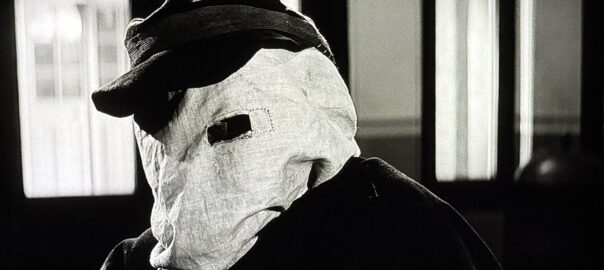
Among the rest of the bonus features, The Terrible Elephant Man Revealed, a 30-minute short doc dating back to the movie’s original 2001 DVD release, features interviews with the aforementioned Hurt, Brooks, Sanger, Francis and Tucker. It offers good overview of the film’s path to the screen (Brooks is an especially winning presence, no surprise), but a fair amount of the information and anecdotes are also contained elsewhere herein.
Joseph Merrick: The Real Elephant Man, running just under 20 minutes, is a mini-doc built around a 2005 interview with Jonathan Evans, the archivist at the Royal London Hospital Museum. He’s quite knowledgeable (obviously) about Merrick but also the Victorian era, so his perspective lends valuable context to both the subject’s life and its intersection with society at large. In a very pleasant, judgment-free manner, Evans talks about changes made for the sake of dramatizing the story (including the fact that Merrick actually approached a circus sideshow himself, as a way to make money), and also details fascinating but as of yet unsuccessful attempts to identify by way of DNA testing the specific disease(s) afflicting Merrick. A passing but curious mention of Merrick’s sister leaves one wanting a bit for further exploration, but this is still a very interesting watch.
Running thirteen-and-a-half minutes, Skintricks serves up excerpts from a same-named Dutch television film, originally broadcast on June 5, 1988, featuring interview material with Hurt and make-up maestro Tucker. This is a solid chat, as the pair trade anecdotal volleys detailing the technical difficulties of applying 22 different parts for the facial prothetic, which took from 5am to 12pm during the one-day-on/one-day-off shooting schedule that comprised the bulk of the movie’s production, and found Hurt limited to a raw egg and orange juice mixture (sipped through a straw) for most of his in-costume days. Tucker talks about not being able to make and hide edges for the prosthetics around Hurt’s neck, having to cook new pieces every day, and using a very strong surgical adhesive to hold the material. Hurt reflects on economizing his movements during the day to make the make-up last, and jokes that suicide would have been in order if the production was a TV show that required multiple seasons. Most awesomely, Hurt and Tucker actually pull out and try on some of the elements of the prosthetic head, lending demonstrative example to the anecdotes.

Running around 12 minutes, Clapper Board: John Hurt, from November 1980, finds the actor enjoying a cigarette during an interview with Chris Kelly. Hurt talks charmingly about the atmosphere in the room upon first meeting for the project, with Brooks present, the movie’s make-up (of course), and some of the particulars regarding its rehearsal. Again, there’s a bit of overlap here, but the highly conversational replies, combined with Hurt’s candor and lack of polish, make for a refreshing and engaging watch.
A Conversation with David Lynch, conducted (offscreen) by filmmaker Mike Figgis, is by far the strangest inclusion to this set, only because the interview occurred on November 28, 2006 and doesn’t really touch on The Elephant Man at all. Instead, Lynch sits in a dimly but evocatively lit hallway of the Hotel Centrum in Lodz, Poland, and shares thoughts on ideas as fish, the “action-reaction process” of artistic creation, and how painting (in his opinion) possesses a real value in destroying in order to find a way forward. He also, quite naturally given the time period, talks about his embrace of digital photography and technology, and 35mm celluloid being dead to him. This chat is very watchable in large part because it’s more of a peer-to-peer thing, and Lynch is quite clearly extremely relaxed and in a good mood. Still, it feels like this featurette would be more at home on Criterion’s Inland Empire release.