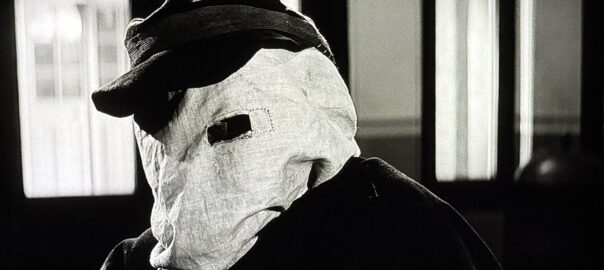
Hurt also recalls feeling a bit nervous when, three or four months after shooting, he made a phone call inquiring about its editing process and was told, “Well, there’s a film in here somewhere.” Among the most memorable reflections, Hurt talks about always knowing that the scene in the “ghastly, pompous, Victorian urinal” would be the rawest moment in film, because in his view it was the first and only time Merrick’s emotions take control over him. Hurt wraps things up by telling a well-traveled but nevertheless winning anecdote about his apartment getting broken into some years later and a bust of the Merrick cranium (which he had kept) protecting him from a would-be robbery by apparently tumbling out of its resting place at the top of his closet and frightening away the interloper.
A 25-minute interview with Lynch, also from 2009, finds the filmmaker reminiscing about writing Ronnie Rocket during the period after Eraserhead, finishing the script in 30 days, and ultimately finding no luck in securing financing for his planned directorial follow-up. Needing money and thinking that it may not be a bad idea to try directing someone else’s screenplay, Lynch met up with Stuart Cornfeld, a producer and fellow AFI Conservatory graduate, to talk about four scripts. Immediately upon hearing the title of The Elephant Man, “a small bomb went off in my head,” Lynch relates; reading the actual script only confirmed his instincts. Lynch then goes on to share anecdotes that hardcore fans will of course find fairly familiar, including executive producer Mel Brooks’ reaction to the special screening of Eraserhead (“You’re a madman, I love you! You’re in!”) that was set up in order to approve him as director. Lynch also talks about loving the look of Jack Cardiff’s period drama Sons and Lovers, shot by cinematographer Freddie Francis, and flipping a coin to decide between Francis and another highly regarded top choice to shoot The Elephant Man; when Francis lost, Lynch says he and producer Jonathan Sanger looked at each other for a beat and realized, “No… it has to be Freddie.”
Perhaps most touching, however, are Lynch’s reflections on a component of the film that very famously did not work out — his own attempts at working up make-up and a full-body prosthetic for Merrick in a Wembley garage during the film’s preproduction in the summer of 1979. Recalling the end of this period as “four very, very dark days when I thought I would be fired off the film,” Lynch talks about having nightmares and then waking up during these days and finding real life was so much worse that he wished he could go back into the nightmares. The hindsight-benefit of the film’s success and Lynch’s present-day stature, yes, give these bits some smile-inducing levity, but Lynch’s straightforward recounting is also a big part of what makes them so charming — he doesn’t try to gussy them up, or obfuscate about how devastated and riven with anxiety and uncertainty he was at the time.
A 25-minute interview with the aforementioned Sanger (who, it should be noted, penned an excellent book on the film’s journey to the screen, 2016’s Making The Elephant Man: A Producer’s Memoir) comes from a 2018 BFI Southbank event with Ian Haydn-Smith. In it, Sanger recounts first receiving the script by way of his babysitter at the time, whose boyfriend had co-written it; after optioning it, he was thinking of targeting Alan Pakula to direct, before meeting up with Lynch. Sanger reflects a good deal on the same arduous make-up process, and Hurt joking, “I never thought anyone could take away the pleasure of working on a movie, but you guys have done it.” Some of these stories, like the incredible tale of borrowing the actual real-life plaster body cast of Merrick from the Royal London Hospital Museum and Archives, are repeated elsewhere, but still interesting to hear in a bit more fleshed-out form here. Other tidbits are a lot more unique — as when Sanger shares information about the decision to do no dubbing on Hurt’s voice track, or talks about co-screenwriters Eric Bergren and Christopher De Vore cameoing in the film as street musicians, behind an instrument that Lynch (of course) built especially for the movie.
The final interview, with stills photographer Frank Connor, dates from 2019 and runs 25 minutes. After a bit of career tract reflection, Connor talks about shooting photos entirely in black-and-white, to match the project, and Hurt having Connor blow up an image of him in character as Merrick on his bed at the film’s end to give to everyone as a gift at the end of the shoot. Connor’s reminiscences about the project, and everyone being all-in for it, are exceedingly positive, and their occasional nonspecific nature is easily counterbalanced by the fact that his perspective comes from a production occupation so rarely platformed. Connor also recalls Lynch becoming very enthusiastic about the quality of his work once Lynch got around to seeing it in full, after discharging the rest of his responsibilities.
