So a man, Frederick Evan Young, dressed as Chewbacca from the Star Wars movies was arrested this past week for allegedly head-butting a tour guide operator in front of Grauman’s Chinese Theater, it’s being reported by Showbuzz/CBS. Even better? When initially asked to stop harassing two young Japanese tourists for money, he supposedly exploded and said, “Nobody tells this wookie what to do,” which I guess is the catch-all, let’s-throw-down loser phrase for Star Wars fans clad as Chewbacca, much like “Do you know who I am?” for celebrities, and “You think you’re better than me?” for drunks and/or rednecks.
I’ve lived in Los Angeles a decade now, and some of these characters — performers is too generous a designation, actually — are the saddest thing around. There are a few skilled mimics or upbeat folks, shaking hands and bringing awe to little kids. But mostly it’s a bitter bunch, these people who stand around in frequently natty costumes, shilling for money. And I have seen some of them react angrily when not compensated for a picture (the origin of this incident), even of the hasty, non-posed variety. It can be aggro panhandling, with capes, boots and the like.
So nice going Frederick. Like hardcore Star Wars devotees didn’t have to catch enough crap without you giving people grade-A bulletin board material like this.
Killer Drag Queens on Dope, on Thursday, March 1, at 7:30 p.m., at A
Different Light, a West Hollywood bookstore serving the gay, lesbian and bisexual community. Billed as a camp classic in the tradition of John Waters, the film costars Omar Alexis, and tells the wild story of Ginger & Coco,
two dolls who also happen to work as contract killers. I’m not sure what’s the day job and what’s considered the moonlighting, though…
It’s a happy birthday to Jennifer Jason Leigh, who turns 45 today. You know, everyone of a certain age fondly remembers Fast Times at Ridgemont High, but then when they remember that film they think of Phoebe Cates, and that’s just not fair to Leigh. So you know what — I’m not going to hotlink Cates’ photo. There. Don’t say I never gave you anything, Jennifer Jason Leigh.
Birthday shout-outs as well to Laura Linney, who turns 43 today — and a belated anniversary to zombie maestro George Romero, who popped out of his mother’s womb 66 years and one day ago, wearing that same pair of glasses, I believe. I imagine their width made for an uncomfortable delivery…
The original grand dame of country music (with all apologies to Dolly Parton), Tammy Wynette dominated
genre charts in the late 1960s through the mid-’70s, racking up a
mind-boggling 17 #1 singles. Along with June Carter Cash, Loretta Lynn
and the aforementioned Parton, Wynette is probably one of only a
handful of classic country artists that even non-traditional fans of
her era knew and could enjoy, and thus helped pave the way for the
crossover, mega-commercial success of artists like Garth Brooks, Shania
Twain and The Dixie Chicks.
Recorded live at the Church St. Station Theatre in Florida — a venue where Johnny Cash once debuted “Ring of Fire” — this hour-long concert disc’s complete track listing is as follows: “Welcome to My World,” “Another Chance,” “Womanhood,” “Fairy Tales,” “When the Grass Grows Over Me,” “Til I Can Make It On My Own,” “Your Good Girls Go Bad,” “D-I-V-O-R-C-E,” “Stand By Your Man,” “Crying in the Rain” and a more spiritual-tinged medley of “Amazing Grace,” “I’ll Fly Away” and “I Saw the Light.” It’s a strong collection, to be sure, but notable as much for some of its exclusions as the songs that make the cut. I personally would have liked to have seen (and heard) “The Ways to Love a Man,” “Singing My Song” and the underrated “My Elusive Dreams” (her first chart-topper, from 1967) swapped in, probably for “Fairy Tales” and “Womanhood.”
These nitpicking details aside, this release is a fairly superb introduction to the bittersweet and reflective tones and tunes of Wynette, who passed away too soon in 1998, after years of health complications. The late-in-show medley is fantastic, and Wynette doesn’t shortchange crowd favorite “Stand By Your Man” — she still locates a genuine depth of feeling in the song that’s heartening and remarkable. Tammy Wynette: Greatest Hits Live comes with a 5.1 surround sound audio mix, and is presented on a region-free disc suitable for worldwide play. There are no DVD bonus features. B+ (Concert) C (Disc)
Another tangential thought on film credits and touts — hitching a movie’s prospects to the pedigree of its writers, producers or director is certainly nothing new. It’s almost as old as the movie business itself. But making fun of the filmmakers’ prior credits in self-effacing, post-modern fashion is becoming seemingly the latest trend in movie marketing.
Jason Friedberg and Aaron Seltzer helped kickstart the development last year, with Date Movie, which was billed as “from two of the six writers of Scary Movie.” This was a canny realization of the opening paragraphs of any number of hack critical savagings, and a preemptive strike against the same. It took the piss out of the pooh-poohing, in other words; the film went on to gross almost $50 million Stateside and another $35 million abroad. Follow-up Epic Movie — a scatalogical recapitulation of scenes from other recent genre films, plus random digs at Paris Hilton and a rip-off of Saturday Night Live‘s “Lazy Sunday” sketch thrown in for good measure — opened atop the box office at $18.6 million last week, auguring good things for this trend of promotional self-mockery.
March’s Aqua Teen Hunger Force Colon Movie Film for Theaters, meanwhile, raises the bar even further. The trailer for the feature-length adaptation of the “Adult Swim” cartoon bills
itself as “from the first assistant director of the 2nd unit of Hellraiser
III: Hell on Earth.” It’s not bullshit, either. That would be co-writer-director Matt Maiellaro.
Wild Hogs, opening March 2. Billed as being about four guys from the ‘burbs hitting the open road, the film’s poster touts stars Tim Allen, John Travolta, Martin Lawrence and William H. Macy, in that order.
Now I know that Travolta has sullied his overall box office average (and sometimes reputation) by appearing in a fair amount of crap. And he’s also shown an occasional willingness to cede top-spot billing; in Ladder 49 to Joaquin Phoenix, for instance, and in Mad City to Dustin Hoffman. (On the other hand, he’s also taken top billing in a few films in which he wasn’t the lead, including A Love Song for Bobby Long.) But second billing to Tim Allen? Allen hasn’t had a live action hit outside of the Santa Clause franchise and, arguably, the utterly forgettable Christmas with the Kranks and the admittedly brilliant Galaxy Quest, which each grossed just over $70 million in their respective holiday frames. Is Wild Hogs‘ billing a sign of Travolta’s slippage, a concession/nod to Allen’s (perceived) appeal to the “Bubba crowd” — via his long-running sitcom Home Improvement — that would putatively support a motorcycle flick, or both? Probably more of the latter, but all I know is that the public at large has had their referendum on Allen as a robust, leading man movie star (e.g., For Richer or Poorer, Joe Somebody, Big Trouble), and they’ve shrugged their shoulders, saying, essentially, “Ehh, he’s fine for the kids, I guess.” I’m still baffled, but I’ll chalk this one up to Travolta’s magnanimity, I guess.
Because I Said So is seeing release on
Super Bowl weekend is a no-brainer, naturally. This is a chick flick
through and through, an air-quote wacky showcase of over-demonstrative maternal caring
for the Williams-Sonoma set. Still, all of its intrinsic “rightness” in demographic pandering doesn’t necessarily make Because I Said So
a good movie, even if it is studded with a few brief moments of
flighty humor. Mostly, the film feels forced (you’ll probably notice this just before the second of three dropped cakes), and its manic pacing
artificially induced. Daughters, meanwhile, will recoil in ghastly recognition and/or
irritation at Diane Keaton’s harping, voluble matriarch. For the full review, from FilmStew, click here.
It’s a happy birthday to Isla Fisher, who turns 31 today. Isla, you were a hoot in Wedding Crashers — even if you did use a body double and a hand double. In ways both broad and subtle, you captured what it is guys like about crazy chicks, even when we know they’re crazy. And in honor of fiancé Sacha Baron Cohen (one can only imagine the crazily play-acted circus sex) I’ll even include another linked picture.
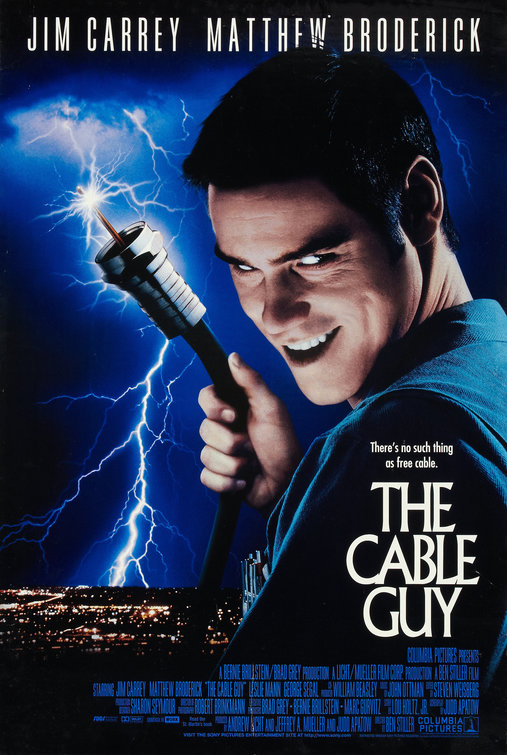
But audiences have shown a certain resistance to Carrey in darker and/or melancholic roles (no news flash there), and while this one-sheet effectively hints at the film’s R rating and conveys the surging paranoia that overtakes his character in the movie, it’s emphasis on bleak obsession and cryptic symbology sells short the movie’s investigative aspects, which actually may represent an easier path to filmgoers’ wallets. I like the image itself — the slightly agape mouth somewhat mitigating Carrey’s glazed, killer’s stare — but when I look at that poster, the three movies I for some reason quickly think of, in no particular order, are The Grudge, Conspiracy Theory and, believe it or not, The Cable Guy. If The Number 23 underperforms, expect the typical boobirds to come out (however undeservedly) regarding Carrey’s dramatic efforts, and the advisability of selling such a film chiefly on his visage.
You know what I’m really tired of? Friggin’ architects. I
mean, does anyone out there really know an architect? And before you say, “You’re so full of shit, Brent. My dad’s actually
an architect,” is this the same father that lives in a neighboring state but
hasn’t seen you in 12 years, and once told your mother to “give you a cut” of
his monthly alimony check for your Christmas gift? I rest my case. Dude is
probably not an architect. “Pharmaceuticals redistribution manager” is more
like it…
Not to be impolite, but architect is one of those
bullshit jobs that Hollywood screenwriters seem to lazily trot out when they need some hot-shit occupation to
attach to a desirable young guy who, golly gee, at his core really wants to settle down and
have a family, or is already a nice young family man. When lawyer has a bit too much of a negative occupational
connotation for your protagonist, doctor is a bit too pointy-headed, and
advertising executive is a bit too in danger of puncturing the movie’s
entertainment value, architect is seemingly settled upon as the perfect
white-collar big screen job (see Adam Sandler in Click, Luke Wilson in My
Super Ex-Girlfriend, et al). It’s professional and lucrative — even vaguely
scholastic — but its day-to-day specifics seem to dance beyond our
intellectual grasp, and you never see any one of these characters do something related to their job except maybe deliver a passing line of dialogue about the “sleek angles” or open spaces of an area. If you believed the movies and television, 75 percent
of us are cops, lawyers, doctors, forensics investigators and architects.
The incidental trigger for my rage comes in the form of this
week’s Because I Said So, in which Tom
Everett Scott’s somewhat rakish, entrepreneurial architect competes for Mandy
Moore’s affection with a guitar player played by Gabriel Macht. He easily wins
over Moore’s mom (Diane Keaton),
but the moment he reveals his occupation, you know that he’s a shit-heel in
waiting. Well… because of how that occupation doesn’t jibe with Moore’s
creative catering business, as well as the fact that he answered a mother’s
personal ad for her daughter, went along with contrived meeting with said
daughter, entered into relationship with said daughter, and never saw fit to
tell said daughter about the truth behind their meeting… though of course he (sort
of) tells his own mother. Idiot
architect…
I’ve mentioned my career advice for the perfectly pouty Estella Warren previously, so imagine my pleasant, surging optimism when I first heard that she was headlining an independent movie which posited her as the object of romantic attention between two guys. Then imagine my disappointment when I found out it was Her Minor Thing, a PG-13-rated romantic comedy about a 25-year-old virgin who gets “outed” on television by her reporter boyfriend, and then ends up falling for his cameraman.
No, no, no, Estella. This simply will not do. With all due respect, even as a largely unknown commodity as an actress (outside of that faithful contingent of Kangaroo Jack fans) you’re far too va-voomish to be playing misunderstood Everygirls who’ve had their hearts continuously trampled upon or randomly broken out with the chickenpox when they tried to physically consummate a relationship. This works for you no more than it would for Angelina Jolie. It’s ridiculous, I’m sorry to say. You need to go the sexpot route, honestly. Like, all dangerous and noir-y.
While waiting for the brilliance of my advice to be borne out, though, fans of good-natured romantic trifles could certainly do worse than Her Minor Thing, in which Warren plays Jeana, a young woman whose life gets turned upside down when Sacramento reporter Tom (Michael Weatherly) — outwardly sensitive but naturally also an inveterate womanizer — reveals her secret on the air, before he knows he’s being broadcast live. Of course, this in turn feeds consternation and drama, and while Jeana and Tom initially stick together, she slowly finds herself attracted to cameraman Paul (Christian Kane, above left).
Directed by Charles Matthau (son of the late Walter, and helmer of the underrated The Grass Harp), Her Minor Thingbounces along harmlessly, no better or worse than one’s expectations of it heading in. Attempts to give Warren just a pinch of physical comedy are wince-inducing (sexpot, Estella, sexpot!), but Kane and Weatherly give nicely rooted performances and supporting players including Rachel Dratch, Victoria Jackson, Kathy Griffin and Ivana Milicevic are on hand to keep the proceedings relatively lively.
Presented in widescreen, Her Minor Thing comes with Dolby digital 5.1 and 2.0 stereo English language mixes, and optional subtitles in English and Spanish. A lot of independent releases don’t have any bonus features, but this release hearteningly includes a 10-and-a-half-minute featurette buoyed by engaging cast and crew interviews. Plenty of love is showered on location shoot home Sacramento, and Matthau reveals himself a sardonic puppetmaster. C (Movie) B- (Disc)
The South By Southwest Film Festival has announced that the locally filmed feature Elvis and Anabelle will have its world premiere on March 10, at
6:30 p.m., at the Paramount Theater in Austin, Texas.
Max
Mingella (Art School Confidential) and Blake Lively (Accepted) star as
the titular characters, a mortician’s son and town beauty queen, respectively. The film tells the story of “an unlikely love that blossoms between
[the pair] after she dies,” which I sincerely hope involves neither necrophilia nor you-just-gotta-believe enchantment. Mary Steenburgen, Joe
Mantegna and Deadwood‘s Keith Carradine round
out the supporting cast.
Elvis and Anabelle was shot in and around Austin in May, 2006, making SXSW the
natural fit for the world premiere, according to producer Carolyn Pfeiffer. “We’re delighted to premiere a wonderful hometown film at an
outstanding hometown festival,” she said. “South
By Southwest, which always draws tremendous audiences, is truly a great fit
for the film.”
Schindler’s List and Saving Private Ryan to Clint Eastwood’s Oscar-nominated Letters from Iwo Jima. But what of
the first great battle to end all
wars, World War I? Set against the backdrop of embryonic aerial warfare and
infused with a healthy pinch of cross-cultural romance, Flyboys attempts to remedy that indistinctness in modern-day
filmmaking.
Inspired by the true story of the legendary Lafayette
Escadrille, the movie is set in 1917, when the Allied powers of France, England, Italy and
others were on the ropes against the German juggernaut. While millions of young
men were dying overseas, the United States
remained, officially at least, out of the fray. Still, some altruistic young
Americans disagreed with this nonintervention, and volunteered to fight
alongside their counterparts in France.
Of these conscripts, a handful decided to learn how to fly, and became part of
the aforementioned air corps.
Offering up a fictionalized ensemble around this juicy non-fiction
tidbit, Flyboys centers around headstrong
cowpuncher Blaine Rawlings (James Franco), who after a brawl leaves behind his
family’s foreclosed ranch a step ahead of the law. In France,
he joins, among others, rural Nebraskan William Jensen (Philip Winchester), New
York blueblood Briggs Lowry (Tyler Labine) and black
expatriate boxer Eugene Skinner (Abdul Salis). All are eager to learn how to
fly, but their romanticized sense of adventure, however, quickly takes a hit when
their war-weary French captain, Monsieur Thenault (Jean Reno), and an equally battle-scarred
American pilot, Reed Cassidy (Martin Henderson), who’s the cynical sole
survivor of his group, show them the grim realities of their equipment and
circumstance.
The new recruits quickly train, and learn what they can on
the fly (no pun intended), but are quickly thrust into the heat of battle. Blaine,
meanwhile, concurrently falls for rural French girl Lucienne (iridescent
newcomer Jennifer Decker). There are good times and bad — including the looming
prospect of a mole in their midst — but in time the young Americans prove
themselves, routing the “Fokker scourge” and learning the true meanings of fraternity,
courage, love and tolerance.
With a variety of replicas and rented vintage aircraft, Flyboys represents the biggest mobilization
and fleet of World War I aircraft since Howard Hughes’ Hell’s Angels, and over the course of its 138-minute running time
it presents a variety of dogfights, a massive shootout involving a German
zeppelin, all manner of bombed-out locales, rainy weather and a pet lion (don’t
ask). Still, Franco gives the film a human anchor, and provides a rooting
interest in the more intimate dramatic scenes. He and Decker have a nice,
playfully naïve chemistry, and director Tony Bill — who made his mark as a
producer on The Sting in 1973 and has
since juggled a career both in front of the camera and behind it as a director
in film (Untamed Heart), television
movies (Harlan County War) and serial
television (Felicity, Monk) — does a good job of weaving
together all these disparate threads into something that’s greater than merely the
sum of their parts.
Housed in a regular Amray plastic case, Flyboys is presented in 1.85:1 anamorphic widescreen, to preserve
the aspect ratio of its original theatrical exhibition. It also comes with a plethora
of discrete audio options — English language Dolby digital 5.1 surround sound and
5.1 DTS tracks, plus complementary French and Spanish Dolby surround sound
tracks. Nice use is made throughout of both aural shading and effects,
particularly in the aerial battle sequences. Optional English and Spanish subtitles
are also available; Francophiles are on their own, though the native setting
certainly helps in a few scenes, including an awkward-cute flirtation between Blaine
and Lucienne. The transfer is quite solid, with extremely little grain and no
problems whatsoever with artifacting.
Strangely, the only supplemental feature is a feature-length
audio commentary track with Bill and producer Dean Devlin. Given their intimacy
in mounting this $60-million, independently produced project against great
odds, these two are a comfortable pair, and this guided chat benefits from their
familiarity. They talk about everything from the scripting process and the arduous
development track of the film to Trevor Rabin’s sweeping score, done on a
budget. They effortlessly cram in all sorts of fascinating period trivia and
production detail, too, whether it’s on the functionality of those oh-so-dashing
scarves that pilots wore or the insurance necessary for the world’s oldest
functioning plane, a Bolerio used in background scenes in Flyboys. Would-be producers, too, are given some practical advice
regarding foreign shoots; because it was cheaper, Devlin had entire sets built
in Czechoslovakia,
and shipped abroad. The only bummer comes when the duo talks about deleted
scenes — material that isn’t included herein. A gallery of preview trailers for Copying Beethoven, The Last King of Scotland, Home of the Brave and The Illusionist closes out the disc. B (Movie) C+ (Disc)
Catch and Release, the directorial debut of Erin Brokovich screenwriter Susannah Grant, opened last week, to $7.6 million, and a fifth place weekend slotting. Starring Jennifer Garner, the movie unfolds in a rustic state of monotonously pitched pining, and centers around Gray Wheeler, who after the sudden death of her fiancé, seeks solace in the company of his ex-roommates (Kevin Smith and Sam Jaeger).
As more details about her boyfriend emerge — information involving a
healthy secret bank account, a Los Angeles massage therapist (Juliette
Lewis) and her son — Gray comes to see new sides of the man she thought she
knew, and at the same time finds herself drawn to his childhood pal Fritz
(Timothy Olyphant).
You feel trace elements of a
fuller ensemble character study about grief, but the characters herein — the
inveterate playboy with the hardened heart, the stoic secret crush, the ditzy single
mother — are reduced to thinly sketched functionaries, and behavioral
rationalizations big and small consistently feel a step off. For the full review, from CityBeat, click here and scroll down.
It’s a happy birthday to erstwhile Twin Peaks temptress Sherilyn Fenn, who turns 41 today, improbably enough. (And to my Dad as well, who — sorry, chief — is considerably less hotter…) Fenn should get together with Olivia Wilde and talk arched ‘brow acting 101.
the news last week that the Motion Picture Association of America is making crucial changes to its charter, and finally providing at least a little transparency. The move is partially shaped by Kirby Dick’s documentary This Film Is Not Yet Rated, new to DVD this week, about the Neapolitan swirl of secrecy and hypocrisy surrounding the ratings board and its secretive system of classification. While far, far from perfect, the movie is certainly an entertaining one, if also intellectually lazy.
“The reason there is secrecy is so that people can’t critique the system — that they don’t understand it and know where to begin a critique of it,” argues Dick. “I think the MPAA basically doesn’t care whether or not there’s a ratings system or not, but if there’s going to be one they want to control it, because they want to make sure that their films get the least restrictive rating, so that they can make the most money.”For the full interview/feature from FilmStew — including a tidbit about Jane Fonda’s legendarily orgasmic writhing in Coming Home, and what it might foretell when combined with the forthcoming changes in classification appeals — click here.
 will be signing DVD copies of Alexis Arquette’s new movie, <a href=) Killer Drag Queens on Dope, on
Killer Drag Queens on Dope, on 
 Wild Hogs, opening March 2. Billed as being about four guys from the ‘burbs hitting the open road, the film’s poster touts stars Tim Allen, John Travolta, Martin Lawrence and William H. Macy, in that order.
 Because I Said So is seeing release on
 The Mask,
  I’ve mentioned my career advice for the perfectly pouty Estella Warren previously, so imagine my pleasant, surging optimism when I first heard that she was headlining an independent movie which posited her as the object of romantic attention between two guys. Then imagine my disappointment when I found out it was Her Minor Thing, a PG-13-rated romantic comedy about a 25-year-old virgin who gets “outed” on television by her reporter boyfriend, and then ends up falling for his cameraman.
 Schindler’s List and Saving Private Ryan to Clint Eastwood’s Oscar-nominated
 Catch and Release, the directorial debut of Erin Brokovich screenwriter Susannah Grant, opened last week, to $7.6 million, and a fifth place weekend slotting. Starring Jennifer Garner, the movie unfolds in a rustic state of monotonously pitched pining, and centers around Gray Wheeler, who after the sudden death of her fiancé, seeks solace in the company of his ex-roommates (
 the news last week that the Motion Picture Association of America is making crucial changes to its charter, and finally providing at least a little transparency. The move is partially shaped by Kirby Dick’s documentary