The weekend is fading, and Saw III has left its indeliable stamp on the box office, perhaps at least partially the successful result of its attempted media brownout. Whatever. The judgment shall still commence. There’s less pleasure to be found in the twists herein, and director Darren Lynn Bousman’s stale stylistic mimicry (we get it, Darren, you really liked Mark Romanek’s Nine Inch Nails music video work) is reductive in the extreme. The result is dutifully depraved gore porn, hardly exciting or cathartic. For the complete review, from IGN, click here.
Category Archives: Film Reviews
Catch a Fire
 director Phillip Noyce’s Catch a Fire, starring Derek Luke (above left) and Tim Robbins, tells the story of one such demanding choice. For the full review, from IGN, click here.
Excellent Cadavers
 Excellent
Cadavers, opening this week in limited release and also available on DVD. Based
on Alexander Stille’s 1996 book of the same name — which also was the source
for a 1999 narrative feature starring Chazz Palminteri — the movie is certainly
not part of the Italian National Tourism Board’s welcoming care package, that’s
for sure.
In the beginning of 1982, there was a Mob killing “only” every
three days in
of the year, more than a 1,000 corpses had been stacked up. Excellent Cadavers focuses on hardnosed prosecutors
Giovanni Falcone and Paolo Borsellino, who led the city’s famed mid-decade
Maxi-Trials, where, from an underground bunker, more than 300 Sicilian Mob defendants
were eventually convicted in December 1987, including 19 life sentences for
mid- and high-level bosses. The resultant price, of course, was high — in 1992
Cosa Nostra struck back with hits on Falcone, Borsellino and others, after many
of the investigatory and legal innovations they had passionately argued for
were repealed or otherwise blunted, freeing hundreds.
Turco uses photojournalist interview subject Letizia Battaglia’s memories as a
child (she speaks eerily about the scent of blood) as well as a series of
extremely graphic black-and-white stills (apparently the Italians let as many
inquisitive people gather around bodies as a given sidewalk will allow) to
illuminate the ebb and flow of public acquiescence and outage. This is
eventually intercut with fascinating footage from the aforementioned trial,
interviews with current and former Italian magistrates (which is what they call
federal prosecutors) and a wide-ranging overview of the knotted and bought-off
Italian political scene.
Turco cedes too much of his movie’s pace and plotting to others (especially
early on), but makes up ground in a home stretch that includes revelations about
seven-time Prime Minister Giulio Andreotti’s wink-wink acquittal of criminal Mafia
ties due to statutory limitations and recently ousted former Prime
Minister/billionaire businessman Silvio Berlusconi’s connections to organized
crime as well.
defeat or the recent arrest of Bernardo Provenzano, a Mob boss who for more
than four decades lived in quiet “open secrecy” before recently being reeled
in, Excellent Cadavers highlights the
incentivized nature of the long-term relationship between dirty business and
equally imbedded politicos. The film opens in Los Angeles at the Laemmle Grande 4-Plex on Friday, October 27, and while it isn’t yet available for sell-through commercial release on DVD, more information can be accessed on the title through this web site.

Sleeping Dogs Lie

“Honesty,” Billy Joel once sang, “is such a lonely word.” And it’s true, especially in matters of the heart. Earlier this summer, The Break-Up mined laughs from the pathos of a genuine romantic split. The low-budget indie Sleeping Dogs Lie, meanwhile, is about the damage we do under the guise of honesty; its informal creed is that it’s trying to live up to the lies we tell about ourselves that ultimately makes us better people. Complete honesty is overrated, and something to be feared and handled with nuclear suitcase-type care. Everyone says they want it from their friends and lovers, but its weight and cost is often too much.
Shot during a two-week hiatus from his job directing Jimmy Kimmel Live, Sleeping Dogs Lie represents the third feature feature film from screechy-voiced stand-up comedian and erstwhile Police Academy stooge Bobcat Goldthwait (who was also at one point somehow married to this), and it takes a gross-out sex humor nugget, places it within the awkward, messy confines of the real world, and extrapolates forward in surprisingly effective if visually threadbare style.

“Once, when I was in college, I blew my dog,” says Amy (Melinda Page Hamilton, injecting her performance with just a touch of Renee Zellweger’s crinkle-nosed angst) in the opening moments of the movie. While we don’t glimpse the deed itself, we watch the lead-up (Amy was bored) and shameful aftermath of said act, then spring forward to Amy’s relationship with fiance John (Bryce Johnson, a sort of budget Paul Walker), who eventually pressures Amy into revealing her dark secret during a trip to meet her parents (Geoff Pierson and Bonita Friedericy). Overhearing her confession, Amy’s meth addict brother Dougie (Jack Plotnick) finally has some payback ammunition against the “perfect little angel” of the family.
Against a backdrop of other family secrets spilling forth, the rest of the film details John and Amy’s halting attempts at reconciliation, and Amy’s burgeoning relationship with coworker Ed (Colby French), a fellow teacher at her school. Will Amy be able to work things out with John, and if not, will she make the same mistake of candor with Ed?
Shot on a shoestring, the movie isn’t necessarily expertly crafted — it’s shot in sometimes jittery, too-close fashion by Ian Takahashi — but it does peddle a kind of sweet message of self-acceptance.Watching the film, I was reminded of the various stupid and petty grudges many friends and family (and myself too, I’m sure) have held against loved ones when we get an answer we don’t like. Saying you want the truth is frequently just asking for a cudgel if you don’t like what you hear. There’s the nougat of shock at the core of Sleeping Dogs Lie, certainly, but the saying that there’s a lot of truth found in jest is applicable to this twisted little tale. Maybe there’s something to that policy of “don’t ask, don’t tell” after all. For an exclusive interview with Goldthwait on the film, click here. (Roadside Attractions/Samuel Goldwyn, R, 89 minutes)
Man of the Year
 Man of the Year, starring Robin Williams, just doesn’t work. It’s
not completely a bludgeon-your-eyes-out-type flick, but it is a lot closer to
that status than it should be, given the deliciousness of its premise and the
current state of swelling public dissatisfaction with all the dissembling,
incompetence, corruption, pork-barrel handouts, war-waging and page-fondling going
on in Washington, D.C.
The movie centers around Williams’ Tom Dobbs, a Jon
Stewart-like figure and the host of a popular cable talk show that skewers
politics and current events. Fed up with the status quo, he enters the race for
presidency against an incumbent Democrat and glad-handing Republican senator,
hoping to shake things up and generate legitimate public discourse on the real
issues. This dovetails, however, with the installation of a new touch-screen,
paperless national voting system. When said computerized structure
malfunctions, Dobbs is surprisingly elected.
Williams’ shtick of improv runs is tiresome to some folks,
but he gets loose with some true winners here in the campaign trail portion of Man of the Year, dismissing the concept
of intelligent design (“You have a waste processing plant next to a recreation
area”) and hijacking a televised debate in whirling dervish fashion that brings
a smile to your face.
Levinson shoots the picture in a floating-frame, doc-photog
style in an effort to abet this offhand manner, but this backfires and makes
the entire movie seem more casual and incidental than it should be. You need a
real groundedness to counterbalance the whimsicality of some of the free-form
plot twists here, to make the story seem concrete and remotely believable.
Anyone who’s followed politics even a little bit, though,
will find their suspension of disbelief tested on occasion by the conveniences
and contrivances of Man of the Year’s
script. Watching the film, the one thought that coursed repeatedly through my
brain was, “Why isn’t more being done with this concept?”
Despite Christopher Walken’s inherent awesomeness, material
with his physically ailing Jack Menken, Dobbs’ longtime manager, falls flat,
and Laura Linney gives as unfocused a performance as I’ve ever seen from her as
Eleanor Green, a conscientious employee of the company awarded the voting
machine contract. After her admonitions of a glitch go unheeded, she’s framed
as a drug addict by her employers in an effort to discredit her (!), so she
sidles up to Dobbs — the one man she thinks can/will believe her. Awkward, halting romance ensues along with comedically flavored socio-political intrigue.
not something we’re made to care about. Certain scenes — including a breakdown
Eleanor has over a cappuccino — drag on for too long, and Levinson also surprisingly
makes the rookie mistake of revisiting thematic bits, like Eleanor’s confession
to Dobbs, that should be streamlined and surgically clean. All of this unfortunately
feeds a chief reading of the film as one mortally wounded by misappropriation of
time. (Universal, PG-13, 115 minutes)
Alex Rider: Operation Stormbreaker
Based on a series of popular English kiddie spy novels by author Anthony Horowitz, Alex Rider: Operation Stormbreaker is unfailingly polite in its efforts to woo you, and doggedly
energetic. It certainly seems to care about what audiences think, in
other words. The problem is that it’s skin deep, but ultimately not
quite as fleet of foot as it needs to be to merit or counterbalance
such cheekiness. The movie’s efforts to be hip and of-the-moment result
in a failed balancing act of tone and pitch. For the complete review, from IGN, click here.
With God on Our Side: George W. Bush and the Rise of the Religious Right

I’ll periodically here be reaching into the proverbial back catalogue and taking a look at some worthwhile off-the-beaten-path cinema in a section called Old Made New, and with the Mark Foley Congressional Page scandal exploding all around and the Republican Party’s long-held grip on morality as a political billy club seemingly waning, what better time than now to delve into With God
on Our Side: George W. Bush and the Rise of the Religious Right?
Those seeking a clear-eyed portrait of what’s been pegged as the inexorable rise
of evangelical influence on the American political machine would do well to
spend some time in the company of this utterly engrossing documentary. A
fascinating portrait of the dance between Big Religion and politics, With God
on Our Side sheds interesting light on the two big supposed dinner party topic no-nos, and
tangentially raises questions that independent thinkers of all persuasions
should be considering.
Despite its name-dropping, somewhat baiting title and opening credit
sequence, With God on Our Side is less filtered through the prism of one
man than one might expect. Its 100 minutes, in fact, are roughly evenly divided
between a chronology of the evangelical movement’s ascendancy in modern day
politics — dating back to Barry Goldwater’s resounding defeat at the hands of
LBJ in 1964, intensifying the at-that-time “moral minority’s” sense of loss, and
of the country somehow slipping away — and a look at what many insiders view as
their prodigal son, current President George W. Bush. The former portion is
actually just as fascinating, if not even more so, perhaps because its bird’s
eye view comes with some divorced distance from the sort of white hot emotional
response the current administration often provokes.
In tracking the presidential elections since 1964, and the partiality of what
was up until that time the largest tract of virgin timber on the American
political landscape, interesting patterns emerge and battle lines come into
focus — especially in the wake of Jerry Falwell’s creation of Moral Majority, a
non-denominational, politically motivated group. Particularly interesting is the
manner in which evangelicals grapple with their personal joy over Jimmy Carter’s
self-described status as a born-again Christian and the realization that, for
some perhaps, his political sensibilities were more liberal than their own.
The Carter presidency actually comes across as among the least, shall we say,
calculating or self-serving administrations to court or embrace the evangelical
bloc. Taking a realistic look at the evidence here, it’s interesting that the
evangelical Christian movement is so closely identified with the Republican
party, because time and time again there is a clear pattern of candidates and
those in governance paying a certain lip service on culturally conservative
issues only to then “abandon” or sell out (the common mass mailing rallying
cries) the stated goals and visions of those to the far right. From the
championing of voluntary school prayer — which President Reagan half-heartedly
touted exactly once before letting it be stillborn in Congress — to the cyclical
rumblings about sanctity-of-human-life or anti-gay marriage constitutional
amendments (cough, cough, Dubya?), the bait somehow remains ever fresh.
As With God on Our Side segues into its second half, then, one could
reasonably raise questions about the motivations of George W. Bush’s religious
conversion. After all, as a failed businessman and professionally adrift
man-child of entitlement, he oversaw outreach toward evangelicals in his
father’s presidential campaign of 1988, which included a bruising primary slate
against televangelist Pat Robertson. Could “#43” be nothing more than a
charlatan, a poser using religious contrition and identification as a
springboard to power? Ultimately probably not, but the movie does — almost
subtly and subliminally — present Bush as someone for whom a unique fusion of
faith and ambition occurred.
Regardless of political stripe or religious affiliation, one thing viewers are guaranteeed to come away with after watching With God on Our Side is an adjusted sense
of perspective. Current reportage may dote on a perceived evangelical rise, but
co-directors Calvin Skaggs and David Van Taylor (A Perfect Candidate)
show how it has been a consistently upward-trending force in American politics
for at least four decades now. The only thing that’s changed is an increasing sophistication and the success of the evangelical movement’s
grassroots campaign to turn out the vote in substantive blocks and affect public
discourse (if not policy) through political advocacy. Of course, they may be staging their version of a sit-in come this Election Day.
Texas Chainsaw Massacre: The Beginning

A lot of modern horror has become more synonymous with
horrifying rather than terrifying — the chief difference being the latter is
something that grips you on a base, visceral level certainly, but also provokes
significant feelings of psychological unease. The gulf between these two approaches
is roundly apparent in The Texas Chainsaw
Massacre: The Beginning, a stalking franchise prequel of near-bottomless
sadism and equal pointlessness.
into Marcus Nispel’s 2003 remake of director Tobe Hooper’s gritty,
groundbreaking 1974 horror picture, but never overwhelmed the predominant
emotion — a choking hopelessness — that made the movie so wrenchingly effective,
and feel like one big, long, coarse exhalation. The Texas Chainsaw Massacre: The Beginning, on the other hand, is
full of only desultory jump scares and abattoir torture. It doesn’t generate
genuine tension; it’s gore pornography, plain and simple.
weekend for what’s perceived as a faithful article, but with the releases of The Grudge 2 and Saw III on the horizon, it’s very doubtful that The Beginning will be able to approach
the grosses of its 2003 predecessor, which pulled in $80 million domestically
and another $26 million internationally. That film, after all, had the swelling
intrigue of a franchise reboot, as well as both an advertising campaign and
some modicum of word-of-mouth that pointed up the picture’s
based-on-true-events roots, which helped extend its audience.
margins should be smaller and more staunchly of a piece with the traditional
core horror base, meaning theatrical returns more inline with Boogeyman, The Hills Have Eyes, Hostel
or The Amityville Horror, which
collectively averaged around $50 million Stateside.
Eric and Dean (Matt Bomer and Taylor Handley), headed across the state of Texas
to report for duty in Vietnam. In tow are their respective girlfriends,
Chrissie and Bailey (Jordana Brewster and Diora Baird). An auto accident during
a would-be robbery leaves the quartet badly injured, but when an apparent
lawman, Sheriff Hoyt (R. Lee Ermey), arrives on the scene things only get
worse.
the twisted, cannibalistic Hewitt clan, which includes his disfigured, mentally
challenged nephew Thomas, aka Leatherface (Andrew Bryniarski). Hoyt takes Eric,
Dean and Bailey with him back to his house, where an unremittingly grim regimen
of torment commences. Thrown from the vehicle, Chrissie eventually makes her
way to the house with a local biker (Lee Tergesen), and tries to save her
friends.
few trivial, unifying tidbits (Leatherface was deposited in a dumpster after
his mother’s death upon his birth, and we see him craft his first titular
mask), but these morsels feel less like grand and/or illuminating character revelations
and more like arbitrary filler between torture and killings. Exactly who, after
all, has been clamoring for answers to these questions, particularly when the
explanations are so cursory?
is not a prototypal horror villain protagonist in the same sense as Friday the 13th’s Jason or A Nightmare on Elm Street’s Freddy, and
secondly, because the movie treats Leatherface as a morbid, lethal caged circus
curiosity. Hoyt is very much the central figure in the movie, calling
Leatherface out only when he needs to have him pound on and/or cut up someone.
logic and cleanly defined spatial relationships, most notably in the third act.
At one point Dean turns the tables on Hoyt, but — seemingly only since the
ending is predetermined by the survival of characters we’ve seen in the 2003
movie — implausibly doesn’t finish Hoyt off. Dean also then magically appears
during an off-site confrontation between Chrissie and Leatherface, who’s previously
shown no sort of skulking wherewithal to dispense with one victim in the manner
that he does.
antebellum junkyard palettes of Daniel Pearl, who shot the 1974 original and
its recent solid re-imagining. Composer Steve Jablonsky’s score, meanwhile, further hammers
home the obvious in offending, exaggerated fashion. (New Line, R, 89 minutes)
Employee of the Month
 Employee of the Month as eye-gougingly bad as it seems? Yes, pretty much.
And stop trolling the Internet for pictures of Jessica Simpson. Really, Melissa Theuriau is much, much hotter.

School for Scoundrels
 Jon Heder has been skating by on wan iterations (Just Like Heaven, The Benchwarmers) of his inspired turn in that movie. It didn’t even seem like he was really looking to stretch. School for Scoundrels, in which he stars opposite Billy Bob Thornton, provides the first real glimmer of possible long-term career sustainability. He plays a doofus New York City parking enforcement officer (OK, I’ll say it: meter maid) beset by low esteem, sure, but halfway through the film he grows a pair and launches into a battle with Thornton for the romantic attentions of Jacinda Barrett, who must really be thankful that Rachel McAdams isn’t working more. I hate to still give any traffic to them, but for the full review of the movie, from IGN, click here.

The Guardian
 Kevin Costner and Ashton Kutcher’s The Guardian examines the relationship between a veteran Coast Guard Rescue Swimmer and one of his headstrong young charges, each naturally haunted by their own dark secret. A potentially fresh setting and some quality FX work is counterbalanced by a dutiful insistence to hit all beats of synthetic conflict, and cram in a pointless love story as well. This is a flick for boomers if ever there were one. You can almost see the suburban dad who really loved Field of Dreams firing it up on DVD for a “date night” with his wife the weekend the kids are at the lake house with their friends. For the full review, from FilmStew, click here.
Alone in the Dark
 director Uwe Boll’s Alone
in the Dark, in a slightly redacted reworking of my original theatrical review. You will desperately need, in
my estimation, the following items for survival:
awful genre tripe
- Cash for anonymous purchase, plus hats and/or sunglasses to disguise identity (you won’t want to have this rental credited to your account)
- A considerable amount of alcohol
- Kleenex to wipe away tears of laughter
- The gene blocking the impulse of shame
From frame one, Alone in the Dark announces itself as awful with such a manic, drunken
fervor that you have to on some level
step back and tip your hat in awe to its audacity. Helmed by Boll (Blackwoods,
The House of the Dead), there is no
subtext in Alone in the Dark, only
capital-T text — writ large, bold and obvious. Every line, every moment seethes
with a brazen stupidness, from the nonsensically edited action and on-screen
flubs (I’ll give them a stay of execution on the spelling of “analysing,”
though I don’t think this is a British production and it doesn’t jibe with the
American characters) to the body armor apparently picked up at a Starship Troopers 2 yard sale and the
riotously appalling dialogue (one suggested drinking game: a swig for every
time a character says, “The readings are off the charts!”). The film is a
masterwork of awfulness, a literal and veritable bad movie blueprint, from
start (which features a comically long narrated preamble) to merciful conclusion.
The plot, as it were, details a bunch of folks as they try
to rustle up the last of a few artifacts relating to the ancient Abkani tribe.
Of course, a shampoo-needing knucklehead at the beginning of the film has
opened a precious golden arc, meaning… aw, crap, who really knows or cares?
There’s monsters. And zombie-esque human marauders. On the other side,
Christian Slater squints and shoots as Edward Carnby, a paranormal investigator
and erstwhile orphan who used to run with a shadowy government organization
known as 713, but now wears a swashbuckling leather duster and plays by his own
rules. That leaves Stephen Dorff’s equally stubbled and glowering Burke
Richards in charge of the 713 posse; along to fulfill the cleavage quota is
Aline Cedrac (Tara Reid). Pow! Bam! Zing!
Adapted from an Atari videogame by two debut screenwriters
and the writer of MVP2: Most Vertical
Primate, Alone in the Dark makes
many choices, every single one of them poor, but chief amongst the blunders is
trying to sell us a bespectacled Reid as a brilliant anthropologist. She is the
most utterly lost of a cast that phones in every crappy line with an
automaton-like indifference. They say that even ugly babies have faces their
mothers love, but this is truly a film that not even hardcore, braindead genre fans could
appreciate in straightforward fashion. As a slice of camp comedy, on the other hand…

The Brown Bunny
He’s flippin’ crazy, that irascible Vincent Gallo (sample rant from his eponymous web site: “The only impact Harmony Korine will have will be on the lives of the girls he slipped drugs to, got stoned and raped while they were passed out — an autobiographical scenario he chose to include in his average screenplay Kids…”), but one thing’s for certain: he’s committed to following his own myriad artistic instincts, down whatever rabbit holes they may lead him. I was thinking about this again when I was talking with a friend about Gallo’s uncommonly tender The Brown Bunny, so I thought I’d re-post elements of my original theatrical review.
The film is a rarity in modern American cinema — a movie about masculine neediness. This isn’t to say that the movie is an easy, pleasurable watch. Far from it, in fact. The Brown Bunny‘s pace is punishingly, defiantly slow, and it’s still generally the kind of thing that you admire more than actively enjoy, so modest are its at-arm’s-length rewards. The film stars producer-editor-director-cinematographer Gallo (who else?) as Bud Clay, a haunted shell of a man who, after a motocross race, winds his way slowly west toward Los Angeles and a damaged relationship with his waiting girlfriend, Daisy (Chloë Sevigny). Along the way he grapples, in often abstract ways, with both fidelity and loneliness.
Caring as little as Gallo does for conventional structure and pacing, The Brown Bunny is designed as much to elicit mood as anything else; de facto mini-musical videos of open road (Gordon Lightfoot, Jackson Frank) alternate and share the screen with a few loose story strands that find Bud awkwardly, casually and/or silently picking up a trio of women (Anna Vareschi, Cheryl Tiegs and Elizabeth Blake), all named for flowers, only to then just as quickly abandon them.
Much of the movie’s notoriety stems from its sexually explicit ending, and for the life of me I can’t decide whether this is bold, envelope-pushing, exhibitionistic folly or Gallo’s radical, deadpan, completely unspoken attempt to give The Brown Bunny — inarguably one of the most baldly uncommercial American movies of the past five years — an overtly sensational “hook” or selling point. The scene in question is shocking, yes, and even titillating, but also wholly inessential to the movie’s basic twist and, more importantly, emotional validation. As such it comes off as tangential sensationalism at a point when the characters’ raw emotionalism (“I wish you liked me again, like before… when you liked me the most,” says one, heartrendingly) should be ripping you in half.
Gallo, who previously directed Buffalo ’66, places a fetishistic premium on setting and place that touches rewarding and then frequently sprints right past it into tedium’s waiting bosom. With long, loooooong establishing shots and a good many passages that lack disciplined pruning, the look of the movie summons comparisons of an even fuzzier, further off-center Miller High Life commercial. Taken in sum, the preceding are evidence of Gallo’s brutal — and, in some respects, dazzlingly audacious — disregard for audience sympathy or even reaction. I’d be intrigued to see this material paired with a like-minded yet stronger directorial hand; as is, The Brown Bunny too frequently comes across as a series of accumulated mundanities rather than the racked-focus character portrait it should be. And yet there’s still a quiet, unassuming integrity and untainted throughline to the picture. The Brown Bunny certainly isn’t for the casual moviegoer, and maybe not even for most devoted film fans. Its sad, lonely portrayal of romantic resignation and arrested development, though — most hauntingly captured in Bud’s keening, high-pitched mutterings at film’s end — is something that clings to your memory like a form-fitting psychological trauma. (Wellspring, unrated, 93 minutes)
Jackass Number Two
 Jackass Number Two is as much a test of one’s own journalistic decency
standards as anything else. The title, for instance,
winkingly refers to a polite bathroom code parents use with children, so
there’s naturally a healthy spread of fecal humor. But how to describe and
explain, in print, said scenes of ingestion and decoration? Or the film’s opening
segment, involving a sheathed penis used as a puppet to entice a snake? Or the
sequence, concerning the stimulation of a horse and its imbibed after-effects,
which leads co-star Chris Pontius to (finally!) exclaim, “You know, I’m ashamed
of myself”? For the full review, from the Los Angeles Daily News, click here.
Feast
Blood, maggots, effluvium and alien vomit are all liberally meted out in John Gulager’s Feast. It’s the film that helped put a bullet in Ben Affleck and Matt Damon’s Project Greenlight television series, though, so you know it has a killer’s pedigree. The unapologetically streamlined story of a group of disparate patrons at an out-of-the-way watering hole who are set upon by rampaging (and apparently horny) marauders, Feast is a credible genre entry, blending self-aware laughs with abundant gore in a manner that surely Internet-stoked fans of Snakes on a Plane were looking for in that film. For the full review, from CityBeat, click here and scroll down.
Gridiron Gang
 Gridiron Gang,
an obviously plotted if mostly solidly conveyed, based-on-true-events
tale of urban-set uplift. In his first true dramatic role, Dwayne “The Rock”
Johnson stars as a hard-nosed juvenile detention camp probation officer
molding a group of teenage felons into a disciplined amateur football
squad, which then competes in a league against local high school teams. For the full review, from FilmStew, click here.
Grizzly Man
OK, it’s not that much of an older release, but I was talking to someone recently who had plowed through seemingly all of this year’s top-shelf documentaries, and yet somehow had missed Werner Herzog’s superb Grizzly Man, from 2005. Ergo, this re-up, originally published as part of a 2005-in-film retrospective for Now Playing Magazine on December 23 of last year:
Man, nature and the beguiling grey area in between get a workout in Werner Herzog’s mesmerizing, strangely affecting documentary Grizzly Man, which focuses on the unusual life and violent death of a self-styled grizzly bear expert and amateur preservationist.
A college washout and alcoholic would-be actor who in his 30s gave up marijuana and drink cold turkey and reinvented himself with a Prince Valiant bob and phony Australian accent (the latter eventually giving way to a high-pitched, slightly effeminate surfer patois of indistinct region), Timothy Treadwell lived unarmed in the Alaskan wilderness among bears for 13 summers, and filmed his adventures in the wild during his final five seasons. With himself as the central character, Treadwell crafted strange, idiosyncratic narratives of high confession. He would live alone for weeks and sometimes months, staging and engaging in therapeutic soliloquies, rants and imagined conversations with his animal “friends.” There’s a pained, natural beauty to this odd and startling footage — from which Herzog chiefly carves his narrative, along with fantastic music of accompaniment from Richard Thompson.
Enigmatic, alluring, personable and infuriating in equal parts, Treadwell fancied himself a fuzzy, New Age professional “protector” of wildlife. It was in October 2003, though, that Treadwell’s mutilated remains, along with those of his on-again/off-again, quasi-girlfriend Amie Huguenard, would be discovered near their campsite in Alaska’s Katmai National Park and Reserve. The pair had been mauled and devoured by a grizzly (and the attack audio-recorded), perhaps one of the very bears Treadwell so lovingly photographed.
Grizzly Man isn’t exacting as a biography of Treadwell (we don’t meet his parents and get a glimpse of his formative years until an hour into the affair, and the movie takes at face value the urban legend — seemingly testable — that Treadwell finished runner-up to Woody Harrelson for the role of Woody Boyd on Cheers), but that will come neither as a surprise to Herzog fans nor an irritation to those new to the director. In true Herzogian fashion, Grizzly Man offers up not only ruminations on the mysteries of the wild that the title and subject matter augur (in one ferocious fight, a bear even releases his bowels), and its relationship to an Earth that is no longer its domain, but also separate and distinct mysteries of human nature — what drove the flaky and yet heartbreakingly approachable Treadwell, for instance, and who was Huguenard, briefly glimpsed only once on tape?
Herzog “investigates” these questions only to the degree to which it interests his thesis that the world is a place of sustained disarray and unhappiness in which only untenable respite can be achieved. He also draws parallels — chaos, disorder and murder — between Grizzly Man and his own work, including the famously deranged production of Fitzcarraldo, and includes interviews with Treadwell’s pilot friend and the examining coroner, the latter of which may or may not be staged.
Grizzly Man seems, I know, too small and exclusive to be anything more than an ornamental pleasure, a cinematic postcard for a few. But in its concluding moments, as Treadwell works himself up into a sputtering, incandescent rage in an amazing, self-pitying and paranoia-tinged rant against the national park service, you glimpse a stranger in modern society, this world of asphalt and glass — and in its basest, most distilled form, a piece of the innate humanity in all of us. Grizzly Man is a portrait of a cracked American original, but this one man’s brokenness proves oddly and profoundly moving. (Lionsgate, R, 103 mins.)
The Protector
 Ong Bak: The Thai Warrior was a genuine cross-cultural sensation,
grossing a cumulative $10.5 million overseas and pulling in another $4.5
million via a solid spring 2005 release in the
States
including the Best Asian Film Award at the Sitges Fantastic Film Festival 2003
in
movie was a hit with both audiences and critics all over the world, attracting
legions of fans and making star Tony Jaa an overnight sensation.
for Jaa and director Prachya Pinkaew, and after an opening that doesn’t skimp
on serene evocation, it’s a relentlessly paced, 82-minute dash that will
solidify the personable Jaa’s place within the stable of far Eastern action-hero
elite, especially with Jet Li’s alleged impending retirement from such genre
fare and Jackie Chan — who cameos here in a wordless, non-action scene that
serves to pass the baton from one generation of martial arts screen star to the
next — turning 52 earlier this year.
down when a notorious Asian gang steals his family’s prized elephants. As a
somewhat hokey prologue informs us, Thai kings have for centuries rode
elephants into battle, and — their revered status still culturally affirmed —
they remain protected by a proud legion of ancestral warriors who practice Muay
Thai martial arts. The pachyderms of Kham’s father (Sotorn Rungruaeng),
including Por Yai (an elephant named Sambat), were to be offered as a token of
devotion to His Majesty the King of Thailand, but they are stolen, and Kham’s
father murdered in the mayhem. Kham takes off in pursuit, and moments later
we’re in a muddy river, enjoying the exact sort of cathartic speedboat chase
that this summer’s somber Miami Vice
really should have had.
Kham heads down under to unravel a conspiracy that leads him to gangster
restaurateur Madame Rose (Jin Xing) and her thuggish henchman Johnny (Johnny Tri
Nguyen). After promptly stepping into a stolen cab upon his arrival, Kham
learns that there are others, too, who do not wish the truth to get out, and with
the help of a disgraced, Thai-born police detective, he must battle almost
impossible odds if he is to reclaim his beloved animal.
Protector helps establish a new tradition of Thai action cinema. While
infused with beats of humor both definitely intentional (particularly in some
of the witty martial arts choreography by Jaa and Panna Rittikrai) and less
suavely so (some of the accented televised news reportage within the movie is
derisible, and makes no sense within the context of the movie’s Australian
setting), the movie is, appropriately, so fleet of foot as to not unfashionably
wear the burdens of its improbabilities. The Wu-Tang Clan’s the RZA contributes
some original music, as does composer Howard Drossin, but the film is also
marked by the weird and incongruous insertion of R&B and soul music in a
few other passages — one supposes additions particular to the movie’s Stateside
release.
Protector isn’t striving for acute realism, and it gets back to its bone-breaking
symposium fairly quickly. Muay Thai is a blend of pressure-point, hand-to-hand
martial arts and constant motion — the same principle upon which the emergent
discipline of parkour is based — and Jaa, while not as shaggily identifiable as
the aforementioned Chan, is a solid screen presence, and certainly nearly as
skilled.
and imagination that went into making the film, and rivals Oldboy’s infamous hallway sequence for sheer maniacal verve. An
uninterrupted, four-minute take within The
Protector shows off action movie artistry at its most elegant, finding
Kham, punching, kicking and jumping his way past and quite literally through
dozens of assailants (and furniture — perhaps part of Ikea’s Fall Breakaway
Collection) as he makes his way up a four-story staircase to confront Johnny.
lower-budgeted, more intelligently staged genre fare as a sort of practical
antidote to CGI excess, The Protector’s
effort is unique in its emphasis on harmony. The requisite viciousness is
intact, to be sure, but it also highlights (in at least slightly realistic
fashion) strategic retreat, and the advantages of picking both specific points
and moments of attack — something action movies very rarely attempt to convey,
and even less frequently get right. What makes this scene sing are its perfect
imperfections — sometimes Kham or a tossed baddie goes through glass or a door
or a vase, sometimes they bounce awkwardly off.
Technically, The
Protector’s pièce de résistance arrives after Kham has fought his way past
one comically gargantuan thug, T.K. (Nathan Jones, 6’11” and 360 pounds), only
to be set upon by three more and a
return engagement from Jones’ character in advance of a showdown with Madame
Rose. For my money, though, it might involve Kham’s showdown with a legion of
hard-charging, regular-sized henchman — in a scene that spins giddily into a
cracked, absurdist showcase of all manner of broken bones, which literally have
to total in the three to four hundred range. (I hope the foley artists got paid
a bit extra for this gig…)
in eidetic fashion, The Protector did
leave me with at least one lasting fancy: that I could sound a foghorn and
unleash a wave of roguish BMX skate bandits. That would be almost as useful as
having Jaa as my wingman. Almost… (The Weinstein Company, R, 82 minutes)
Idiocracy
</p>
<p>The same thing seems to be happening to <a href=) Judge’s live-action follow-up, Idiocracy, which was secreted out to 130 theaters last week in an unpublicized, cover-of-night, seven-city dump worthy of a presidential excursion to Baghdad. Murder victims have been dumped less deviously than this. So what gives? For the joint review and exploration of Fox’s self-snuffed release of the movie, from FilmStew, click here.
Judge’s live-action follow-up, Idiocracy, which was secreted out to 130 theaters last week in an unpublicized, cover-of-night, seven-city dump worthy of a presidential excursion to Baghdad. Murder victims have been dumped less deviously than this. So what gives? For the joint review and exploration of Fox’s self-snuffed release of the movie, from FilmStew, click here.
Unknown White Male
It’s out on DVD this week — which I don’t yet have a copy of, and likely won’t — but Unknown White Male is still a film with such inherently interesting subject matter that I thought I’d throw up this review, which originally ran in concert with the movie’s limited theatrical release late this February. To wit:
Directed by Rupert Murray, Unknown White Male
tells the remarkable, fascinating and true story of Douglas Bruce, a
30-something New Yorker whose identity has been pieced together and
re-forged, sans a lifetime’s worth of comfortable reference points. On
the evening of July 1, 2003, Bruce chatted with a friend by phone and
made informal plans for dinner. At 7 a.m. the next morning, he snapped
out of a fugue state and found himself alone on a subway headed for
Coney Island. He didn’t know how he’d got there, where he was going or
even who he was. All experiential memory was lost; he was without
identity.
With no wallet or ID card, no sense of what door the
keys in his pocket might unlock, and only the random, sparse contents
of a small backpack on his person, Bruce wandered into a police station
and asked for help. For days he was a medical sideshow attraction — the
confused and panicked, but polite and slightly English-accented fellow
who bore no outside traces of drug abuse, significant physical trauma
or neurological illness.
Multiple MRIs and CAT scans reveal a small pituitary tumor in
Bruce’s brain, but one present probably since birth and in theory
unrelated to memory function. An array of blood tests and all manner of
stringent psychological questioning goes nowhere, and a scrap of paper
with a name and phone number initially yields no clues. Stricken by
retrograde amnesia, there is absolutely nothing to connect
Bruce to anything in the outside world. It’s only when he’s being
committed, and asked to sign a piece of paper, that a flash occurs: his
purely instinctive, chicken-scratch signature clearly begins with the
letter “D.” Still, this leads nowhere fast.
That aforementioned phone number eventually does unlock his past, and
from there Bruce begins a journey through a still inexplicable maze.
There’s a cool detachment to Bruce that’s fascinating to witness. It’s
as if all the accrued baggage of adulthood — the acrimony, the petty
grievances, but also all the shared social fabric that tethers us
together in invisible but tangible ways — has been stripped away,
replaced by a confounding, impassive naiveté. In casting off old
“friends” and habits alike, and retaining or rehabilitating some
elements of his former self, Bruce’s plight presents a parallel
challenge to his family and all those who knew him, for they too must
bury their memories of the man they once recognized.
Director Murray, a longtime friend of Bruce’s, walks us emphatically if not
ardently through Bruce’s quest, cobbling together past video footage,
photographs, recreations, some astonishing footage Bruce himself shot
in the days and weeks after the incident, and, of course, plenty of
interviews. Yet to call Unknown White Male a collage or
pastiche imbues it with a certain handmade quiltedness that the movie
doesn’t really possess or embrace. There’s far less detailed sit-down
sessions with Bruce than one might imagine about the frightened search
for emotional reference points — the panicky mental equivalent, one
imagines, of constantly feeling for furniture in the dark — and as the
movie wears on and Bruce becomes less and less worried about ever
regaining his memory, Murray’s inquisitiveness seems to somewhat mirror
this shrugging nonchalance.
Still, Unknown White Male is a film whose subject matter is
so engrossing that it pulls you along, and there are all sorts of
weird, emotional EKG spikes, as when Bruce wakes up in his old
apartment for the first time and asks the “friend” staying with him
where his mother is. She’s dead, several years on, but in that person
having to relate that to Bruce — and having it subsequently related to
us here — the movie charts and highlights in very affecting fashion
certain basic universalities of human experience that are apparently
engrained in all of us, memory be damned. (Wellspring, unrated, 87 mins.)
Half Nelson
 Writer-director Ryan Fleck’s Sundance-minted Half Nelson is a glancingly remarkable, two-handed character study that slips up a bit in its overly impressionistic trafficking but still features a solid performance from Ryan Gosling (above), who continues to be the best kept under-25 secret in Hollywood. While tough-love mentor tales are a dime a dozen, much rarer are movies which indulge the notion — let alone proffer a glimpse — of the curative
effect of surging adolescent inquisitiveness and an unwounded (yet far
from naïve) psyche on a somehow equally or even moreso vulnerable or adrift adult. And that’s what Half Nelson attempts, so mad props for effort, at least. For the full review, from FilmStew, click here.
The Quiet
The Quiet
reminds me of that old Conan O’Brien sketch, which I haven’t seen in a
while, entitled “Seeee-crets,” wherein a guest usually participates in
a taped confessional by admitting, with clench-jawed commitment, to
some absurd, mock-dark skeleton in the closet. The Quiet is
marked by a similar solemnity, except that it doesn’t fancy itself a
joke. Shot by M. David Mullen in what is possibly the most dimly lit
house ever, it’s a dreadfully self-serious and undeservedly
self-satisfied drama, an exposé of idyllic suburbia that offers forth
the surface appearance of evocative contrasts with none of the
corresponding psychological depth.
Leading the parade of
wafer-thin characterizations is high-school cheerleader Nina (Elisha Cuthbert, also a producer), whose sneering, unsubstantiatedly vicious
demeanor is egged on by an equally catty and bitchy friend, Michelle
(Katy Mixon). This, despite an outwardly perfect life, naturally means
that she’s masking a dark secret. The most immediately apparent source
of Nina’s irritation is Dot (When a Stranger Calls’ Camilla
Belle), a silent, presumably deaf girl, whom Nina’s parents, architect
Paul (Martin Donovan) and interior decorator Olivia (Edie Falco), have
taken in after the death of her father. Dot is the very definition of
unassuming, but nonetheless becomes a whipping post for Nina’s pent-up
anger — even more so when letterman Connor (Shawn Ashmore), Michelle’s
crush of the moment, expresses an interest in her. All manner of
guarded secrets then come tumbling forth, both in confession and
through deduction, with life-altering consequences for nearly all those
involved.

The Quiet is actually director Jamie Babbit’s second feature film (she’s also helmed episodes of Popular, Gilmore Girls and Nip/Tuck), but it exhibits none of the colorful eccentricity of her first — the zonked-out high school lesbian comedy But I’m a Cheerleader,
which I found dreadful, but at least flamboyant and original, bad in an
interesting fashion. Penned by Abdi Nazmian and Micah Schraft, though, The Quiet
merely substitutes tranquility for perspicacity, and is driven by the
twin engines of illogicality and whimsicality. Characters are defined
frequently only through others’ descriptions of them, and rarely
through their own behavior. Olivia is a pill-popping, emotionally
inattentive zombie, though we see no evidence of that in our first (and
longest) encounter with her; Connor, meanwhile, is a “hunk” (and
desired, quite explicitly, by Michelle) merely because he’s the only
young male in the movie. The only instance in the story in which this
doesn’t really hold true stands in stark, further jarringly contrast
because of these failings in dimensional shading.
Then there’s the niggling matter of Dot’s deafness and muteness.
Throughout the film, it’s advanced that she can read lips if people are
facing her. Yet The Quiet, a movie presumably predicated upon
carefully modulated mood and a few key revelations, is remarkably slack
about enforcing this scene to scene, so twists that in theory should
surprise characters within the movie will have you howling, “Idiot!” at
the screen. By the time The Quiet’s utterly preposterous ending
unravels — complete with a bizarre, out-of-left-field false confession
that both makes no sense within the actual narrative and offers no
sense of authentic catharsis, release or reprieve for the character(s)
it lets off the hook — you’ll be struck dumb in your own way. (Sony Pictures Classics, R, 95 mins.)
Idlewild
 seduce the same sort of<br />
mainstream audiences that sparked to <i>Chicago</i> and <i>Moulin Rouge</i>.<br />
Its narrative is a simplistic one, yes, but the movie is <b>an<br />
imaginatively rendered and ultimately touching expression of the<br />
collision of creativity and responsibility, and the former bursting<br />
through the constraints of a small town outlook of diminished<br />
expectation</b>. </p>
<p>Set in a same-named Georgia burgh in the 1930s,<br />
<b>the film makes brisk, efficacious work of backstory with an<br />
eight-minute opening credit sequence</b> that establishes the childhood<br />
bond between Percival (André Benjamin) and Rooster (Antwan Patton, aka<br />
Big Boi). Shy and unassuming, Percival helps his father (Ben Vereen)<br />
run the local mortuary, though his real love is music, especially the<br />
piano. The more flashy and outgoing Rooster helps run a nightclub known<br />
as the Church, a source of constant consternation for his wife, Zora<br />
(<a href=) Malinda Williams). In the wake of the death of gangster patriarch
Malinda Williams). In the wake of the death of gangster patriarch
Spats (Ving Rhames), Rooster runs an end-around on ruthless and
unscrupulous hooch merchant Trumpy (Terrence Howard), a ploy that
proves dangerous. Percival, meanwhile, is smitten with Angel (Paula
Patton, no relation to Antwan), a torch singer with a secret, who comes
to town on a temporary contract and finds herself caught up in the
ensuing uncertainty and conflict.
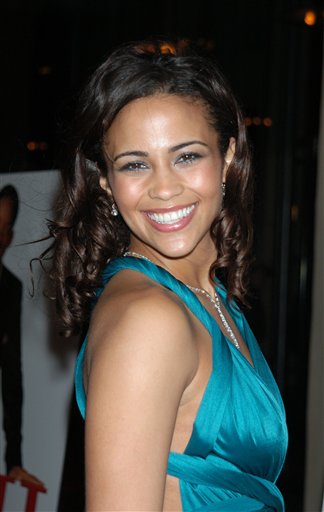
Writer-director Bryan Barber, a frequent music-video collaborator
and longtime friend of Outkast, knows the pair well enough to write to
their relative strengths, and not ask them to stretch too far beyond
their comfort zone. For Patton (the less screen experienced of the two)
this means a role shaped as much by those around him (including Bobb’e
J. Thompson as a younger iteration of the character) as Rooster’s own
actions; for Benjamin it means a nervous and introverted role that taps
into his soulful quietude. While full of plenty of crooked,
idiosyncratic detail, Idlewild, which got its start as an HBO
movie, doesn’t strive for an exacting historical accuracy so much as an
emotional truth, and in this regard it succeeds.
Where the movie really sings, though, is in its cathartic, mash-up
dance sequences, choreographed by Hinton Battle. Combining elements of
swing, jitterbug, break-dance and the Lindy Hop, these numbers shimmer
with unbridled joy and a pure, pleasing energy unmatched by anything
else on the big screen this year. Barber’s video-honed style, too,
feeds the story. While the beginning and end of the movie offer the
most stylized bits, he also deploys classic editing techniques, subtle
flashes of slow motion and fast forward throughout, and a soundtrack —
which includes a score from workhorse John Debney — that incorporates
various bleeps, scratches and modern high-hats folded into
period-inflected music.
While driven, especially early on, by an overt theatricality that
extends to many of its supporting performances (Faizon Love is a hoot
as blustering club owner “Sunshine” Ace), Idlewild locates a
balanced contrast in Percival, the heart of the film, and Benjamin
knocks this role out of the park with a perfectly measured performance.
If movies are indeed a siren call to the musical performer — who’s also
cameoed in Be Cool and given an equally grounded turn in Four Brothers — the unadulterated delight of Idlewild proves he has an equally felicitous future there. (Universal/HBO Films, R, 123 mins.)
Factotum
It would be the autobiographical novels Post Office, Women and Hollywood, along with, eventually, the 1987 movie Barfly — all searing portraits of a distinctly Southern California underclass — that would resonate worldwide and turn blue collar novelist and poet Charles Bukowski into a celebrated countercultural icon. The biographical drama Factotum, though, takes as its core Bukowski’s same-titled second tome, as well as excerpts from three other books, all centering around drunken roustabout Henry Chinaski, widely acknowledged to be the writer’s alter ego.
Directed by Norwegian filmmaker Bent Hamer (Kitchen Stories) and released this month through IFC Films, the movie is a rambling, episodic mock-biography of Bukowski, anchored by a fine, square-jawed starring performance from Crash‘s Matt Dillon. Like his creator, Chinaski swings through a wide variety of low-paying, non-creative, menial jobs (working at a bike shop, a pickle factory, as an ice deliveryman and janitor) and a smaller handful of codependent, quasi-abusive monogamous relationships (embodied here by Marisa Tomei as a fling, and Lili Taylor as on-again/off-again girlfriend Janet). Truly playing the field, you see, would take too much effort — as well as time away from Chinaski’s favorite mistress, the bottle. Through it all Chinaski pens short stories and sends them off blindly to a magazine in New York, subsisting on jug-wine and pancakes, cigarettes and melancholy.
Hamer has a penchant for fade-ins and -outs that will strike some as too affected, and the “story” here is undeniably paced like a snail, and at times willfully crude. (One amusing segment finds Chinaski getting his testicles delicately taped up into a homemade diaper after he contracts crabs from Janet.) Dillon, though, has in his age settled into a more mature, relaxed and naturalistic delivery, and he here approximates Bukowski’s deep, rumbling and inflected timbre — part wizened yet intoxicated preacher’s cadence, part sonorous bullshitter — in a manner that really gives you a window into Chinaski’s inherent glumness, his death-grip hold on misery. You get a palpable sense of how Chinaski’s (and thus Bukowski’s) acting out stems from his racing, perpetually dissatisfied inner monologue, and how his general disagreeableness and bad attitude toward those around him is hardwired to an irreconcilable urgency to locate in both life and his art the same sort of forward-leaning insistence he feels in his soul.
For Bukowski, writing was living. An arthouse curio, Factotum isn’t for all tastes, but it’s studded with dark delights (Chinaski stalking one employer, trying to score a check for a half-day’s work), and it conveys with unflinching precision the life of a dinged, beaten-down spirit for whom creativity wasn’t just an impulse but rather a compulsion. (IFC Films, R, 94 minutes)Snakes on a Plane
I dutifully caught Web sensation Snakes on a Plane yesterday afternoon, and it underwhelms in almost every significant way, proving that New Line’s scattershot-campy, sleight-of-hand marketing comes from a place of internally admitted weakness.
The crowd with which I saw the movie was exactly the right one, full of scruffy-faced twenty- and thirtysomethings sporting vintage T-shirts and an appropriate holler-back attitude. It’s the product itself that disappoints, however. I’ve said before that the success of Snakes on a Plane hinges on being either a truly exceptional genre entry that refashions and redeploys heretofore tired rules in a fresh way (see: Speed) or being so gloriously, tongue-in-cheek bad from gate to gate that the audience exults in feeling smarter than the film.
Despite the title-evidenced simplicity of the concept, though, Snakes on a Plane actually makes pretty dismal use of its space. The script, by John Heffernan, doesn’t generate any feelings of claustrophobic tension, and there’s surprisingly little of the passengers’ plan of defense and attack that has to do with their surroundings and implements. Instead, they… stack luggage, because clearly no one could think that snakes can slither through small cracks and otherwise constricted spaces.
Certain problems seem born of the re-shoots designed to goose the movie’s rating up to an R from a PG-13, as one gets tight close-ups of gore (a high heel stiletto through an ear, for instance) that are squirmingly effective but don’t smoothly integrate to the anarchically staged action. Many set pieces just flat out fail, however — surprising since the staging in director David Ellis’ Final Destination 2 was quite strong. There are several pockets, undeniably, of amped-up, glorious silliness, and the performances (including Todd Louiso as a snakes expert and David Koechner as a slightly lecherous co-pilot given to some great, zonked line readings) are appropriately heightened — everyone knows what kind of movie they’re in.
But Snakes on a Plane is marked by passages of inscrutable blandness, and its grand finale — in which the plane finally lands — marks some of the worst editing in a genre picture in recent years. It’s just awful, inexcusable. The fact that the film finished second at the box office this week to Will Ferrell’s holdover NASCAR comedy Talladega Nights (Snakes‘ Thursday night preview grosses don’t count toward its weekend tally) and only pulled in a little over $1 million more than the decidedly hype-free Anacondas: The Hunt for the Blood Orchid did in a similar frame two years ago suggests that audiences don’t necessarily feel the need to pay to see something they follow anecdotally online, and thus “complete” the experience. Maybe everyone really was laughing at you, Snakes on a Plane, and not with you. (New Line, R, 105 minutes)