Dredd opens this week, and with that in mind here’s a look back at my review of the unapologetically brawny, full-frontal assault on the senses.
The Victim
Extra helpings of off-kilter and off-key melodrama sink Michael Biehn’s bewildering directorial debut The Victim, a nasty little down-and-dirty thriller about a murder, a panicked stripper on the lam and a trio of guys trying to sort out the truth and protect their own skins. Beset with many of the problems of low-budget indie flicks but none of the narrative cleverness, stylistic fleetness of foot or other mechanisms of coping with them, this grindhouse-type offering may find a certain cult-ish reception amongst longtime fans of the veteran genre actor, but otherwise disappear fairly deservingly without a trace.
Against the backdrop of several reports of missing women, rugged loner Kyle Limato (Biehn) retreats to a cabin in the woods, only to have his solitude interrupted by the hysterical Annie (Jennifer Blanc, Biehn’s real-life wife), a stripper who claims to have seen her friend Mary (Danielle Harris) murdered. She and Mary were in the woods partying with cops James Harrison (Ryan Honey) and Jonathan Cooger (Denny Kirkwood) when rough but consensual sex between James and Mary went wrong. Kyle takes Annie in, and rebuffs queries from the suspicious police officers when they come knocking at his door. When James comes back, however, kidnapping and various stand-offs ensue, as Kyle and Annie try to discover what’s happened to Mary’s body.
Shot chiefly in and around one location, and frequently in day-for-night swap fashion, The Victim gives off a grungy, DIY vibe. Its production was reportedly a difficult one, and obviously resources weren’t abundant, but the film’s lack of stylistic flourish and connection isn’t its main problem — that lies in the execution of the story itself. Biehn picks an awkward point of entry for his tale, and then constructs things in a way that remove secrets from the narrative. Its leading dialogue (repeated variations of “Do you believe me now?”) basically telegraphs that there will be a “twist,” but the movie doesn’t have any deep-seated intrigue, really; it’s just a matter of which one of two characters is lying, and to what degree.
Its characterizations are a bit deranged — Harrison is a puffed-chest guy who, when the tables are turned back in his favor, barks “I’ve been a winner my whole life!” — but The Victim doesn’t really play those elements up for blackly comedic effect, as Quentin Tarantino or Eli Roth might. Leaps in logic and motivation are terrible throughout — in Biehn’s world, apparently a crime has only been committed if a body can be found, and that in and of itself then establishes the veracity of someone’s story, regardless of other facts or conflicting eyewitness accounts. The movie’s acting is additionally problematic; histrionic seems to be a baseline setting. On the plus side, the movie’s special effects work, while not extensive, is quite solid, and composer Jeehun Hwang’s contributions are superb — slightly offbeat little numbers that pull viewers forward in their seats a little bit. Unfortunately, The Victim otherwise just doesn’t have much going for it.
Housed in a regular plastic Amaray case in turn stored in a complementary cardboard slipcover, The Victim comes to DVD presented in 1.78:1 widescreen, with a Dolby digital 5.1 surround sound audio track and optional Spanish subtitles. Its bonus features consist of a hearty, 25-minute making-of featurette which spotlights the many friends, family and pulled favors that went into production (sit-down interview chats are balanced with on-set footage), as well as a feature-length audio commentary track with Biehn and Blanc, in which the latter more than hints several times her skill with fellatio and the fact that she and Biehn have something of a turbulent, “fight-and-fuck” relationship. To purchase the DVD via Amazon, click here; if brick-and-mortar Best Buy is your thing, though, then by all means have at it. D+ (Movie) B- (Disc)
Starry Starry Night

An imaginative, emotionally resonant coming-of-age story about two young kindred spirits who seek solace in one another, writer-director Tom Shu-Yu Lin’s Starry Starry Night, an adaptation of Taiwanese author Jimmy Liao’s bestselling illustrated book, is swollen with genuine feeling. Showcasing the commingled frailty and toughness of adolescents, and the rich inner landscapes that exist apart from whatever tethering relationships they have with adults, Lin’s sophomore effort represents a solid blend of technical achievement and kindhearted portraiture.
The narrative beats are sometimes familiar, and its metaphorical underpinnings rather highlighted, but the movie’s superlative inducement of whimsy ensures that its grip on one’s attention and heart never significantly loosens. While not nearly as overtly comedic as something like Stephen Chow’s CJ7, Starry Starry Night taps into the same sense of fantastical wonderment as that film, as well as the more melancholic tones of movies like Hirokazu Kore-eda’s compassionate I Wish and Spike Jonze’s Where the Wild Things Are. For the full, original review, from Screen International, click here. (China Lion, unrated, 98 minutes)
Hollow
A world premiere at last year’s Fantasia Film Festival, British import Hollow cashes in on the found footage revival kicked off at least in part by 2009’s Paranormal Activity, telling the story of a quartet of friends who suffer a dark turn of events in a remote village in Suffolk, England that’s been haunted for centuries by a local legend. Solid, largely naturalistic performances and a nice technical package help offset a story whose bump-in-the-night eeriness reaches a certain level of diminishing return long before the end of its 95-minute running time, rendering Hollow a marginal recommendation only for hardcore genre enthusiasts. For the full, original review, from ShockYa, click here. (Tribeca Film, unrated, 95 minutes)
You May Not Kiss the Bride
An uneven action-comedy of unconvincingly forced hijinks, You May Not Kiss the Bride plays like a strange, misbegotten mash-up of The Bounty Hunter, Green Card, Get Shorty and The Big Bounce. The cross-pollinated ensemble story of an arranged marriage, unlikely budding romances and a bunch of criminal mischief and double-crossing, it’s amiable yet still consistently wearying — a movie that never figures out a way to stitch together all of its incongruous elements.
After a mishap involving a customer’s cat, unassuming pet photographer Brian (Dave Annable) is strong-armed into canceling out his debt by marrying the daughter, Masha (Katharine McPhee, late of American Idol), of Croatian mobster Vlatko Nikitin (Ken Davitian), in order to help expedite her immigration. This triggers the wild, hormonal jealousy of Brian’s assistant Tanya (Mena Suvari), who’s convinced that the two of them should be an item. It also puts Brian in the crosshairs of Brick (Vinnie Jones), an ill-tempered henchman of Nikitin set to actually marry Masha for real, after a year passes of the simply-for-show nuptials.
Following a big public wedding, Brian and Masha head off to a secluded Tahitian resort. When Masha gets kidnapped, though, Brian becomes desperate to track her down — enlisting the help of Ernesto (Rob Schneider), a horny, jack-of-all-trades tourist-transportation guy, and Lani (Tia Carrere), a kind-hearted waitress.
You May Not Kiss the Bride begins as a more conventional, if undeniably broad, laffer, and then morphs rather fitfully into an air-quote zany action comedy, with Brick visiting violence upon Brian and others, and chase sequences culminating in explosions and the like. The result is neither fish nor fowl — a movie that has no settled sense of purpose or narrative clarity. The story is expansive enough that it allows for a wide range of recognizable faces, but any and all dramatic payoffs are pat, and the material isn’t snappy enough to truly merit their involvement.
Ergo, You May Not Kiss the Bride, shot mostly in Hawaii, becomes just a series of bits, passing time until declamatory markers are passed. As the amorous, unhinged Tanya, Suvari gives a committed, crazy turn — probably the movie’s best, or at least its most enjoyable — but many of the other performances seem to be on different wavelengths. Writer-director Rob Hedden’s chirpy, DIY production (it’s even billed in the opening credits as a movie by “Hedden and friends”) gets a tip of the hat for its independent production, but the technical execution and oversight aren’t strong enough to shape this muddled comedy into something worthy of recommendation. For the full, original review, from ShockYa, click here. (Freestyle Releasing, PG-13, 100 minutes)
Arbitrage
A crisp, procedural-type throwback to 1980s-style financial world thrillers about rich men behaving badly and skirting danger, writer Nicholas Jarecki’s narrative feature directorial debut, Arbitrage, has the benefit of a superb, invested cast and a narrative that’s plugged into the current zeitgeist in a compelling fashion. The story of a billionaire hedge fund manager trying to broker the sale of his company ahead of the discovery of either long-simmering financial impropriety or a tawdry and possibly criminal matter from his personal life, Arbitrage won’t necessarily win awards for originality, but it’s a sleek, engaging and efficient little cat-and-mouse thriller about some darker human impulses, and the lengths to which a man will go to maintain his rewards and style of life.

On his 60th birthday, Robert Miller (Richard Gere) appears to have it all. A Wall Street titan with a successful financial trading and investment company, Miller has a beautiful wife, Ellen (Susan Sarandon), and a brilliant daughter, Brooke (Brit Marling), who is his chief financial officer and heir apparent. He even has a secret mistress, French-born art magnate Julie (Laetitia Casta). What no one else knows, however, is that his company is poised to take a punishing dive — the result of an over-extended financial bet and fraudulent shell game to conceal it.
So Miller is already desperately trying to unload his troubled empire when an automobile accident with Julie leaves her dead. With the assistance of Jimmy Grant (Nate Parker), an unlikely face from his past, Miller selfishly flees the scene, mindful of both the secrecy of his affair and the trouble messy manslaughter charges could cause for his professional fortunes. As dogged detective Michael Bryer (Tim Roth) pursues various leads and zeroes in on whom he believes to be the culprit, Miller’s behavior gets even shadier.
Its basic narrative is essentially a smooth-blended version of Margin Call and a rangier Law & Order episode, but one really gets a sense of Miller’s captain-of-industry sense of entitlement, and also the intelligence and cloistered-world thinking that informs it. Arbitrage exists in a swirling fog of duplicity and overall grey morality — one that pulls a viewer in and binds them to the narrative, however innately familiar, by refusing to allow for the existence of white knights. Everyone here lives in compromise.
If there’s an overarching criticism, it could relate to the movie’s rather needlessly compressed timeline, which basically unfolds over less than 48 hours and requires a few silly leaps in logic. Still, Arbitrage is a competent, slickly made thriller of corruption and immorality — it knows of the noose, and how to tighten it. For the full, original review, from ShockYa, click here. (Lionsgate/Roadside Attractions, R, 108 minutes)
Francine
There’s a familiar saying that even a broken clock is right twice a day, which Brian M. Cassidy and Melanie Shatzky’s assertively minimalist Francine recalls. An emotionally impressionistic story of a recently paroled woman coping with life on the outside of prison, this character study feels like a less successful riff on Kelly Reichardt’s much more evocative Wendy and Lucy — caught up in its own metaphor, its blank canvas and broadly sketched melancholic tones an empty vessel for those who would like to automatically turn the personal into the political.
There isn’t much in the way of plot to Francine. Oscar nominee Melissa Leo stars in the title role, as a woman who leaves prison and tries to re-acclimate to life in a downtrodden lakeside town. Though awkward around pretty much all humans (she frequently doesn’t respond at all in conversation), Francine comes to life through animals. She gets a couple odd jobs at a pet store and then a veterinarian, taking in felines and other animals until her house begins to resemble an episode of TLC’s hit new show “Crazy Old Cat Lady.” Boozy interactions with other societal fringe-dwellers then ensue.
It’s not that Francine feels phony, necessarily — it just feels tripped up and smitten with the notion that in saying so little it’s actually saying a lot. Francine is a fairly realistic emotionally stunted character, and Leo inhabits her with a deadpan commitment and complete lack of vanity — and not just because of a full-frontal nude scene in which she exits the prison shower. There’s just not enough latent intrigue or outside force upon Francine, and the movie’s elliptical psychological explorations feel half-sketched rather than arty. For the full, original review, from ShockYa, click here. (Washington Square Films, R, 74 minutes)
Resident Evil: Retribution

More high-calorie, low-sense, audiovisual CGI stimulation arrives in the form of Resident Evil: Retribution, the fifth and most roundly unsatisfying entry in the previously lithe and fun, $700-million-grossing sci-fi videogame franchise. Slow-motion action and lots of noisy gun battles cannot mask a decided lack of ideas and genuine narrative hurdles in this dispiriting claptrap, which serves chiefly as an inexorable march to the concluding set-up of yet another sequel. Returning impresario Paul W. S. Anderson has written every movie in the franchise, and occupies the director’s chair for the third time here. Rather than bring a unifying vision, however, his imagination and orchestration instead exude the slapdash feel of a hastily assembled, studio-curated greatest hits collection. For the full, original review, from Screen International, click here. (Sony/Screen Gems, R, 96 minutes)
The Trouble with the Truth
A spare but winning romantic drama that taps into the same talky, intellectually stimulating vein as Richard Linklater’s Sunrise/Sunset collaborations with Ethan Hawke and Julie Delpy, The Trouble with the Truth is cinematic catnip for anyone who fancies themselves a student of the human condition. Written and directed by Jim Hemphill, this intimate bauble serves as a great showcase for actors Lea Thompson and John Shea, and a reminder that human desire doesn’t expire at 35 years of age.
On the heels of learning that their 24-year-old daughter Jenny (Danielle Harris) is engaged to be married, middle-aged divorcées Bob (Shea) and Emily (Thompson) get together for a dinner, their first in years. Bob is a Los Angeles-based musician who prides himself on his low economic overhead; remarried and living on the East Coast, Emily is a successful author who’s worried that she’s becoming “dull by osmosis” via her new husband. Over dinner, the pair find themselves reminiscing over what went wrong, and what was right in their relationship. As they slide into an alcohol-enabled haze of nostalgia, the question comes into focus — are they up for a passionate one-night stand, willing to give it another go as a couple, perhaps even both, or neither?
The Trouble with the Truth isn’t as stylistically audacious as Hans Canosa’s 2006 drama Conversations with Other Women, another playful adult love story, starring Aaron Eckhart and Helena Bonham Carter, that kept both leads on the screen for the entirety of its 84-minute running time. Shot on Canon DSLRs, its austerity sometimes gets the best of it. Still, this movie is an actors’ piece, and in this regard it succeeds mightily. Bob and Emily are at a place where they can let down their respective guards and simply let fly with their true feelings, with no worries of how inartfully phrased they may be. They “get” each other — deeply and realistically, in the ways that a couple with a turbulent shared history that spans many years of late twenty- and thirtysomething life truly can.
In spirit, Hemphill’s movie certainly owes a debt to Linklater’s previously mentioned films, along with My Dinner with Andre and other similar chatty, philosophically-minded flicks; The Trouble with the Truth is a bit like a re-stitched, backward-glance He Said, She Said, in which both perspectives of a relationship are laid up against one another, conversationally. The deeper in a viewer gets, the more its characters matter to them. For the full, original review, from ShockYa, click here. (Winning Edge Partners, R, 96 minutes)
NOTE: The Trouble with the Truth opens this week in Los Angeles at the Egyptian and Aero Theatres, where Lea Thompson and others will appear in person at select screenings. For more information, visit the movie’s website or its Facebook page.
Alison Pill ‘Fesses Up to Topless Tweet
Props to Alison Pill for owning up in self-effacing fashion to the topless photo of herself she accidentally tweeted out a day or two ago. Not easy to do, no doubt, but the right way to play it, for sure. No contortionist obfuscation — just shrug, call a mulligan, move on.
Hello I Must Be Going
Stella got her groove back in Jamaica, but there’s no reason to believe mojo can’t be recaptured in decidedly chillier climes, as Hello I Must Be Going aptly demonstrates. A fine and funny film balanced between heartbreak and uplift, this smartly observed tale of a thirtysomething divorcée fumbling toward a young adulthood at once more grounded and independent is anchored by a rich, superlative turn from Melanie Lynskey.

The opening night selection at this year’s Sundance Film Festival, Hello I Must Be Going unfolds in suburban Connecticut, where Amy Minsky (Lynskey) has been holed up for three months in the home of her parents, Ruth (Blythe Danner) and Stan (John Rubenstein), licking her wounds over her break-up with her husband David (Dan Futterman). Uncertain over her future, she tumbles into an affair with Jeremy (Christopher Abbott, above left), a 19-year-old actor who has a bit of stage work and a kid’s show under his belt. Things are additionally complicated by the fact that this relationship might endanger a business deal which would allow Amy’s father to finally retire.
Lynskey — who’s made her mark in a wide variety of supporting roles, often being called upon to fill in details and provide a snapshot of a rich offscreen life in but a few moments — has such a subtly expressive visage and engaged, always present demeanor, so it’s great to see her get a chance to put it to even more robust use in a lead role. She’s an ace with unfussy melancholic charm (of which there is still plenty here), but the true gift of her turn in Hello I Must Be Going lies in her full-on embrace of Amy’s fitful inner rhythms. The result is an utter delight, full of interesting choices — tears triggered by happiness, laughter from pain and tension — that convey vivid and recognizable truths about the steely grip of discontent and despair, and the giddy discombulation that can sometimes accompany finally shaking it off.
In fact, the acting is all quite good, and there’s a reason. Penned by Sarah Koskoff, wife of actor-turned-director Todd Louiso (Love Liza), the movie captures humanity and humor in equal measure — but always rooted in its characters, and neither contrived “wacky” situations nor what it believes viewers wish to see. Koskoff and Louiso invest in the differences in the relationships Amy has with her parents, which in turn smartly inform an audience’s sense of the (offscreen) choices that Amy has made that have led her to this particular moment. After about 95 minutes she must be going, of course, but by the end of one’s time with her they’ll appreciate the fact that she stopped by to say Hello. For the full, original review, from ShockYa, click here. (Oscilloscope, R, 95 minutes)
Dreama Walker, Pat Healy and Craig Zobel Talk Compliance
Probably the most unnerving presentation at this year’s Sundance Film Festival, Compliance provides a chilling snapshot of the blurred line between personal reason and obsequious consent to authority — a story all the more unsettling because of its rooting in fact. In writer-director Craig Zobel’s movie, Sandra (Ann Dowd), the high-strung manager at a small town fast food restaurant, finds her Friday rush further complicated when a man, Officer Daniels (Pat Healy), phones to tell her that a pretty young employee, Becky (Dreama Walker), has stolen money from a customer. Convinced she’s doing what’s right, Sandra commences the investigation, following step-by-step instructions from the police officer on the other end of the line and authorizing others to do the same, no matter how invasive the requests become. I recently had a chance to speak to Zobel, Walker and Healy, one-on-three, about their collaboration and the unlikely educational inspiration found in Cops. The conversation is excerpted over at ShockYa, so click here for the read. For a review of the movie, meanwhile, click here.
Girl Model
A vivid and surprisingly emotive exploration of fashion modeling and the refracted reality and cost of the economic opportunities it presents for prepubescent Eastern European girls in particular, the spare but rather superb documentary Girl Model walks a tight-rope adjacent to exploitation, peering down into its caverns, and asking uneasy questions about whether the alternatives for so many young girls are really that much better.

Narrowly focused in savvy fashion, Girl Model interweaves the stories of two subjects who only briefly cross paths. There’s Ashley Arbaugh, an early-30s ex-model turned scout who scours rural Russian open casting calls looking for fresh faces, and one of her discoveries — Nadya Vall (above), a skinny, 13-year-old from a small Siberian town who describes herself as a “gray mouse,” and simple country girl.
Ashley specializes in finding models for the Japanese market (“not too tall, and young is important”), so after she taps Nadya and sends off some snapshots of her for her bosses’ approval, the young girl prepares for a trip alone to Tokyo, where a strict contract that limits her body measurements is supposed to guarantee her at least two jobs and $8,000. Speaking of course no Japanese and only a little English, Nadya (who wears a Teletubbies T-shirt to a going-away party thrown by her parents) is shy and naïve and homesick — all the things one expects of a provincial child. As her optimism about being able to rescue her family from their economic hardship begins to flicker and fade, Nadya’s dreams are contrasted with Ashley’s deep-seated ambivalence about the industry.
Directors David Redmon and Ashley Sabin occasionally intercede on Nadya’s behalf (helping bridge a language divide in brokering a ticket adjustment, and at one point loaning her a cell phone to call home), but they mostly just observe. The film eschews traditional sit-down interviews, which likely wouldn’t have been as effective with Nadya anyway. Ashley, meanwhile, is guileless, and her complicated relationship with the fashion industry — something stirringly communicated through the use of self-shot video from her own heyday, in the late 1990s — gives Girl Model both a charged, unsettled quality and a deep vulnerability that runs parallel to Nadya’s story.
The cumulative effect of this masterful interweaving is a sparse, streamlined movie that is expressive without being heavy-handed. Girl Model is a film that comes to its provocation honestly and intellectually, without showiness or false pretense. There’s a surprising sense of tension that bubbles to the surface, over Nadya’s failure to book jobs and rising debt, and Ashley’s intimations and speculation about the slippery slope between underage modeling and prostitution.
Perhaps darkest of all, however, Girl Model doesn’t preach or offer up easy advocacy. One of the Russian talent brokers talks somewhat creepily about the importance of finding girls when they are extremely young, but later shares with Ashley how he endeavors to scare girls straight and set them on a path of financial security. He seems sincere, making the viewer ask tough questions about what constitutes smart and safe choices for those with frequently so little other opportunity for socioeconomic advancement. For the full, original review, from ShockYa, click here. (First Run Features/Carnivalesque Films, unrated, 77 minutes)
Emmy Rossum Turns 26, But Is Likely Still Hated
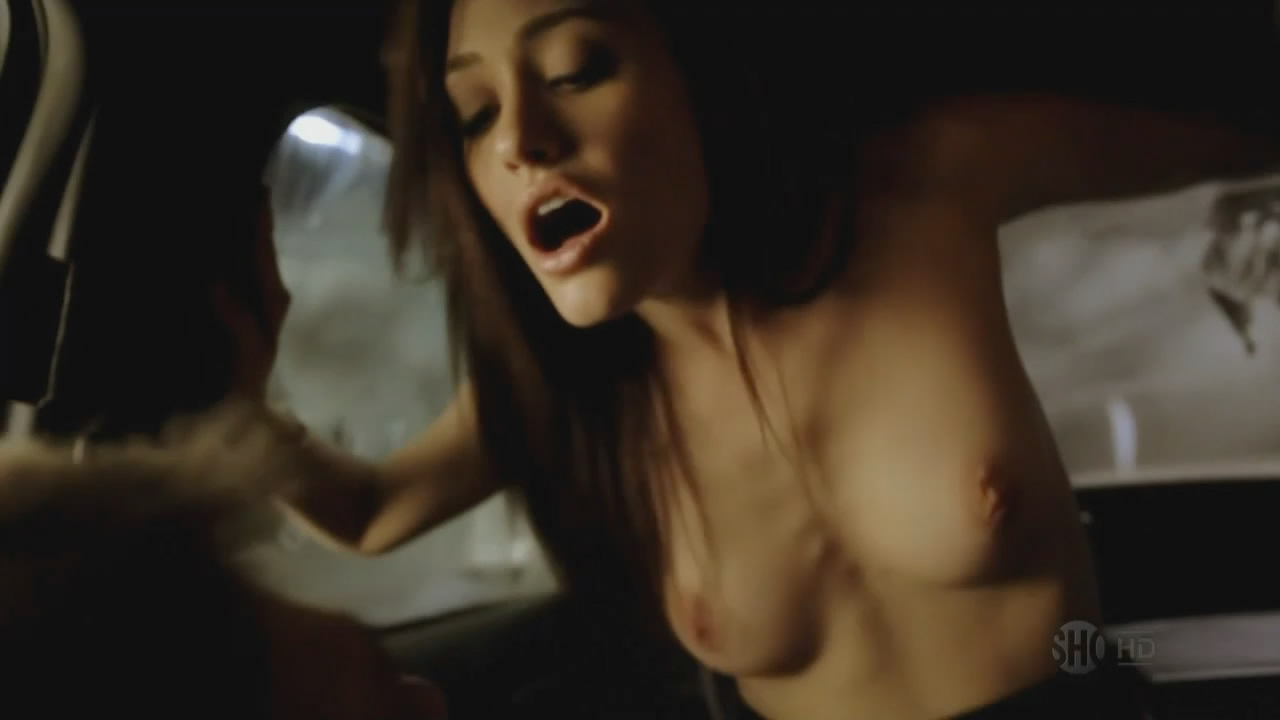
It’s a happy 26th birthday to Emmy Rossum, who has engendered no small amount of hate due to… what, exactly? The fact she’s one of these multi-hyphenate talents, daring to both sing and act and do modeling and what not as well? I’m not sure if her topless scenes in Shameless have helped or hurt her any in this regard — all I know is that in the maybe three or four pieces I’ve penned about either her or her movies over the years, the comments sections have reliably gotten blown up by weirdo trolls, in a manner and to a degree not really keeping with her stature or public profile. So what is it about her that so sets some folks off? I’d really like to know.
Payback
No hardboiled revenge thriller, this. Instead, the acclaimed director of Manufactured Landscapes, Jennifer Baichwal, brings Margaret Atwood’s bestselling novel about debtor/creditor relationships to the screen with Payback, an absorbing cinematic essay that takes a look at debt and the shadow side of wealth.
If it sounds hopelessly dry, it’s most assuredly not. Large philosophical and social questions are interwoven engagingly with historical issues, and in a much more manageable and handy way than the filmic adaptation of Naomi Klein’s tangentially related but similarly ambitious The Shock Doctrine. Baichwal grafts exquisite, gorgeous visuals onto her telling, too, resulting in a lively work that transcends the material’s potentially staid subject matter.
While debt and financial matters are much in the news presently, and pretty much have been since the financial crisis of 2008, Payback is not explicitly a movie of hedge fund management and other financial shell games. Its historical longview is significant and thought-provoking, and invested in a much broader definition of obligation and responsiblity, both individual and societal. From the enslavement of migrant workers to criminal prison sentences and the aftermath of the BP oil spill, Baichwal examines indebtedness in a sort of free-association style that assumes a base-level of intellectual curiosity and engagement on the part of her audience. Assuming that’s present in a viewer, Payback delivers much for thought and conversation.
Housed in a regular, clear plastic Amaray case with an evocative, simple-text-on-red cover (“Some debts can’t be paid with money”), Payback comes to DVD presented in a gorgeous 1.78:1 anamorphic widescreen transfer free of any grain or edge enhancement issues, with both 5.1 and 2.0 stereo audio tracks as well as optional English subtitles for the deaf and hard of hearing. In addition to its theatrical trailer and an insert booklet with notes from Baichwal, bonus features consist of three excised scenes with Atwood and Jane Goodall, and a Q&A session with Baichwal and Atwood after the movie’s North American premiere at New York’s Film Forum. To purchase the DVD via Amazon, click here. B+ (Movie) B (Disc)
Melanie Lynskey Talks Twitter, Hello I Must Be Going, More

After her striking, unforgettable debut in Heavenly Creatures, Melanie Lynskey has crafted a career largely out of deftly inhabiting a wide variety of supporting roles, always with a quiet centeredness that suggest various rich inner landscapes. In the funny, resonant dramedy Hello I Must Be Going, however, she gets to step into the limelight. The opening night film at the Sundance Film Festival, actor-turned-director Todd Louiso’s movie centers on a recent divorcée, Amy, who seeks mental refuge in the suburban Connecticut home of her parents. There, contemplating the crossroads of thirtysomething life, she hooks up with a 19-year-old actor (Christopher Abbott). Recently, I chatted with the lovely Lynskey in person about her on-set playlists, Twitter, embracing uncomfortableness and why dating used to freak her out. The conversation is excerpted over at New York Magazine‘s Vulture, so click here for the read.
The Victim
Extra helpings of off-kilter and off-key melodrama sink Michael Biehn‘s bewildering directorial debut The Victim, a nasty little down-and-dirty thriller about a murder, a panicked stripper on the lam, and a trio of guys trying to sort out the truth of her story and protect their own skins. Beset with many of the problems of low-budget indie flicks but none of the narrative cleverness, stylistic fleetness of foot or other mechanisms of coping with them, this grindhouse-type offering may find a certain cult-ish reception amongst longtime fans of the veteran genre actor, but otherwise disappear without a trace. For the full, original review, from ShockYa, click here. (Anchor Bay, R, 83 minutes)
Wild Horse, Wild Ride
Director Cindy Meehl‘s soulful, Sundance-minted Buck, which told the story of quietly charismatic horse whisperer Buck Brannaman, illustrated just about as well as any film could the unique and poignant connection between man and horse, and how taming wild or otherwise unruly mustangs is a process that often reveals as much about the owner as it does the horse. Following in its nonfiction footsteps (or horseshoe tracks, I guess) is Wild Horse, Wild Ride, an engaging look at a bunch of folks who try to do just that.
As with many other documentaries of sub-cultural curiosity, Wild Horse, Wild Ride builds its narrative around a competition, in this case the Extreme Mustang Makeover Challenge, an annual contest in Fort Worth, Texas, that solicits 100 people to spend 100 days each taming a randomly selected, totally wild horse in order to help get it adopted into a better life beyond federal corrals. Wife-and-husband co-directors Alex Dawson and Greg Gricus select an interesting cross-section of subjects, and then track their progress (or lack thereof) over the course of the next three-plus months.
The framework of the actual competition, which unfolds over the course of two days in front of a bunch of judges and a public that will then be bidding on the horses, isn’t as well sketched out as in movies like Spellbound, Jig or Make Believe: The Battle to Become the World’s Best Teen Magician. There’s not a huge sense of audience emotional investment in the stakes, perhaps influenced by the fact that some of the finalists aren’t included in the movie’s roster of interviewees, and perhaps given the many different reasons the subjects have for tackling this unique challenge.
Regardless, Wild Horse, Wild Ride benefits from a professional technical package that isn’t overly slick to the point of distraction. Its cinematography is attractive, but not overly precious. Dawson and Gricus capture the often intimate, slowly developing bonds between horse and trainer, but also intercut training footage with the requisite sit-down interviews with their subjects.
It’s here that one wishes the movie really stretched its legs and unleashed more of a gallop. Big-hearted if sometimes politely incurious about these disparate motivations, Wild Horse, Wild Ride doesn’t appreciably root down into all the lives of its human subjects. It seems like it doesn’t want to offend by asking tough questions, which is fine but at times a bit unsatisfying. A certain scrim remains, even if the footage of horses and men (and women) learning to trust one another is inarguably often fascinating. For the full, original review, from ShockYa, click here. (Screen Media Films, PG, 106 minutes)
Blinky & Me
An intensely earnest and subjective documentary look at the career and life story of Australian animator Yoram Gross, Blinky & Me casts a look back at the horrors of World War II and the Holocaust through the eyes of a then-child. This is didactic story, and certainly deeply felt, but it would have benefited greatly from a wider perspective, drawing in other voices to frame Gross’ professional work, and its popularity within Australia. For the full, original review, from ShockYa, click here. (Smoking Mirror Productions, unrated, 75 minutes)
2 Broke Girls: The Complete First Season
Diners are a not unfamiliar setting for sitcoms, and the highest-rated new comedy of the 2011-2012 season, the CBS hit 2 Broke Girls, uses one as its chief setting, and the occupational string that tethers a new, odd-couple pair of roommates.
Created by Michael Patrick King and Whitney Cummings, the series centers around Max Black (Kat Dennings), a sardonic, young blue-collar waitress in Brooklyn who finds herself an unlikely new pal in the form of Caroline Channing (Beth Behrs, above left), a disgraced socialite who finds her trust fund frozen when her father is arrested on massive fraud charges. After Caroline lies to get a job, Max takes her under her wing and, after dumping her cheating boyfriend, lets Caroline (and her horse… yes, seriously) move in with her. Together they cope with horny short order cook Oleg (Jonathan Kite), manager Han (Matthew Moy) and perpetually exasperated cashier Earl (Garrett Morris), while hatching a plot to save up $250,000 and start a boutique cupcake business.
The show’s pilot episode — co-written by King and Cummings, and directed by James Burrows — honestly doesn’t put its best foot forward, and is one of the season’s weaker episodes. 2 Broke Girls isn’t a single-camera series, but its rapid-fire repartee (which ramps up as the season wears on) seems like it might actually benefit from a visual re-imagining. As is, the show is fairly flatly shot and paced, and often riddled with slight mis-framings or other editorial hiccups. And the diner itself — in which Max frequently takes aim at hipsters, and Han tries to install karaoke to lure in more business — seems a strange and unconvincing hodge-podge of set design.
Thankfully, the series gets out of the diner a bit more as things wear on, and while each episode ends with a tag charting the girls’ progress toward their financial goal (i.e., the show’s big syndication pay-off), additional complications (including a visit to an underground dentist’s office in the fourth episode, “And the Rich People Problems”), bonding and opportunities (a new upstairs neighbor, Sophie, played by Jennifer Coolidge) flesh out the show in winning ways.
What 2 Broke Girls most has going for it, though, is its cast. There’s more than a pinch of Diablo Cody in the snarky dialogue, but Denning locates a rhythm and smart break points that make some of her patter come across as less contrived. Behrs is also lovely, and she and Denning develop a real rapport.
2 Broke Girls: The Complete First Season comes to DVD spread out over three dual-layer discs, and housed in a plastic Amaray case with a dual-sided tray, in turn stored in a sturdy, complementary cardboard slipcover. Under a static menu screen, the two dozen episodes are presented in matted widescreen, with a Dolby digital 5.1 surround sound audio track. The transfers are okay, though there is a bit of artifacting present in early episodes; problems seem to abate later on, on the set’s second and third discs. There’s also a tri-fold, full-color insert with cast photos and episode summaries. Bonus features consist of a half-dozen minutes of unaired and alternate scenes, as well as a 14-minute behind-the-scenes featurette that includes intercut interview chats with the show’s cast and creators. Commentaries or a few other bells and whistles would have been nice; it seems like CBS or home video distributor Warner Bros. was perhaps hedging their bet on this release. Now that 2 Broke Girls is a hit, and set to return, one would imagine that its second season release will come with a more robust slate of extras. To purchase the set via Amazon, click here. B (Show) C+ (Disc)
Hotel Transylvania

High-value animation gets wrapped around a slapdash story more suited to a Saturday morning cartoon in Hotel Transylvania, an animated film that tries rather unsuccessfully to meld empty nest anxiety with a curious, half-sketched tale about a getaway resort for monsters. Broad, lazy storytelling sinks producer-star Adam Sandler‘s vehicle, which lacks the snap and distinctiveness of something like the recent ParaNorman. Director Genndy Tartakovsky and editor Catherine Apple serve as taskmasters, driving the movie at a blistering pace. But they’re unable to impress a unifying vision upon the film, either in terms of tone or look, and Hotel Transylvania feels especially beholden to the undisciplined rhythms of Sandler’s more banal comedies, where digressive jocularity is valued above character consistency or narrative clarity. For the full, original review, from Screen International, click here. (Sony, PG, 92 minutes)
Happy Birthday, Devon Sawa
It’s a happy 34th birthday to Devon Sawa, who should surely wish to be remembered more for Final Destination than Devil’s Den, even though the latter is… special in its own way.
Bachelorette
Written and directed by Leslye Headland, the New York City-set Bachelorette may have roots that stretch back past 2011’s Bridesmaids, from co-writer-star Kristen Wiig and director Paul Feig. But in almost every conceivable way, shape and form this feels like a rudderless knock-off of that $288 million worldwide-grossing smash hit. Self-consciously raunchy and simply more loud and annoying than funny and insightful, Bachelorette serves as ample evidence that women can do stupid and crude as well as men, if pushed to it.
When Becky (Rebel Wilson) announces her engagement, it stings old high school friend Regan (Kirsten Dunst), an over-achieving, career-driven bitch-on-wheels, but she nonetheless pledges to handle all the wedding planning. The nuptials also reunite Regan with her two other best friends from adolescence — the sarcastic if somewhat self-destructive Gena (Lizzy Caplan), wounded by an unresolved relationship with an ex, Clyde (Adam Scott); and Katie (Isla Fisher), a ditzy party girl and cocaine fiend who loves the good life. Though Becky insists on keeping the bachelorette party low-key, Regan finds her interest caught by another member of the wedding party, Trevor (James Marsden). Much carousing and debauchery ensues, along with a tie-it-together sub-plot about repairing much inadvertent damage to Becky’s dress.
Bachelorette had its premiere at the 2012 Sundance Film Festival, which is a bit dispiriting to think about — the fact that some truly independent and undiscovered filmmakers got a rejection slip merely so that this slapdash vehicle, populated with recognizable faces, could bring a bunch of stars to Park City, Utah. The movie is apparently adapted from Headland’s own stageplay, but its willful bawdiness (slang like “cuntgina” is tossed around, and Gena’s outgoing cell phone message chirps, “Eat a dick!”) feels less rooted in character than some fantasy, gender-flipped construct — a women’s studies paper on the subversion of heretofore historically masculine bonding through lewdness.
A few of Headland’s referential riffs connect because of their specificity — analogies to Fast Times at Ridgemont High characters, Gena and Clyde’s shared recollection through the prism of an old pop song, and the name-checking of a somewhat obscure Saturday Night Live sketch — but most of the writing just seems manic and desperate. The movie is basically After Hours cross-pollinated with The Sweetest Thing. None of the depth of insight into female friendships or romantic relationships in general present in abundance in Bridesmaids is on display in Bachelorette. It’s just pointless vulgarity, peppered with some one-liners and channeled through showy, phony characters.
Then there is the acting, which is also problematic. Wilson (a scene-stealer in Bridesmaids, as Wiig’s roommate) generally acquits herself, and Caplan — getting to showcase a more super-charged style than typical — is still a delightful screen presence, finding ways to work in sly bits here and there. Fisher and Dunst, however, deliver shrill, gaudy performances largely devoid of recognizable human traits. One merely wants this terrible Bachelorette party to be over, so that one doesn’t have to see them again. For the full, original review, from ShockYa, click here. (Weinstein Company/Radius, R, 87 minutes)
Touchback (Blu-ray)
In the loose tradition of tales of sports uplift like Field of Dreams and Angels in the Outfield, Touchback tells the story of an ex-high school football star who gets another crack at glory. But it’s really only interesting in that it stars Brian Presley, who became something of an Internet sensation earlier this year when he was outed by a model, Melissa Stetten, for allegedly drinking and trying to hit on her during a cross-country flight. No biggie, right? No harm, no foul. Well… Presley is a married man, Evangelical Christian, and a guy who’s made a public deal out of his sobriety. Whoops. So there’s that.
Oh, but… the movie itself, right? Twenty years removed from ripping up his knee in a state championship game, small town farmer and family man Scott Murphy (Presley) is struggling to support his wife Macy (Melanie Lynskey) and their two young daughters. Presented with a unique opportunity to revisit his glory days but also tempted by his old high school flame (Sarah Wright), Scott turns to his old mentor, Coach Hand (Kurt Russell), for advice and guidance.
Location filming (in Ohio and Michigan) gives the movie a bit of nice production value, but Friday Night Lights (both the movie and the TV show) mined similar terrain much more effectively. The lines of narrative conflict in writer-director Don Handfield’s movie are obvious and smooth; full of homilies, this is cinema as a little comfort-laden snack cake. The public-private contrast of Presley-as-Scott and then the story (whatever really happened) of his run-in with the tart, witty Stetten is the only thing that gives Touchback any pop or value, just because of its amusing, extra-textual contrast.
Housed in a typical case, Touchback comes to home video in a DVD/Blu-ray combo pack, stored in the typical slimline Blu-ray case. The video presentation is a 1080p, 1.78:1 non-anamorphic transfer, free of grain or edge enhancement issues. Audio comes by way of a TrueHD 5.1 surround sound track, with optional English SDH and Spanish subtitles as well. Bonus features consist of a feature-length audio commentary track with Presley and Handfield, as well as a threadbare, six-minute making-of featurette. It’s a shrug and a wash, really, these back-slapping inclusions. I’m sure Stetten’s audio commentary track to this would be the bomb, though; she should record one and offer it up for complementary sale via her own website. After all, she already crushes impressions. To purchase the Blu-ray via Amazon, click here. C- (Movie) C+ (Disc)
The Day
A casserole of post-apocalyptic siege/road movie clichés and tropes, The Day tells the story of a band of armed, sick and downtrodden survivors looking for refuge and trying to stay alive. Take Cormac McCarthy’s The Road and cross-pollinate it with a couple dozen other more aggressively low-grade genre entries and the result is this very self-serious yet narratively unoriginal offering, which doesn’t have anywhere near the imagination to match the mode of its telling. For the full, original review, from ShockYa, click here. (Anchor Bay/WWE Studios, R, 85 minutes)