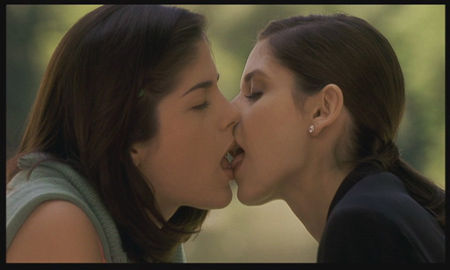
Hey, did you hear the one about the adult movie Pirates? Yes, they also released a cut rated… aRRRRRgh!
In an anticipatory mooring to the wild success of this summer’s Pirates of the Caribbean: Dead Man’s Chest,
this movie and, indeed, all sorts of nautical swashbuckler DVDs and
strange tie-in products have made their way to the market in the past
six weeks — everything except that entirely un-clamored for special
edition of Cutthroat Island (sorry, Renny Harlin). There have
been legitimately licensed, pirate-themed fruit snacks and white
chocolate M&Ms, the utterly bizarre and justifiably long-forgotten
Cheech Marin/Tommy Chong/John Cleese 1983 pirate spoof Yellowbeard (with David Bowie thrown in for good measure!), Echo Bridge’s release of Blackbeard
and even an electronic talking piggie bank, among many other items. But the loosely associated tie-in that certainly drew the most attention is Pirates, an erotic action-adventure romp from singularly monikered writer-director Joone and his company, Digital Playground.
While racking up all manner of intra-industry awards, the epic-scale
film also made history for its seven-figure budget and as the first
modern adult feature to be re-edited to receive an R rating from the
Motion Picture Association of America, the body which rates all the
mainstream big screen fare of its seven signatory studios. “From the
time we were writing the script, we wanted to make a movie that could
play without any sex in it,” says Joone. “We went in with that
mentality — saying that we needed a great story, and as strong
characters as possible.”
Wait… characters, acting? Didn’t those go the way of the dinosaur in
adult films of the post-video age? “Most of the girls that are in it
are contract stars,” says Joone, of a cast that includes headliner
Jesse Jane, Carmen Luvana, Janine, Devon (above), Teagan Presley and Austyn Moore. “And I wanted to use Evan (Stone), who’s to me like
the Bob Hope of the industry. But you go in writing characters that
they can play, not characters that they have to be actors to play.
You’re not making them do things that are way out of their range.” Duly
noted.
Still, when it came time to solicit the MPAA for an R rating, they
didn’t seem as enamored with his efforts at legitimate storytelling
structure. “I remember the first cut we gave them had a lot more sex in
it and they came back with a flat no,” says Joone. “It was, ‘This movie
is not going to pass.’ We asked if they thought it was possible to get
an R-rated cut out of it, and they said, ‘We think you can.’ So that
was a little light at the end of the tunnel, and then it became a
journey of how to get there, because they don’t really tell you what
isn’t passing, they just say very general things, like, ‘It feels
like it has too much sex.’ Or they even said that they were OK (with
certain content) because the characters were on their honeymoon, but in
this scene it’s people that are not married. So you’re just faced with
some things where you’re like, ‘Oh, OK then. I guess if you’re not
married, you’re not supposed to have sex.’”
It
was a six-month process of give-and-take, spanning from December of
2005 through May of this year, and one that resulted in a movie far
less explicit or titillating than any number of R-rated mainstream
thrillers. Joone left the experience a bit baffled but unbowed. “Out of
context it doesn’t work as well,” he notes. “There were scenes where,
from day one, there was no problem with it, but suddenly, in the last
two iterations, there was a problem with it. You felt like you were
chasing your tail. Studios get way more leniency with their films… both
because of stars and the fact that they know it’s going to be a
theatrical release or whatever. I mean, we could not, in our movie,
have two girls kissing. And in how many movies have you seen that?”
The admittedly hamstrung but still diverting, R-rated cut of Pirates,
which imports the loopy adventure and soused leading man of its
Hollywood namesake, is available from MTI Home Video with a clutch of
extras, while if it’s academic comparison you crave, the triple-disc
version of the original movie offers both standard and WMV-HD
presentations of the film in 16×9 widescreen, plus bloopers, photo
galleries, audio commentary tracks with the stars, behind-the-scenes
specials on the visual effects and other production elements of the
movie, casting videos (umm… what?), cast biographies, trailers and more.
And as for a sequel? “Everybody wants me to do it,” admits Joone
with a sigh, “but for me, if I’m going to do it, it’s got to be 10
times better than the first one.” He sees the future of big budget
adult productions as a rather tenuous one. “My philosophy is that
[Digital Playground] is not a porn company, we’re an entertainment
company,” he says. “You don’t have a studio system. You can do whatever
kind of movie you want as long as it has sex in it. And so, as a
filmmaker, you sort of look at the sex as the commercial that pays for
the movie. But the problem with adult right now is that there are not a
lot of filmmakers and storytellers in this arena. A lot of the films
that are being made are gonzo or pizza-man-knocking-on-the-door-type
scenarios. I think for the future to be successful, you need creative
filmmakers behind the projects. If you have that, you will be
successful — talented people putting together a great product. Our
focus has been about making great movies that are geared toward
couples. They’re not about degradation — it’s great people, good
times.”
After a little more talking, too, Joone seems to be coming around to the notion of another Pirates
adventure, something the enormous grosses of the Disney sequel as well
as the to-scale market success and critical embrace of his film
certainly seem to indicate an audience for. “I’m really thinking about
doing it,” he says, “so long as I get the right pieces together.”
He’s not yet a household name, but Jonah Hill is getting plenty of small screen face time in the weeks leading up to the release of the new teen comedy Accepted, courtesy chiefly of two clips — one in which, clad in a foam hot dog costume, he exhorts passersby to ask him about his wiener, and another in which he lets loose with an ear-piercing, high-pitched scream. The funny thing is, that scream isn’t really his.
Directed by Steve Pink, Acceptedcenters on an enterprising high school senior, Bartleby (Dodgeball‘s Justin Long), who, after getting rejected by every college he applies to, creates a fake university to serve as a post-graduation refuge for he and some friends. Hill plays Bartleby’s best friend, Sherman, who actually gets into a nearby school but helps his lifelong pal by designing said fictitious school’s Web site, among other things.
The set-up for the in-heavy-rotation scream occurs when Bartleby and his friends scout a condemned mental asylum to serve as the physical location for their mock university, and a skeleton falls from a ceiling panel, frightening Sherman. In an instinctual stroke of improvisational brilliance, Hill conspired with costar Maria Thayer. “When it came time for my close-up,” relates Hill, “I said to Maria, ‘Don’t tell anybody, but you scream and I’ll just mime it. But don’t say anything to anyone else, because it’ll be way funnier that way, if they’re not expecting it.’ So we did it and everyone around us kind of lost it. I totally didn’t expect them to put it in the movie, but they haven’t changed it. And it gets a huge laugh. That’s one of my most proud moments, because if you write or [come up with something on a movie like this] and it goes in, you feel like you really contributed toward making it a little funnier.”
this week’s big screen re-up of Miami Vice, but Justin Theroux has another movie coming out this year that in some
circles is even more hotly anticipated — namely, David Lynch’s Inland Empire, the visionary filmmaker’s first big screen work since 2001’s Oscar-nominated Mulholland Drive.
“I
love it!” exclaims Theroux when asked about the film and his experience
on it, which involved breaks of several days while he was
simultaneously on call for Miami Vice duty. “It’s loosely a
mystery [but] I have no idea what kind of movie we’re going to have,”
says Theroux in an exclusive interview from the editing bay of his directorial debut, Dedication.
“As far as what the movie is about, I could rattle off a couple scenes,
but it’s difficult to describe. I play an actor who sort of gets cast
in a large movie, and in that movie I play a Southern gentleman, and
that’s about all I know. And then there are tons of scenes within that,
but I don’t know how he’s going to use those scenes, you know?” Theroux
estimates the director could have literally hundreds of hours of usable
footage.
While Lynch always exerts an exacting stylistic control over his
films that often renders flat narrative description or attempted plot
synopses rather moot, the tightly controlled and digital video-shot Inland Empire production marks a further descent into the type of beautiful, slurry mystery the director indulged after Mulholland Drive
— in which Theroux also starred — morphed from a failed ABC television
pilot into a stand-alone feature film. Eschewing a completed
screenplay, he instead parceled out bits days before filming. “David
never really gave us a script, he just gave us scenes, these little
10-page packets,” recalls Theroux. “And then we’d go home and he’d hand
us another one at the end of the night, or hand us three at a time. But
they sometimes seemed really linked and sometimes didn’t. So the actual
process [of filming] seemed probably very similar to what it’s going to
be like to watch it, which involves sort of having to link it together
as you go.”
Regardless, it’s the experience itself that Theroux most cherishes.
“Working with David is probably the best time you’ll ever have in your
life,” he notes. “Contrary to what anyone might think, when you’re
making a David Lynch movie you don’t feel like you’re making a
David Lynch movie; you feel like you’re making a Farrelly brothers
movie or something. He’s just a really, really fun guy to be around,
and everyone that he works around and hires is just a blast. So you
just go and have a goof and get serious for the work, but the rest is
just gravy. It was really fun.”
From the outside, the life of a Hollywood director is glamorous, but just days before its $23 million opening weekend bow, Monster House director Gil Kenan is calling from the doctor’s office, where, in
advance of his film’s big premiere later that night, he’s cramming in a
few interviews alongside a mandatory appointment for a full physical
that will allow him to embark upon an international press tour of three
weeks. We chat a bit about the competition his movie will be facing and
other films soon set to release — he’s eager to get the advance scoop
on Woody Allen’s Scoop — but soon Kenan’s name is called, for the moment cutting short our talk.
The next day Kenan calls back, and confirms what this past weekend’s
box office would corroborate: the 29-year-old is in fine shape. The
motion-capture animated Monster House,
which is deservedly getting great notices, tells the fun, engaging
story of a trio of tweeners who investigate and then do battle with an
anthropomorphized abode, and in a summer full of bloated and
disappointing fare it’s a streamlined winner, something kids, teens and
adults can all enjoy.
For Kenan, all the praise only fits in with what he readily admits
is a surprisingly stratospheric rise. “All kidding aside, I was really
certain that when I graduated from UCLA I would be making short films
in my kitchen for the next five years until I got a job doing something
on a movie and got a break,” says Kenan, a Tarzana, California native.
It was his graduate thesis short, a blend of live-action and animation
entitled The Lark, that put him on the path toward helming a Hollywood blockbuster straight out of film school. “Monster House
is the further embodiment of some of those same themes, one of which is
that houses play an emotional role in our lives,” says Kenan. “In The Lark that notion is much more subtly presented.”
“I was really stunned when the movie got noticed at its first
screening by Creative Artists Agency, and they signed me out of that
screening,” Kenan continues. “That was really shocking to me. I thought
that was as good as it was going to get, and then they started sending
the movie around and it ended up in the hands of Robert Zemeckis, who
thought it was cool. And then he passed it on to his friend Steven Spielberg…”
The rest, as they say, is history. Of course, Kenan still had a few
battles to fight in shepherding the film to the big screen, including
casting age-appropriate actors in the lead voice roles (Maggie Gyllenhaal, Steve Buscemi, Jon Heder and others pop up in supporting roles). “That was a big deal for me,
actually,” recalls Kenan. “I had to fight hard to convince a lot of
people that we needed kids in this movie for it to have any shot at
emotional honesty, and for it to be at all valid as a coming-of-age
story. A lot of people would say, well, you don’t see the kids (on
screen) and their voices change (over production), but I knew in my
heart that the movie wouldn’t work without the kind of weirdness and
awkwardness and natural energy that the kids bring to their parts.”
Kenan’s happy, too, with the integrity of Monster House’s
PG rating, which he admits makes the movie probably a bit too
hard-edged for very young kids. Pointing out that its tension comes
from “good-natured scares,” Kenan notes, “One of the great things about
having Robert Zemeckis and Steven Spielberg as your producers is that a lot of that nonsense that makes movies kind
of gutless goes away. They helped me make this movie the way it needs
to be, which is really scary for young kids.” If its opening weekend
and positive word-of-mouth are any indication, Monster House should be scaring up hearty audiences throughout the rest of the summer.
Kevin Smith was at one point attached to make the film adaptation of The Green Hornet. Kevin Smith wants to make it clear he no longer has any interest in that gig. To wit:
“It really comes down to the fact that I’m not
talented enough to pull off a movie like that,” says Smith, in a straightforward fashion. “It was between that and Clerks
II, and I drove toward Clerks II in such a big, bad way. I almost really had to
fight Harvey Weinstein to doClerks IIinstead ofThe Green Hornet, because he was
like, ‘It’s time for you to grow and stretch as a filmmaker,’ and I’m like,
doesn’t anybody fucking get it, after 12 years? I am not that talented. This is
what I do, this is why I got into films, to tell stories like this. I love
watching films, I love comic book movies, I’d love to watch the Green Hornet movie, but I do not want to
be the guy at the helm of that movie.”
“Number one, if I make that movie I lose
the right to make fun of other people for making those movies,” Smithcontinues. “I learned that
lesson harshly on Jersey Girl. I can’t go after shit like Raising Helen anymore. …But number two, and more importantly, that’s
not the type of story that I like to tell. I like to tell stories about people
sitting around talking to one another, and that’s really all I’m good at, and
most people would argue I’m not very good at that to begin with. So the notion
of doing The Green Hornet is not appealing to me. In comic book form — wonderful. I
love to write comic books. You don’t have to worry about actually shooting it.” For more from Kevin Smith about Clerks II, click here. Or, for a review of the film, click here.
For those that care about such things, the trailer forSaw III, which opens October 27, debuted at Comic-Con in San Diego today,
showing an unfortunate gentleman chained up and pierced through his
hands, feet and mouth, most likely not to celebrate his birthday. The clip will drop in theaters on August 4, in front of Lions Gate’s spelunking horror flick The Descent, and not a moment too soon according to the film’s star.
“I’m
looking forward to fans seeing this one, and learning more about Jigsaw
and his role as a mentor,” says Tobin Bell (left), who anchors the Saw franchise as cancer-riddled, murderous mastermind John Kramer, better known as
Jigsaw. “He’s a civil engineer, a mechanical and architectural
engineer, and he comes from a scientific background,” says Bell of his
character. “He’s a philosopher. He’s interested in Gerte Hofstede, he’s
interested in Gandhi, he’s interested in Jesus, he’s interested in Shakespeare and the poets, and Hermann Hesse. He has a multiplicity of interests
and they dovetail into whatever his project is.” Great! So Saw III is a ruminative disquisition into the nature of reality and the study of the arts, then, right? Well, not quite…
“We’re talking about a scary movie here,”
notes Bell, “so it doesn’t have to be a philosophical tome. But I do
think it’s worthwhile to understand what things motivate and drive
Jigsaw.” Helping on that end is original writer Leigh Whannell, also
back for his third tour of duty with the franchise. “There’s no
question his continued presence” is a help, notes Bell. “Leigh has a
very consistent voice when it comes to the mechanics of how the Saw films work, and that’s a very reassuring thing to have because people like
when things connect and recur. They want to be surprised but they
always like it when there’s some continuity too.”
Kevin Smith is a talker. You probably knew this, however. His movies are full of dialogue — wonderfully effusive (and frequently profane) explosions of words. I caught up with him recently at a press day in advance of Clerks II, and this is what one question about the movie’s genesis produced.
“I really wanted to tell a story about what it was like to
be in my 30s, and I tried to do that with Jersey
Girl and I think I was kind of successful in what I wanted to do, but at
the same time it’s a movie that’s a bit manipulative, tends to be a bit mawkish
and what not,” says Smith. “So I wanted to do version of movie that was a little bit more in
touch with reality, which is odd because this movie does have a donkey show at
its epicenter. So I thought Clerks was a movie about what it felt like to be in
my 20s and I could use Dante and Randal as a way in, so suddenly it became Clerks II. I talked about doing the movie back in 1998, and in the tale end of
the Dogma credits, which came out in ’99, it said, “Jay and Silent Bob will return
in Clerks II: Hardly Clerkin’.” And then I thought you know what, maybe I
shouldn’t fuck with the sacred cow. If I do a sequel to the first film, what if it
sucks and people retroactively go back and hate on the first film as well? So
it became Jay and Silent Bob Strike Back,
but all the ideas were there, and the groundwork had been laid in my head, and
that Dante and Randal story was always kind of in the background. I figured I’ll
do it in comic book form or what not.”
“And then when I started thinking about
telling the story about what it felt like to be in my 30s I thought, shit, that’s the story. It’s all coming together, it’s gelling now. Some people
online have been like, well, it’s obviously a reaction to Jersey Girl. Jersey Girl didn’t do well
so he’s going back to the well and retrenching. And they’ve missed the target
but hit the tree — Jersey Girl played a role but it wasn’t that. BecauseI was already dialed intoClerks IIwhile
making Jersey Girl, to some degree. Because I was like, “Man, the next movie I don’t want to
work with famous people or celebrities, I just want to work with people who are
unknowns. I don’t want to have to worry about In Touch or US Weekly putting them on the cover every
fucking week.” I mean, it’s weird when you spend two years of your life trying
to put togther a story and then you sit down to talk about it, and nobody wants
to talk about it. [Instead] they say, “Did you see the pink diamond, is it huge?” I’m like
yes, but, what does that have to do with anything man? When the backstory
overshadows the story, it’s just not cool anymore. As a storyteller it’s kind
of insulting — it’s like Jesus Christ, either the movie is as bad as you say and you have
nothing to talk about except these two or you find these two more fascinating
than the movie we put together.”
Turbulent times tend to help produce more reflective filmmaking, and nowhere has this been more apparent than in the wealth of anxious, sometimes allegorical dramas and usually more straightforward nonfiction narratives that have put the war in Iraq and broader questions of domestic security, privacy invasion and American military commitments abroad under the microscope. To this end, director Eugene Jarecki (below) recently took some time to chat about his cautionary documentary about the big business of the American war machine, 2005 Sundance Grand Jury Prize winnerWhy We Fight.
Jarecki was inspired to make Why We Fight by then-outgoing President Dwight Eisenhower’s farewell address, which Jarecki stumbled across while making his previous film, The Trials of Henry Kissinger. In the classic speech, Eisenhower — the former Supreme Commander of Allied Forces in Europe during World War II — warned Americans of the dangers of what he called “the military industrial complex,” a term coined to describe the increasing power of abetting bureaucrats and unelected — and thus unaccountable — think tanks and corporations who peddle the big business of war. (The prophecy appears fulfilled: America now has a military budget greater than all other 18 members of NATO, and all other discretionary portions of the federal budget combined.)
“The film looks at American wars dating back to the end of World War II and hypothesizes that there’s something that links these wars together,” says Jarecki, “that all too often you find there’s a tremendous gulf between what Americans think the particular war is about when it’s starting and happening, and what they gradually start to wonder about over time. They come to find out and believe that the reasons they’ve been given (for war) are not necessarily in keeping with what’s been discussed and going on behind closed doors. For me, that represents a kind of democratic crisis, that you have such a big disconnect between what the policymakers are doing and what the rest of us think should be happening.”
Unlike Michael Moore or Robert Greenwald, though, Jarecki’s movies tend to take a less overtly politicized bent. “My films try to reject the partisan pigeonholing of some of those other films, and the way that I do that is just by working overtime with a real range of people who are firsthand, front-line insiders,” he says. Interview subjects in Why We Fight range from William Kristol and Gore Vidal to John McCain and the Center for Public Integrity’s Charles Lewis. “I do that because I really like detective movies, and I also know that when people go out on a Saturday night (they) want to go on a journey, and everybody likes to be a sleuth,” says Jarecki. “So I try to structure the films to reveal information in much the same way that I find it in the archives.”
Why We Fight also takes a long, hard look at America’s collective psychological state. “I think there’s no question that as a country born in a revolutionary way by a small band of colonists who were also very poetic thinkers, who wrote some of our greatest prose about democracy and the tradition of the fight for human dignity,” says Jarecki, some of that remains imprinted in the American DNA. “All of that is a founding that has a lot of idealism in it,” he continues, “and of course it forgets the Native American massacres, it forgets African-American slavery, it forgets women and other groups and how long it took to find their way in this society. But nonetheless it’s fair to say that America has been, in the broader context of human history, a place for finding better standards for global democracy. Flawed as it is, it has a lot of heart, it’s trying very hard and it’s always been a very well-meaning work in progress. So it’s understandable that Americans should look at past wars in that (revolutionary) context, but the danger is of course when you look at all wars in that context because that would create a sort of carte blanche for our policymakers to always pretend that every war is a great war and a war worth fighting.”
While the film itself is a knockout, the DVD includes a hearty collection of extended and deleted scenes, a nice historical timeline, an audio commentary track by Jarecki and Colonel Lawrence Wilkerson, an audience Q&A from a special screening, Jarecki’s television appearances on The Daily Show and The Charlie Rose Show and a clutch of educational DVD-ROM material, which turns the disc into a handy lesson plan for educators. Mostly, though, Jarecki hopes Why We Fight inspires a dialogue about the country’s core principles and its massive commitment to such standing army and its attendant infrastructure. “There’s no question that we’re writing the world story now, and the better our story gets the better the world will be,” says Jarecki. “And that means holding America to the type of standards that we care deeply about — the standards that are ingrained in our Constitution and in our founding history.”
The
life of a character actor can be a fairly anonymous one, but there’s
something about Stephen Tobolowsky’s malleable visage — ranging from
plaintive to droll — that earns him an easy place in your memory. Of
course, it doesn’t hurt that he’s been stealing scenes and memorably
serving stories since first parlaying his education in theater at the
University of Illinois into a string of television roles in the
mid-1980s. Movies soon consistently followed, both comedic and dramatic
work, and from Groundhog’s Day (“Phil? It’s Ned… Ned Ryerson!”), Mississippi Burning and Spaceballs to Memento, Sneakers and Single White Female,
among many others, Tobolowsky has become a go-to guy for all sorts of
bit parts officious, unctuous, exasperating and craven. In the
deliciously entertaining Stephen Tobolowsky’s Birthday Party, though, he takes center stage as never before.
Mena Suvari’s ex-husband), the movie is a cinema verité
slice-of-life which finds Tobolowsky holding forth in absorbing,
good-naturedly verbose style with all sorts of stories and anecdotes
from his life. It was shot in simple, straightforward fashion to mark
the real-life occasion of its subject’s 54th birthday celebration, but
the idea came much before that, from Tobolowsky’s esteemed status as a
great party guest.
“The genesis was 17 years ago, with Coronas in hand, in my kitchen,”
recalls Tobolowsky, “with me telling stories about being held hostage
at shotgun (one of the movie’s best bits) and other things that had
happened to me, and everyone standing around laughing. Robert
immediately said it would make a great idea for a movie. So it only
took 15 years to do it. I think one of the other people in the kitchen
was a woman who became a producer at NPR, and years later she asked me
to write one of these stories down and perform it live on the radio.
And that forced me to put pen to paper, because the expectation of
performance is much different in a kitchen… than when people are paying
$25 bucks a head on stage to see someone on stage read a story. They
expect professionalism at that rate, and because it was successful on
the radio I had the confidence to think that Robert’s idea might work
on film.”
The movie holds sway because of Tobolowsky’s gift as a beautiful
storyteller, a weaver of colorful detail, but also because the tales
are all so relatable. Well, almost all of them — maybe not the
one about the evening with the stripper spent looking through her high
school yearbook. “Robert wanted lots of Hollywood-type stories,” says
Tobolowsky, who admits he has a few, some of which are included here,
“but the thing that I felt and still maintain is that stories that are
not about film or celebrities or Hollywood figures are ultimately more
exciting, because they have a chance to be more universal and
consequently more powerful. Some of the strongest memories I have are
not necessarily of Hollywood dinner parties, but more of evenings on
front porches where people would tell me stories about their lives, or
talking with the trucker at 3 a.m. Those seem to be the ones that stick
with me.”
Despite the movie’s sometimes frank diversions into adult arenas,
Tobolowsky has had no problems sharing it with his two boys, ages 12
and 17. Surprisingly, he says, they both loved it. “My oldest son
started inviting groups of friends over, I guess because they couldn’t
believe some of the sex and drugs stories,” he says with a laugh. “I
try to be truthful about everything,” he continues. “What I tell them
is that, at my ripe old age now, I don’t know a single soul who wishes they had smoked an extra reefer as opposed to read another book. I haven’t done drugs in years and years and years,
and I regret the amount of time that I wasted doing them, but we all
wish that we had used that time in a more valuable way. That’s what I
tell them.”
Both for those who’ve sparked to Tobolowsky’s rich performances over the years or merely sort of recognize him, his Birthday Party
is a wonderful and funny insight into the man behind the poker-face.
With stories like these, you won’t feel bad about skipping out on your
ex-roommate’s lame party. For more information, visit www.STBPmovie.com.
Director
Uwe Boll is a filmmaker in the grand, throwback tradition of the
snake-oil showmen of the medium’s traveling circus infancy. Derided by
some (okay, many), he’s made a handful of genre flicks (Blackwoods, House of the Dead, Alone in the Dark), most of which are rooted in videogames, and recently also started challenging journalists to boxing matches (no word yet on whether or not I’ll make the cut). His latest film is January’s BloodRayne,
now new to DVD, complete with a feature-length audio commentary track
with Boll and star Kristanna Loken, storyboards, a five-minute CGI
montage, a 53-minute dinner-and-discussion with IGN’s Chris Carle, and
a separate copy of the eponymous videogame itself. I took some time
recently to talk with Boll about both BloodRayne, its
disappointing and strange commercial release, and his myriad of
forthcoming projects. The conversation is excerpted in brief below, 15
questions for 15 rounds.
Alone in the Dark that there were a lot of script problems on that movie and you weren’t really happy with it. So for BloodRayne you went out and secured Guinevere Turner (American Psycho, The Notorious Bettie Page, television’s The L Word). How did that come about?
UB: We were definitely looking out for better writers, and
for better writing for all the movies coming up, and Guinevere Turner —
even if she has no ideas from videogames — came up with the best pitch.
We were so convinced that I gave her a full briefing — like 10 pages
that I wanted in the script and she was really able to get in: the way
BloodRayne looks and fights, and certain back stories and brimstone and
vampire hunters. So this was basically a very positive development that
we had a writer like her.
BS: What about for Dungeon Siege: In the Name of the King, which seems to be your biggest production to date?
UB: It’s three times bigger than all of the other movies I
have done, and it has a $60 million budget. What is really massive is
that we have 1,400 CGI shots, which is more than (the second) The Lord of the Rings,
and it will be a big, epic movie — the first fantasy epic. All of the
other movies (I’ve done) are more horror and action, so it’s a
different thing. The writers on Dungeon Siege, David Freeman
and Doug Taylor, they both wrote the main story and script, even though
there were other writers involved. It took one and a half years, and
the first draft was like 300 pages long, but they really worked
together and developed a great script. It’s heartbreaking, full of
fantasy, interesting twists and characters, which is one of the reasons
that we got so many great actors in the film. But the same is true of BloodRayne.
BS: What was it about BloodRayne that most interested
you? I know you’ve snapped up a lot of videogame properties, that
you’ve searched for film ideas there, in that medium. But was it the
character first and foremost?
UB: First of all, I always wanted to do a vampire movie, and
here was a chance to do a videogame-based vampire movie and to do it as
a prequel, and really in Transylvania. This is one of the reasons we
shot in Romania. All of this fed my excitement. It was completely
different. In Alone in the Dark you had creatures, House of the Dead is more an action fun zombie movie, and BloodRayne
was more of a character-driven, period piece vampire movie, and so
totally different from the movies I’d done before. There’s a lot of
misunderstanding in the public, where people think I am this guy doing
videogame-based movies and they’re all the same. But this is bullshit
because in videogames you have all genres. You can do an adventure
movie, a horror movie, fantasy, sci-fi. So you have the same
flexibilities as any other movie. So I always look out to make sure
that I do different movies and genres.
BS:
What was it about your leading lady, Kristanna Loken, that most
attracted you — the fact that she has action experience but is
beautiful too?
UB: We had a list of three women that we thought would be good for BloodRayne.
It took a while because Kristanna lives partially in South Africa, so
we went first to another actress, but she passed on it, which was good.
And then Kristanna came back and called me on my cell phone in the
middle of the night in Romania, where (I was scouting), and said she
really wanted to do it. And I had loved her in Terminator 3. BloodRayne is tall, strong and a real heroine, an Amazon fighter. And she’s perfect.
Alone in the Dark and Blackwoods were both hammered critically, and ranked pretty low on various critical aggregate sites, and BloodRayne didn’t do much better. Is that something that you pay any attention to, or does it just make you redouble your efforts?
UB: Look, you never go easy over it, and I think there are
reviews that are fair and good, coming up with the positive and
negative things about that release. (pause) And there are also reviews
out there where they go on the message boards and they see what kind of
videogame geeks, how much they hate me or whatever. They’re getting
influenced not by critics, but more (by) people hanging out on the
Internet. Then they write negative reviews about it because they read
so much negative stuff there. And I also think that from time to time
there are reviews that are unreasonable and unfair, and this is
something I cannot do anything about. But my wish for the future is
basically that more people see the movies before they write something
and before they judge the movies. And then they should compare it to
similar movies and write something based on their real impressions.
This would be my wish list for the future.
Of course these are genre movies and not everybody likes that, so you cannot expect with House of the Dead to get a great review in the Washington Post.
But these are $20 million movies, and the people working on my movies
are all A-list crew people, A-list CGI people. My camera guy, Mathias
Neumann, won all kind of awards; he got, last year in New York City,
the (award for) Best DP in commercial advertising worldwide, so these
people are professionals. And the (effects) people on Dungeon Siege right now are the same people that did Mission: Impossible III and Superman.
So if then people write, “Uwe Boll’s movies are trash,” or, “He is like
Ed Wood,” then this is bullshit. You can write that you don’t like the
story, or you think it’s poor direction or poor acting or whatever, all
this kind of stuff, no problem, but to write that the movies are
completely garbage or are made like hobby movies or amateur movies has
nothing to do with those movies. Alone in the Dark, House of the Dead and BloodRayne are technical, state-of-the-art — they are more expensive and better technically than White Noise
and these kind of other movies. This is the reality. They’re looking
better, our score is always played with a symphony or orchestra of 120
people, made by people (who’ve worked) with Hans Zimmer. And (critics)
writing this bullshit means also that this crew is unprofessional, and
this has nothing to do the reality. I don’t care if the people on the
Internet are writing it, but if the New York Times guy is trashing BloodRayne
(as if) I did a movie on 8mm or something, then I have to think it’s
kind of like a self-fulfilling prophecy in his head: “Oh, it’s from Uwe
Boll, I have to trash it.”
BS: If it’s the Internet geeks or fan-boys that so vehemently
dislike you, do you foresee a time, then, because you’re so associated
with videogame adaptations, when you’ll step away from that a little
bit?
UB: Absolutely, I’ll be doing two movies this year. I’ll do Postal, based on the videogame. And Seed
is a horror movie I’ve written which has nothing to do with a
videogame. And in the next few years, I will do definitely a minimum of
the same amount of non-videogame movies as videogame movies.
BS: Tell me a little about those films, then. What’s shooting first and what’s your schedule for the rest of the year?
UB:Seed comes first. In July we start it, and it’s
based on the history of the U.S. death penalty. So you know that under
U.S. law that if you survive three executions in the electric chair
they have to let you go.
BS: I did not know that.
UB: Yeah, but it’s the truth. And in the 1960s and ’70s,
there were electric chairs that were in really bad shape, basically
fucked up, and people survived it but were brain-dead. There are rumors
about what really happened to the people, but they claimed that they
are dead because they had no idea what they should do with these bodies
where the heart was still working but the rest of the body is almost
dead. And so then they buried the people alive.
BS: Wow.
UB:Seed is based on this kind of story, and the
fictional part is that a guy comes back and they dig him out after
having been buried. And (laughs) so it’s a really super, super hot
horror movie.
BS: Has that been cast yet?
UB: No, we start in the next few weeks, but we’ll go more for
unknowns. Because it’s based on reality I don’t want it to be too much
like BloodRayne or whatever. It would be bad for the movie. My
plan is to shoot it more like a documentary — all hand-held, and to get
that feeling like you get in Henry: Portrait of a Serial [Killer], for example. So this (is the) kind of feeling I want in Seed. We’ll have actors that we know, but I don’t want a big star.
BS: And what’s the gist of Postal?
UB:Postal is an action-comedy in a way. It’s like Falling Down,
with Michael Douglas, but funny. In the game you can play it without
violence, too. You can go in a bank and wait in a row; you wait for
two-and-a-half hours in the videogame and then basically you cash in
your check. But also you can go in the bank and kill everybody, and
cash in your check super-fast. (laughs) And in the game you can play
George Bush, Jr. or Osama Bin Laden, you can play all kinds of people.
And my plan is to do, like, Wag the Dog meets Pulp Fiction meets Falling Down.
The script, right now, is being re-written by the game guys. Running
With Scissors is a company in Arizona (that) developed the game on
their own as outsiders, and they’re super-involved also in the
development of the movie. And I think it will be a hilarious movie.
We’ll go for a bigger cast, but only as cameos. We have a couple cops,
and a local political guy who wants to join forces with Bin Laden. So
you have all kinds of freaks and people running around. I think it will
be really funny.
Part Bridget Jones’s
Diary, part Swimming With Sharks, Lauren Weisberger’s bestselling 2003 novel The
Devil Wears Prada — about the hellish life of a top fashion magazine editor’s
assistant — helped birth the seriocomic, New York workplace-set chick lit
subgenre, capitalizing on the appeal of Sex
in the City. Yet its translation to the big screen was anything but smooth,
churning through five screenwriters.
“For a long time I think the studio thought of this as a
‘boss from hell movie,’” says director David Frankel, “and I thought that it
was about two much more complex characters than just the naïf and crazy boss. It’s
about a young girl who has real conflicts about which path to choose in life. It’s
a coming-of-age story for a woman, and it’s about the price of excellence and what
compromises and sacrifices one makes in life to achieve that. (The editor) Miranda represents a lot of powerful women, and what price they pay for their
ambition. But we understand why she’s demanding in the course of the film and
we come to sympathize with her pursuit of excellence. And the movie’s hopefully
surprisingly moving.”
Certainly abetting that dramatic fleshing out is Meryl Streep,
who stars as magazin-ista Miranda Priestly. “I don’t know what research she did,” admits
Frankel. “She was very careful not to let us peek behind the curtain of her
process. We gave her a lot of information about magazine editors throughout the
years… but I honestly don’t know if she read any of that. I just know she had
an angle of attack on the character that I thought was brilliant.”
Equally important to the movie’s success, though, is its
other star, Anne Hathaway, for whom Frankel also has nothing but the highest
praise. “She really carries the film, she’s like a young Audrey Hepburn or
Julia Roberts,” he says. “She’s just remarkably vulnerable, engaging and funny,
and certainly her experience working with Meryl paralleled the story — which is
that of a young, ambitious girl who comes face to face with someone who might
be her idol, and she has to learn how to work with her and impress her, and
whether that path that her [supposed mentor] has chosen is the path that she
wants for herself.”
It was the movie deal that launched a thousand feverish nights of keyboard pecking, probably more.
In the spring of 1997, a beer slinger/bouncer named Troy Duffy hit the aspirant-filmmaker lotto when he sold his screenplay The Boondock Saints for $300,000 to Miramax’s Harvey Weinstein, who promptly attached Duffy to direct, agreed to let his band do the soundtrack, and, as a goodwill bonus, even offered to buy and throw in co-ownership of the Melrose Avenue bar where Duffy worked. If Schwab’s was the old symbol of Tinseltown discovery, this was a radical new overhaul for the post-Tarantino age of underclass, video store-fed auteurism.
Co-directors Tony Montana and Mark Brian Smith capture the rise, but mostly the fall, of Duffy in their up-close and highly personal documentary, Overnight. Call it Project Redlight — an inverted fairy tale and cautionary portrait of self-deception, whose horrific real-life comedy at times reaches Christopher Guest-like proportions of delusional absurdity.
Smith first caught Duffy performing an acoustic set one night at the now-razed J. Sloan’s. “I looked around the room and noticed that everyone had stopped their conversations,” he recalls. “And then, after the set, he was this center of attention; everyone was surrounding him, and he was being very outspoken, very charismatic, and was making people laugh. I said, ‘I’ve gotta meet this guy.'” Smith approached Duffy as a filmmaker, offered to do a music video with him, and was told to swing by Duffy’s apartment and “bring a six-pack of beer,” a standard entrance fee. Two weeks later, Smith was co-managing the band, partnering at Duffy’s suggestion with Montana, an ex-actor who had background as both a personal trainer and a professional wrestling manager.
In the halcyon days of their early friendship and the deal’s infancy, Duffy — a dynamic, Boston-born, thick-necked blowhard who communicates in the traditional alpha-male modes of drunken cajolery, passive-aggressive manipulation and grandiose bombast — was a rallying (if generally soused) ringleader. He even sent an e-mail to Montana’s parents praising their son and detailing the pair’s plans for shaking up the town. Overnight, however, captures the amplification of his bullying and egomania.
Chain-smoking Marlboro Lights in his standard uniform of surly, anti-establishment disaffection (a black T-shirt and overalls), the burly, invective-spewing Duffy rides herd in Overnight like a Mafioso Don on his wide-eyed, wallflower compatriots — a group of seven (including Montana and Smith) known without irony as The Syndicate — all the while hoarding credit and deflecting all blame and responsibility. “Troy was always shirtless and walking around with his hands in his pants,” recalls Montana. “He had an obsession with pornography. He was so overcompensating. He was a very strange individual.”
After Duffy reacted negatively to sundry early casting suggestions for The Boondock Saints — his deal stipulated a $15 million budget with Weinstein having approval over several of the leads, or $10 million with Duffy getting full casting approval — he agreed to take a meeting with Ewan McGregor. “Troy thought he could go out, meet with Ewan and get drunk, have a Scottish-Irish love affair, as he called it, and sign him lickety-split. That’s what he said,” explains Montana. “So he went to New York, and when he came back, things got very quiet. It turned out that they had a bad meeting, got into an argument over the death penalty, and Ewan wasn’t interested. And at that time, Ewan was really one of Miramax’s rising stars.” Additional dissent within the company — most peg then-president of production Meryl Poster as a fan of neither Duffy’s coarseness nor The Boondock Saints script — made for a slowly developing portrait of buyer’s remorse. “Harvey waited six months to put it into turnaround so it would be considered damaged goods and no one would pick it up, which is exactly what happened,” Montana says. “He slowly kept bankrolling a little bit of pre-production money, and then in November [1997] notified Troy’s agents that they weren’t making the picture.”
Framed within the context of the Oscar success of The English Patient and Weinstein’s ongoing Hollywood feting at the time, it’s not hard to view the entire affair as Miramax bleeding Duffy and the project dead before eventually dumping its corpse out of a speeding car. “In the Hollywood food chain, the distributors are at the top… and they can play games like that,” says Montana. “They don’t care how you feel, what you’re going through, whether you have money or you don’t.”
Montana and Smith would come to experience much of the same ugliness of the business, though initially it came in the form of condescension. “The funny thing is that I don’t think the higher-ups — the executives and the producers and the agents — really thought we’d ever end up with anything,” says Smith of their Overnight footage. “I think they thought we were doing this for Troy — we were a part of his posse, part of the entourage, and were living a pipe dream that … we had a product here. They appeased us, and they let us shoot, [but] they’d roll their eyes when we would walk in the room. It was very humiliating for us.”
The irony, of course, was that, as Duffy’s fortunes spiraled downward, Overnight‘s prospects actually seemed rosier. “Some of our closest friends and family asked if we were going to continue shooting, if we [still] had a story. And we knew what we had captured to that point, and we certainly knew what kind of character Troy was,” says Smith. “So [we decided to] follow him going through the hell of getting this film restructured and getting another record deal. That’s part of the story. We embraced the darkness and, toward the end of the film, it sort of being this Greek tragedy.”
The apex of strangeness was reached after a bizarre incident at the Palm Springs Film Festival — the immediate aftermath of which is captured in Overnight — in which a runaway car jumped the curb, barreled toward Duffy and his producer, and then sped away. It was then that Duffy, who Montana says always kept a shotgun and pistol around, took his guns, changed his phone number, moved out of his apartment, and went into semi-seclusion, claiming the Miramax Mafia — a phrase bandied about in publicity circles but meant literally here — was out to get him. Duffy suggested Montana and Smith take the same measures of precaution, even though he blamed their efforts to document the entire Boondock saga for causing his endangerment.
Montana and Smith last had contact with Duffy on June 30, 2000, when, Montana says, Duffy threatened him over the phone and demanded back the release he had signed. The filmmakers refused. “We decided to cut off all communication with Troy, go underground, and edit the film,” says Smith. “We had to lie to peopl
e we ran into out on the streets, tell them we shelved the project. Only our closest friends and family knew what we were doing.”
“We weren’t about to go down with the ship and just give up four years of our lives,” adds Montana. And for that, inveterate film-gossip hounds and others warm to a jaw-dropping look at a Hollywood train wreck, no matter what they may ultimately think of Duffy or his movie, are thankful.
As the co-writer of deeply loved comedic baubles Grosse Pointe Blank and High Fidelity, Steve Pink helped locate
the unique humor in both violently clashing cultures and slacker ethos, and he
says you’ll see that same idiosyncratic stamp of personality on Accepted, a high school laffer that
serves as his directorial debut.
The film centers on Bartleby “B” Gaines (Justin Long), an
inveterate dreamer and graduating senior who’s on his way to amassing a perfect
collection of college rejection letters. (“We establish that he’s a very clever
guy,” says Pink, “but someone who applied it in ways that aren’t traditional —
like he didn’t write for the paper, but did his own ’zine.”) To avoid the
embarrassment of confessing to his parents that he didn’t get into school, B
drafts several of his oddball friends from similar, college-less circumstance
and creates his own university. Calling in some friendly favors, he has techie bud Sherman (Jonah Hill) craft a web site, secures some free space courtesy of a local
abandoned mental hospital and also convinces Sherman’s burnout uncle (Lewis
Black) to pose as the dean.
And voila! The South Harmon Institute of Technology
is born. B and his fellow South Harmon classmates soon realize they’ve done
their jobs too well, though, as dozens of other college rejects from out of
town start showing up for classes. Under the scornful eyes of the privileged
students and faculty from a neighboring college, B and his friends forge ahead
with maintaining a functioning but inherently fake university.
Pink says he was lured behind the camera by the film’s
unique potential (it was written by Mark Perez, Adam Cooper and Bill Collage),
and that he wanted to bring a touch of reality to the adolescent experience and
inject Accepted with some character
and energy from classic teen films of yore. Bartleby is somewhat similar to Ferris
Bueller in that he’s an inventive and otherwise directed kid with a healthy
disregard for institutions — someone who wants to see what it’s like to live
outside the carefully prescribed borders of adolescent life.
In Ferris Bueller,
notes Pink, the joke is that he’s teetering on the edge of this “gateway evil,
when he just really wants to take off a day of school. In this movie it’s
similar: if you don’t go to college, you’re a lost soul. Your very happiness is
threatened by virtue of the fact that your success is put squarely in doubt.
Will you be a successful, productive member of American society if you don’t
get a college degree, or one that’s prescribed by a mainstream institution? If
you have a massively entrepreneurial or artistic spirit or something, then yes
of course you will, but that’s not what kids are trained. Kids are tracked to
go to college to get a degree to get a good job so they can be happy. OK,
there’s nothing wrong with that value, but that can’t be the only value.”
Those expecting Advanced Level Buffoonery or an audit of
Comedic Archetypes 101, meanwhile, might be disappointed or at least surprised
by the film. “I didn’t want to do the ‘hair gel goofballs,’ you know? I tried
to find people who didn’t seem to fit anywhere else instead of construct
deliberately a bunch of freaks,” says Pink. “I love movies where, even inside
the genre, you love all the people. The bad genre movies, to me, are the ones
where all the characters are in service of the gross-out joke or the wacky set
pieces that they engage in. I want kids to identify with people in the movie
and also have it be really, really funny.” If Accepted is accepted, Pink might emerge as the new John Hughes. Accepted is slated to open August 11, from Universal. For a review of the film, meanwhile, click here.
Set in suburban Orange County in a paranoid, dystopian
future where one-fifth of the American population has been hired to spy on everyone
else in the name of national security and the war on drugs, director Richard
Linklater’s A Scanner Darkly is a hallucinatory
and cautionary tale of drug use based on a novel by Philip K. Dick somewhat
informed, in turn, by his own experiences. Owing to the genre cachet of its
author, there was considerable interest from Hollywood
studios in making the film.
Waking Life — it
came with all sorts of strings that voided the deal. “We never really thought
it about (as live action),” explains producer Tommy Pallotta. “There were
certain design issues. …What does it mean for the characters and mirroring
their psychological universe? It just really didn’t come to us. It was just an
artistic vision we had that we felt matched the material. Very early on when we
tried to get funding for the project we were met with a lot of resistance,
because it’s an R-rated film and they didn’t feel that there was an audience
for it. So they were interested in it, but only wanted us to do it live action.”
In the wake of the success of SinCity, however, prospects look quite
different for trippy live action-animated hybrids, and the more R-rated, the
better. Still, A Scanner Darkly is
far from an easy sell. A paranoid journey into the absurd — with all its
attendant double crosses, head feints and slurry identities — Pallotta
describes it as an independent-minded animated film with adult themes. “To me
it’s science fiction,” he says, “but does it really fit what people associate
with that genre? There are no spaceships. To me the interesting things about sci-fi
are the philosophical and existential questions about what does it mean to be
human, the ontological questions (about) the nature of reality.”
“Sci-fi as a genre has a certain set of expectations in movies,”
Pallotta continues. “I think there’s a cynical notion on the moviemaking side
that people have to see a chase scene. But teenagers are really open-minded, they’re
into seeing different movies from different countries and people are so much
more sophisticated now — they want something new, something they haven’t seen
before. So I have faith that the audience wants that as well.”
That the $8 million A
Scanner Darkly is a labor of love is undeniable. All the actors (including Keanu Reeves, Woody Harrelson and Winona Ryder, above) accepted
scale — a necessity, really, given that they worked for a month or less while
most of the film’s animators toiled for around a year. The estate of Philip Dick
also cut their fee significantly after discussions with Linklater and his
production staff. How that love is embraced by audiences — darkly or brightly — remains to
be seen. For a review of the film, click here.
12 & Holding, which opens this week and expands in arthouse venues across the nation in June.
A quirky tale centering around three 12-year-olds who lose a brother and friend at the hands of two older kids in an unfortunate bullying incident gone wrong, the movie examines the fashion in which these pre-teens cope with grief and other altered circumstances, especially as they run into parents who either suppress, discourage or can’t fully cope with the new ways in which they act out. Zoë Weizenbaum, who played the young Pumpkin in Memoirs of a Geisha, gives a memorably remarkable performance as Malee, a young girl who develops an inappropriate crush on one of the patients, Gus Maitland (Jeremy Renner), of her therapist mother.
“I had some apprehension about the movie just because of the things that (Malee) does,” admits Weizenbaum. But the director, Michael Cuesta (L.I.E.), “explained to me that she’s a really lonely and confused girl, going through all these changes, and her mother is really disconnected from her. It’s an emotional rollercoaster going through puberty and being a teenager, and when you don’t have support it makes it a lot worse. She doesn’t have a father figure (and) she looks to Jeremy as someone to talk to, but I guess she approaches it in the wrong way. She’s just really confused and lonely. It’s sad, what she does.”
What Malee does includes an awkward, attempted seduction — a scene difficult for any actress, but especially one only 14 years of age. “The disrobing scene was done really tastefully,” says Weizenbaum, “and working with Jeremy I basically didn’t have any nerves when it came to doing the scene because of how buddy-buddy we were and how professional he was.” Adds Renner: “Zoë is just so smart and giving, and it’s very easy to like and adore her. I didn’t have to be patient, which I thought I might have to be working with someone younger. She’s probably more professional than I am. She’s just a gem to work with, she felt like family.”
While the Malee-Gus arc is the film’s strongest, it isn’t home to the only interesting, naturalistic adolescent performance. Like Weizenbaum, Montreal native Jesse Camacho — who plays Leonard, a pudgy kid who attempts to reform his family’s eating habits when he loses his sense of taste — won his role after sending in scenes of himself on tape. Cuesta “said I was very natural,” relates Camacho. “I had done these sit-ups in one of the scenes, and apparently those really helped me land the role because they weren’t very good.” No worries — nobody will be saying the same thing about Camacho’s screen work, or that of any of his 12 & Holding peers.
Based on Garrison Keillor’s quirky, long-running eponymous
public radio series and set during said fictitious variety group’s last
broadcast, the musical dramedy A Prairie
Home Companion is director Robert Altman’s 25th feature film, but it still
represented a heartening first for John C. Reilly. “I was doing A Streetcar Named Desire on Broadway,
and thinking, ‘What’s the next movie I ought to do?’ I literally made a list of directors I wanted to work
with,” recalls Reilly. “Altman was the first one, and four days later he called
me to do the movie. So I was thrilled, obviously, because he’s a pretty special
director. Not every filmmaker has the guts to give people the freedom that Bob
does. He kind of just lets you find your own way into the character and if you
ask him questions about something he’ll give you a straight answer, but if
you’re asking him what you should do he’s gonna say, ‘Well, I don’t know, I
hired you. You tell me what you should do!’”
Shaping his own character was a treat for Reilly,
particularly given his frequent on-screen scene partner — Woody Harrelson, who
Reilly met and befriended on the set of Terrence Malick’s The Thin Red Line, another project from a true American auteur. “Me
and Woody are Dusty and Lefty, these old trail hands — archetypal characters
that Garrison has created over the years,” says Reilly. “We do some singing… go
at it a lot. It’s similar to our own friendship — we like to give each other a
hard time, let’s put it that way. But there’s also a lot of funny stuff in
there.” Indeed, set over the course of one rainy evening, the show takes place
against the backdrop of the sale of the radio station, making for much
seriocomic tension.
For Reilly, the experience of actually working with Altman
outstripped even his own inflated expectations. “I found myself many times on Prairie Home Companion having no idea
whether I was on-camera or off-camera,” he says, “and there’s a real,
delightful freedom in that because most of the time in movies you’re all too
aware of where the camera is. There’s a lot of joy in a Robert Altman movie.”
The Simpsons
scribe Don Payne is set to see his feature-length screenwriting debut, My Super Ex-Girlfriend,
bow later this summer, and it came at a price. “Unfortunately animated shows
don’t really have a hiatus, so I had to write it on my nights and
weekends,” he says. “I was actually able to do it pretty quickly — I just had
to ignore my responsibilities as a husband and father, which I’m sure I’ll pay
for when I’m divorced and my kids are in therapy.”
There are few projects for which Payne would gladly jump
through those same hoops, but the sequel to last year’s Fantastic Four is one of them,
so he might want to putting a therapist on retainer. With director Tim Story back
on board, Payne has been tabbed to tackle a script given an initial pass by
Mark Frost. “I’ve been reading Fantastic Four comics since I was a kid,” he
says, “and I’m intimately familiar with the characters and their history — as
are so many other fans out there. So I know their voices because I grew up with
them, and it’s just a thrill to be able to put words in their mouths.”
Having already riffed on and re-contextualized superhero
conventions for My Super
Ex-Girlfriend, Payne thinks he can jump back into more overt
action territory with Fantastic
Four 2, but he still sees the franchise’s appeal in its familial
roots, despite rumors of the sequel focusing on the Silver Surfer. “If I were to leak anything to you about the story, it would
be clobberin’ time for me,” says Payne. “But I think the Fantastic Four are actually
like the Simpsons in a lot of ways — they’re a uniquely dysfunctional,
squabbling family who, at the end of the day, has a real love for one
another.”
OK, as long as Sue Storm doesn’t start rocking a blue beehive
’do and The Thing doesn’t develop a beer gut…
With more than 1,400 special effects shots and a final budget —
according to its director — a bit over its green-lit figure of “exactly
$184.5 million, but still well south of $200 million,” you might expect
the hard sell from Bryan Singer on Superman Returns, Warner’s
reboot of its venerable superhero franchise. You might expect lots of
wonkish talk about advances in CGI and eye-popping spectacle. You would be wrong. For the full interview feature, from summer preview coverage for CityBeat, click here.
John Heffernan wrote the script for a movie called Snakes on a Plane. Perhaps you’ve heard of it. “I hate to even say it, but the one thing that September 11 did that
really worked for us favorably was that it made it more feasible, I
guess, that someone wanting to do something bad on a plane would have
to think outside of the box, as it were,” says writer John Heffernan.
Yes, the unintended boon that Osama bin Laden provided for American
B-movie fans has taken a while to materialize, but it will finally come
to fruition — take that, terrorists! — in the dog days of summer, in
the form of the forthrightly titled Snakes on a Plane. For a chat about the genesis of the project, in a summer preview piece from CityBeat, click here.
In a world of receding taboos, actual sex in mainstream cinema is still one,
though a number of notable French imports — including the incendiary Baise
Moi and Catherine Breillat’s Romance and Anatomy of Hell —
have over the last half dozen years made erosive inroads here, alongside Vincent
Gallo’s divisive The Brown Bunny. The latest film to draw attention for
such content is maverick director Carlos Reygadas’ challenging, elliptical Battle in Heaven, arriving on DVD fresh from an arthouse theatrical run
last year, and I took some time to speak with star Ana Mushkadiz on occasion of
its release.
As with The Brown Bunny, the frank depiction of sexual fellatio
in Battle in Heaven is decidedly at odds with a stylistic mode that might
charitably be described as meditative. Those looking for cheap, streamlined
thrills would for several reasons be advised to look elsewhere — not the least
of which is because Reygadas (Japón) likes to work with
non-professionals. Ergo, there’s no offshoot titillation of familiarity here, as
there might be for American indie fans with Chloe Sevigny in The Brown Bunny.
An intimate dual character study (for which the colloquial expression
“two-hander” might be appropriate under other circumstances), Battle in
Heaven tells the story of Marcos (Marcos Hernandez), the middle-aged
chauffeur of Ana (Mushkadiz), the adult daughter of a Mexican general.
Although a child of privilege, Ana leads a double life as a prostitute in a
high-end brothel, as much to amuse herself and stave off boredom as anything
else. Marcos is the only one to know her secret, but when he picks Ana up one
day he too is burdened by a terrible secret that he eventually confesses to her
— the fact that he and his obese wife (Berta Ruiz) kidnapped a baby for ransom,
a baby that has subsequently died in their custody. From here pity, fanciful
crush and fleeting affection commingle in expressionless, straightforward
fashion, building to a shocking climax book-ended by sexual whimsy.
If Battle in Heaven is an unlikely blend of elements — locating
intimate, and sometimes even charged, but non-traditional erotic angles and
holding firm on them, as well as panning outside and around a courtyard during
one sexual encounter — erstwhile freelance art designer Mushkadiz is an equally
unlikely star. Neither a professional actress nor someone even necessarily
looking for a break in film, she says a mutual female friend gave Reygadas her
phone number, and she went and met with the director not knowing in advance why.
“We just talked about life, that’s it,” she says matter-of-factly. “He told me
about the story and the sex scenes. He described it in about two sentences. I
saw his other movie, Japón, and so I got a sense of where he wanted to
take it. But he talked about it with so much confidence and in a really natural
way, so it never seemed obscene or like porn or anything.”
“It’s so natural to him that he didn’t even really need to explain it,” she
continues of the film’s explicitness. “We talked a lot about sex in real life
and sex in movies, and we share many ideas about this — how taboo it is to show
sex in movies, and about how simply he wanted to show this, with no sheets or
covers.”
Battle in Heaven was filmed with a spare, 10-person crew, and when it
came time for exterior shots, of which there are a decent number of extremely
long takes, Mushkadiz recalls affectionately how everyone “just (told) people
we’re shooting a film, don’t look at the camera.”
A young woman of finely balanced contrasts and contradictions — she one
moment says she doesn’t consider herself a big film fan, but later declares a
love of cinema — Mushkadiz has a bit of the dreamer’s disease. “I went to circus
school when I was younger,” she says. “I was really into performance, and clowns
— juggling and the rope and trapeze.” Later she says, “I studied photography in
Mexico, a bit of painting and drawing, and then (writing) and poetry at
Massachusetts Art Institute. And then I studied philosophy. I like mixed
technique very much.”
She doesn’t necessarily think analytical application or parsing study yields
singular insights into Battle in Heaven, though. “When you do painting…
it’s a feeling, an instinct,” says Mushkadiz in accented English. “It’s hard to
change or (translate) the creative process into a fully intellectual process.
When a movie is finished (and) people start asking questions, you (arrive at an)
idea to give lots of explanations, but in a real sense art is a creative process
that one goes through without thinking — just doing and being sensible about
one’s way of believing and feeling.”
For Mushkadiz, Ana is a bit of a place-holding cipher. “I think one of the
beautiful parts of Ana is that she’s a really open character. For some can be a
real bitch, for others very tender, and for others very manipulating. But she’s
really just the feminine side of the movie, she represents a woman,” Mushkadiz
stresses. “The reason there’s not much background on her is because it’s not
important if she’s there because her father is a bastard. What’s most important
is what you get from the idea of, ‘Why not?’ Why not a girl who is rich
and of good social position — why wouldn’t she prostitute herself? Why does
having money and coming from a high class family mean that life should be
perfect? So she represents that; she’s just a girl, any girl.”
Having already completed one other film, Alex Infascelli’s yet-to-be-released Hate 2 O, Mushkadiz seems somewhat conflicted about a career in front of
the camera, and in fact charmingly emits a big, unselfconscious yawn when
discussing such a proposition. “Yeah, I think so,” she says when asked if she
wants to continue as an actress. “I’m really into doing what I do also. I think
art is a really demanding career, in that it requires time and energy and
patience to one day finally become a real artist for yourself, where you
consider your work valuable and prestigious. But I still think acting is quite
an amazing experience. So if I keep having the opportunity, I’ll be very happy.”
Writer-director James Gray may not have yet had the massive, mainstream breakout that’s launched his own career into the stratosphere. But he can’t help but feel a bit like a proud father, given the casting in his 2000 movie The Yards of the talented trio of Mark Wahlberg, Joaquin Phoenix and Charlize Theron. Set in the rail yards of Queens, NY, the film tells the story of an ex-con (Wahlberg) released into the morass of his uncle’s contracting business, where his best friend (Phoenix) and cousin (Theron) are swirling. Ridley Scott is on record as saying it was in part after watching The Yards that he knew Phoenix had the decadent wherewithal to play Commodus in Gladiator, a performance which of course earned Phoenix the first of his two Oscar nominations.
“I’m incredibly proud of them both,” confirms Gray during a recent interview. “They’re getting their due. In Joaquin’s case, I knew that was coming, because he’s a person of tremendous talent. And Charlize is too, but she’s somebody that it’s happened quicker for.” Equally intriguing is the fact that on the new, director’s cut DVD of The Yards, Oscar winner Steven Soderbergh sits with Gray for an audio commentary track on the movie, something he also did for Catch-22 with Mike Nichols. “Steven called me pretty much out of the blue and told me that he really loved the movie,” recalls Gray. “And I was very grateful to him for that because I respect him, and he’s a terrific guy personally and professionally.”
“I had known him casually before that,” Gray continues, “and he had said, ‘Listen, if there’s anything I can do to support you on your next thing or this too, let me know.’ And so, when the picture came around to being re-transferred — which we really needed to do because the original transfer was not well done — Steven volunteered to go back and do the commentary on it, which was very generous of him. And this just all flowed basically from his affection for the movie.” Studded with other notable and respected performers (Ellen Burstyn, James Caan, Faye Dunaway), The Yards is considerably informed by the clannishness of The Godfather movies.
Gray’s touch starkly interweaves personal dilemmas with familial considerations, creating a thicker and more compelling tapestry of drama than most movies of this ilk. Like fellow contemporary Wayne Kramer (The Cooler, the upcoming Running Scared), Gray seemed determined not to shy away from the grittiness and bruised-knuckle brutality of conflict, showing not just violence for violence’s sake but the outwardly rippling ramifications of such action. On the commentary track, Gray candidly relates how Miramax, disappointed with the film’s test screening scores, balked at completion costs, and how this inspired Gray to pump his own money back into the production. “The truth is, when an audience sees a movie, they never come out saying, ‘That was really great for the budget,’” he suggests with a smile. “They don’t really care about that; they only care about whether the picture works or not.”
“Ultimately, I was facing a decision about whether I was going to have an ending shot that worked or not,” he adds. “I didn’t want to be in a position where the movie was less than it could be, so yes, I did spend my own money on it. It was the only option I had. They wouldn’t give me the $36,000 or $50,000 or something like that, to get the shot I needed, so I had to do it myself. But I don’t regret it one bit, because you spend the money on something that’s going to last forever.” Another DVD extra that will last forever is the very fun, half-hour roundtable discussion between Wahlberg, Theron and Caan that graces the movie’s supplemental features. “It was very hard, as you might imagine, to get the three of them in L.A. at the same time,” Gray reveals. “We of course wanted to get Joaquin too, but he was unavailable. So I just had to eventually go ahead and pull the trigger.”
Never fear, however — Gray’s next project is slated to feature Phoenix, reuniting him with Wahlberg, and it will no doubt also include several pulled triggers, both metaphorically and literally. Called We Own the Night, the movie is a 1980-set drama that takes against the backdrop of a conflict between Gotham cops and a Russian-spawned criminal syndicate that has come to target law officers and their families.
“I’m about to start pre-production on it and I’m very excited about it,” says Gray about the final episode of an informal trilogy that began with 1994’s Little Odessa. “It’s probably the last of these movies I’ll make — New York-set, crime-based tales — and then I’ll be on to something else. I think it’s the best I’ve done, and it should be ready for release about a year from now.” Wahlberg and Phoenix will play at-odds siblings in a family with a rich cop heritage; Phoenix is the black sheep of the bunch, who doesn’t exactly endear himself to his brother when he ends up managing a Russian Mob-controlled nightclub. “The parts for both Mark and Joaquin are fantastic, and I just can’t wait to get back behind the camera and start working with them again,” says Gray.
Again, it’s an end-of-month archival expansion here at Shared Darkness, ergo this 2001 interview/feature with Russell Crowe about A Beautiful Mind, originally published upon the film’s theatrical release. To wit:
A lot of entertainment journalists — a sometimes scurrilous bunch, I confess — don’t really like Russell Crowe. I think he’s a hoot. They take umbrage with his don’t-give-a-damn-style, occasionally curt replies and get-stuffed demeanor, or maybe the occasional salty asides (after a few questions about his youth, Crowe asks, “Why are we always talking about when I was younger? Am I looking like shit, people?”) But basically Russell Crowe just doesn’t (maybe can’t) suffer fools or foolishness. He wants you to bring it. So if he figures you’re lazy in your questions or haphazard in your reasoning, he’ll let you know it.
A Beautiful Mind, in which Crowe plays schizophrenic mathematician John Nash. “Can we just do something?” he asks after taking a healthy drag on his cigarette. “Schizophrenia is a really, really serious disease. The social misunderstanding about schizophrenia is that it’s about split personality, whereas in reality it’s about thinking on totally different planes of reason. And this film is not a medical statement about the disease, but at the same time I wouldn’t want to think that we were at all stepping away from treating it as seriously as it needs to be treated. …I made a quip to the New York Times that was taken as kind of a smart-alecky thing: they said, ‘So what are you doing for research?’ I said, ‘I’m living in Manhattan, I go for a walk every Sunday.’ Saying that and getting a gag out of it is one thing, but it also had a very serious statement behind it: most of the people you find on the streets in New York in that situation are there because there isn’t the same percentage of people being hospitalized for the same diseases that there were 20 years ago, simply because there’s too much reliance on the drugs. So when we’re using the term schizophrenia, let’s keep to a serious tone, stop alluding to it in terms of the job of acting and taking on a character, because that’s a completely separate thing.”
There you have it, folks. Such straight talk has earned Crowe a reputation as an intense, maybe… misunderstood guy? (“I don’t think I’m misunderstood, but I definitely think I’m misconstrued,” retorts Crowe. “I think it’s very easy to offend people with the truth… for some reason.”) Not a problem, according to director Ron Howard.
“I was impressed with not only him but also what he had to say about the movie,” says Howard of his first meeting with Crowe. “And I also perceived something very, very important: Russell has an intense and ambitious intellect, and that maybe surprised me a little bit. In talking to him about the story, the questions that he was raising, the observations that he was making, told me there was that spark there. A person who’s going to portray a genius, the actor isn’t going to be able to fake that intelligence — that’s not a matter of just saying the lines and standing in the light. You have to believe it, and I was believing it as I was talking to Russell and just beginning to discuss the movie” in the loosest terms. “I also loved the creative collaboration that can be so stimulating when you get an actor who has smart ideas and [you] feel like [you’re] on the same page.”
“That intensity is definitely there,” admits Howard of his charge. “I don’t quite know what occurred [on his other films], but I don’t think I quite got the uber-intense Russell. Now, there may be a couple of reasons. I’m not contentious, although I an dogged and thorough. So is he. I’m not loud about it, I’m very trusting and not frightened of conversations with actors. I have a lot of patience for them — in fact I sort of nurture those discussions. Finally we have to go make the movie and I make that clear, but we had a great rehearsal period where we were able to sort through the material in a fairly thorough way. …By the time we were shooting I think Russell and I knew how to communicate with each other and there was a real mutual trust.”
Though he did get a chance to meet the real Nash (the mathematician popped by the set unannounced the first week of filming at Princeton), Crowe didn’t have a lot to go on. There was in fact no tape of Nash, and only 18 or so still photos. Add the erosion of time and the effects of disease, and the big question, Crowe says, becomes “is he going to be a true witness to his life or is he going to bear false witness? I had Ron ask very simple questions on videotape to actually see which way he was going to be: Did you ever smoke cigarettes? Did you ever wear a beard?”
Nash answered no to both counts, despite photographs and other evidence to the contrary. But Crowe is quick to come to his defense. “To add to that,” he says, “we all realize our motivations after 10 or 20 years and tend to forgive ourselves for certain decisions we’ve made and that sort of stuff. This is just a more intense version of that.”
A Beautiful Mindis about a man who has everything and loses everything, and then gains something that he would have perceived to be very small, but then becomes his biggest victory in his life: surviving and having a family.”
“With this particular story, the Nashs didn’t want to sell it at the time when I pursued it about three years ago,” Grazer continues. “Their agents notified the industry that they were willing to, then people did come out of the woodwork and bid and auction for the project — and you have to sort of audition. It’s hard, it’s a drag and it create
s a lot of stress. I remember getting incredibly mad at the agent because I bid exactly what he asked me to bid to get it and then he wanted more.”
A price was eventually agreed upon (in the “million-plus” range, says Grazer), along with the stipulation that Grazer would not produce Laws of Madness, another mental illness book that he owned the adaptation rights to. “Sylvia Nasar’s book is a wonderful biography, a great read, but again it’s a singular opinion, not necessarily absolute truth,” says Crowe, who read both the book and the script before signing on. “But within the book you’d find little gems, like Nash’s mode of speaking was olympic and ornamental, and you apply those to West Virginia (where Nash was from), you look at every sentence in the script and say, ‘Does this sentence meet that requirement?’ So if there’s a simpler way of saying something, that’s probably not going to be the way that John Nash would go — he would choose a more complicated way of saying a simple thing, because that was his bent.”
“You realize by looking at contemporary case studies the physical change that takes place in people because of the use of that medication, and with the onset of the disease. Small gestures that are in place and habitual prior to the onset of the disease become physical manifestations of the disease,” continues Crowe. “You can take everything in and… understand it from an objective point-of-view, but to sit here and truly say that you’ve examined every bit of it and you understand the process off John Forbes Nash’s mind would be an absolute oversimplification. …What attracted me to doing this script was not only did you have what I thought was a great, personal, human story of triumphing against the odds, but you had a magnificent romance that spanned five decades and is still in existence.”
And what about his off-screen reputation? “I do wish it was seen in context more,” says Crowe. “The fact that I’m an actor doesn’t mean that I’m a spokesperson for anything, and shouldn’t be seen that way. …I sometimes think that there’s way too much emphasis placed on it, just as I think there’s way too much emphasis placed on people’s physical looks, on beauty, magazines that give you 25 tips on how to give a blowjob so your husband won’t leave you. I think this is ridiculously crass and fills people’s minds with rubbish. But in giving me the opportunity to answer that question, you’re also putting me in a position to make a statement that’s the kind of statement that I would never usually elect to make. There’s a lot of things about the world that I don’t agree with, mate. I’m just a person.”
Some actors and actresses are synonymous with the Academy Awards, even in loss, while others are anonymous, even in victory. Mary Steenburgen is of the latter category. With her kids now ages 21 through 26, though, the actress can jump
wholeheartedly into a David Mamet Atlantic Theater play that much more easily and, who
knows, perhaps one more Oscar-caliber supporting role. “I’ve pretty
much defied most of the boxes,” she muses. “If I’m in a box, I don’t
know what the name of it is.”For the full interview, from FilmStew, click here.


 this week’s big screen re-up of Miami Vice,

 Mena Suvari’s ex-husband), the movie is a cinema verité
. </p>
<p><b>UB:</b> One of our locations will be in Riverview, a police<br />
office. It’s interesting, everybody (shoots) in Riverview. It’s cheaper<br />
than a studio, and they have sets like built in there — like, a police<br />
station, a morgue, a doctor’s office, a jail. They have this stuff<br />
there, so everyone’s re-dressing it and using it. We shot there for <i>Blackwoods</i> and <i>Sanctimony</i>, my first movies. And it’s still basically a mental hospital, so you still have people running around there. </p>
<p><b>BS:</b> There was some reportage after <a href=) Alone in the Dark that there were a lot of script problems on that movie and you weren’t really happy with it. So for BloodRayne you went out and secured Guinevere Turner (American Psycho,
Alone in the Dark that there were a lot of script problems on that movie and you weren’t really happy with it. So for BloodRayne you went out and secured Guinevere Turner (American Psycho,  in theaters with a standee, and<br />
the trailer was running for four or five weeks, and then they didn’t<br />
show the movie. So you cannot make really substantial box office. But I<br />
think the DVD release will outperform and go there where it would be<br />
normally. I am absolutely convinced that the DVD will be in the top<br />
five on the weekend of release. </p>
<p><b>BS:</b> Looking forward, do you know who will be releasing <i>Dungeon Siege</i> in the States, and what if any steps are being taken to make sure the same fate doesn’t befall that? </p>
<p><b>UB:</b> Yeah, absolutely. <b>We will go in no-risk with <i>Dungeon Siege</i>.<br />
This means we’ll definitely go with a major or mini-major for the<br />
release. I cannot say who it is right now</b>. We plan to show the movie<br />
for the first time in the Toronto Film Festival this year, and all the<br />
major companies are there. All the major companies are tracking that<br />
movie for the past year, and then we’ll see how we proceed with<br />
distribution. </p>
<p><b>BS:</b> Do you think <b>that will release in the States later in the<br />
fall, in time for awards consideration</b>, or will that be early in 2007? </p>
<p><b>UB:</b> I think it will be 2007, spring of 2007. </p>
<p><b>BS:</b> Gotcha. Now what do you make of the critical reaction of<br />
your films? In other interviews with you that I’ve read, you’ve come<br />
across as a very personable guy and passionate about filmmaking, but <a href=) Alone in the Dark and Blackwoods were both hammered critically, and ranked pretty low on various critical aggregate sites, and BloodRayne didn’t do much better. Is that something that you pay any attention to, or does it just make you redouble your efforts?
Alone in the Dark and Blackwoods were both hammered critically, and ranked pretty low on various critical aggregate sites, and BloodRayne didn’t do much better. Is that something that you pay any attention to, or does it just make you redouble your efforts?
 Waking Life — it
 For the full feature, from FilmStew, click here.
 12 & Holding, which opens this week and expands in arthouse venues across the nation in June.
 and stars Stuart Townsend and Gabrielle Union<br />
will be signing copies of <i>Night Stalker</i> and chatting with fans at the<br />
West Hollywood Best Buy (1015 North La Brea Avenue) at the corner of Santa<br />
Monica and La Brea, from 7-9 p.m. Though it was felled too soon, the ABC series<br />
releases on DVD this coming week, with four unaired episodes that help extend<br />
the story of obsessive crime reporter Carl Kolchak, out to track down his wife’s<br />
murderer.</p>
<p>Joining <i>The X-Files</i> as a writer in 1994, Spotnitz quickly became<br />
involved not only in developing the series’ stand-alone episodes, but also its<br />
elaborate “mythology” storyline dealing with government conspiracy and aliens.<br />
He directed two episodes and wrote or co-wrote more than 40 installments,<br />
including the Emmy-nominated “Memento Mori.” He also co-produced and co-authored<br />
the story for the 1998 feature film <i>The X-Files: Fight the Future</i>. For<br />
him, the serial format of television has an inherent allure. “If you’ve picked<br />
an interesting enough arena to explore, you have the years to find all these<br />
different things to take these characters through. In <i>The X-Files</i>, for<br />
instance, the whole idea of why we believe in something larger than ourselves,<br />
and the sense of mystery in the universe, is something that’s really<br />
interesting. And <b>the longer that I got into the mythology of <i>The X-Files</i>,<br />
the more I came to see the belief in extraterrestrials as a substitute for a<br />
belief in God, really. It’s like another type of faith.</b> For <i>Night Stalker</i><br />
I picked out a personally interesting arena, which is, what is the quality of<br />
goodness and what is the quality of evil?” </p>
<p>It certainly didn’t hurt that Spotnitz was such a fan of <b>the original<br />
<i>Night Stalker</i></b>. “The first TV movie, at the time, was the highest-rated TV<br />
movie ever. <b>This was back in the three network universe, and you <i>never</i><br />
saw anything scary on TV — you just didn’t.</b> But this thing was really scary,” he<br />
recalls. “In that version of the show, Kolchak was a down-on-his-luck reporter<br />
in his 50s. He’d been in the big time and fallen out of grace and now he was in<br />
Las Vegas scrambling for a story that would get him back in a major market for<br />
newspapers. He hits on this story about a vampire killing women, and it’s his<br />
ticket to the big time. Darren McGavin was really charming and irascible, and it<br />
was scary and funny. And the second one was also very good. And then they did<br />
this TV series, because the movies had been so successful, and honestly it<br />
wasn’t as good. McGavin was still fantastic, but a lot of things that worked in<br />
the movies didn’t work in a series — the idea of Kolchak as a (scrambling,<br />
underdog) reporter doesn’t hold, it’s a one-note idea. And I sort of signed on<br />
to do this remake without having really understood all the problems that were<br />
inherent in making the series. So the more I examined it, the further I went<br />
from the original series.” </p>
<p>One major departure came in the casting of Townsend (<i>Queen of the<br />
Damned</i>, <i>The League of Extraordinary Gentlemen</i>), who wasn’t even born<br />
when the first TV movie bowed. “I thought he was fantastic in the role,” says<br />
Spotnitz. “He was completely different, obviously, than the McGavin version of<br />
Kolchak, and I knew there’d be a lot of people who would be unhappy about that —<br />
that he’s a younger guy, a good-looking guy. But with the new configuration of<br />
the show, and the mythology that was unique to this version of <i>Night<br />
Stalker</i>, he was the perfect guy because he’s charming and winning, but he<br />
does have that sort of darkness that makes you wonder. You can flip it; you can<br />
think he’s a good guy and also maybe a bad guy.”</p>
<p><img decoding=)


 A Beautiful Mind, in which Crowe plays schizophrenic mathematician John Nash. “Can we just do something?” he asks after taking a healthy drag on his cigarette. “Schizophrenia is a really, really serious disease. The social misunderstanding about schizophrenia is that it’s about split personality, whereas in reality it’s about thinking on totally different planes of reason. And this film is not a medical statement about the disease, but at the same time I wouldn’t want to think that we were at all stepping away from treating it as seriously as it needs to be treated. …I made a quip to the New York Times that was taken as kind of a smart-alecky thing: they said, ‘So what are you doing for research?’ I said, ‘I’m living in
  A Beautiful Mind is about a man who has everything and loses everything, and then gains something that he would have perceived to be very small, but then becomes his biggest victory in his life: surviving and having a family.”