Author Philip K. Dick has, especially since his death in 1982,
blossomed in regard, and is now generally acknowledged as the godhead
of modern science fiction, even though the movies adapted from his
works — Blade Runner, Total Recall, Screamers, Minority Report and Paycheck, among them — often diverge wildly from his texts. For A Scanner Darkly,
however, director Richard Linklater chose to hew closely to the source
material, marrying it to the rotoscope animation technique he helped
pioneer with his 2001 film Waking Life. The result is a thing of unique beauty and free-floating menace, streaked and studded with manic energy and colorful asides.

A Scanner Darkly
centers around an undercover cop who goes by the name of Bob Arctor
(Keanu Reeves), and is set in Anaheim seven years in the future, when
one-fifth of the population is addicted to an illegal drug called
Substance D. While the government wages a military war abroad against
those that manufacture and import the drug, Arctor and hundreds of
thousands of others are paid to spy on their friends and neighbors,
further enabling a culture rampant with paranoia.
 Winona Ryder), motor-mouthed dealer Jim Barris (Robert Downey, Jr.),
strung-out surfer Ernie Luckman (Woody Harrelson) and bug-eyed tweaker
Charles Freck (Rory Cochrane). Since all, on the surface, are users of
Substance D or other intoxicants, each of these characters are various
degrees of twitchy, deluded and otherwise zonked out. The twist comes
when Arctor — who, like all undercover operatives, wears a “scramble
suit” (more on this later) that renders his identity secret — is asked
to spy on himself. As he tries to walk the narrow mountain pass between
collusion and delusion, Arctor’s grasp on reality and fantasy begins to
fray.

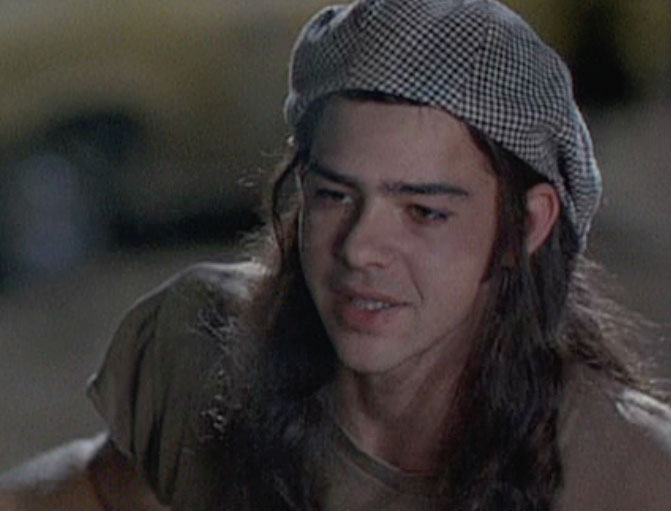
While his films are often powered by a robust geniality — as in, say, Dazed and Confused, School of Rock and Bad News Bears — Linklater also does a great job of persuasively balancing the caustic and the comedic (see Tape, Before Sunrise and Before Sunset), and A Scanner Darkly
certainly continues this trend. By intermingling and subtly linking the
war on drugs with ongoing national security concerns and the war on
terror, Linklater creates a feasible world of only slightly heightened
tonal exaggeration.
A Scanner Darkly will be downgraded or under-regarded by some
simply because of its format, which is a shame. Animation, after all,
is a medium, not a genre. With its thick, hearty outlines — the film is
shot conventionally, and then meticulously drawn over by animators —
and shifting blocks of light and shadow for skin tone, the movie
sometimes seems like topographical human maps come to life, and it’s a
heady, invigorating alternative to younger-skewing animated fare.
The aforementioned “scramble suit,” meanwhile — an opaque jumpsuit
which turns the features of its wearer into an endless morph of
millions of other faces and outfits, like a time-lapse version of
Michael Jackson’s old “Black or White” music video — is utterly
mesmerizing, and emblematic of why this slurry story lends itself so
well to this format. In a live-action telling, CGI could pull off a
convincing enough approximation of this, but never to the degree that
it’s used, wholly of narrative necessity, here.
While A Scanner Darkly is most obviously driven by its visual
audacity, it also has the surreal, loquacious wit and philosophical
tangents characteristic of many of Linklater’s films. The
conspiratorial-surveillance plot at times seems ready to chase itself
into a rabbit hole of its own devising, but late in the game several
key twists pull the story to a new height of allegorical relevance.
A Scanner Darkly
is on one level about personal identity, fraternity and even fidelity,
and the blurry lines and compromised notions of those characteristics,
but it’s also about the transmutation of good into evil and back into
good, and the willful surrender of freedom in the name of
propagandistic safety and betterment. Sounds pretty germane to me. (For an interview with producer Tommy Pallotta, meanwhile, click here.) (Warner Independent, R, 98 mins.)